
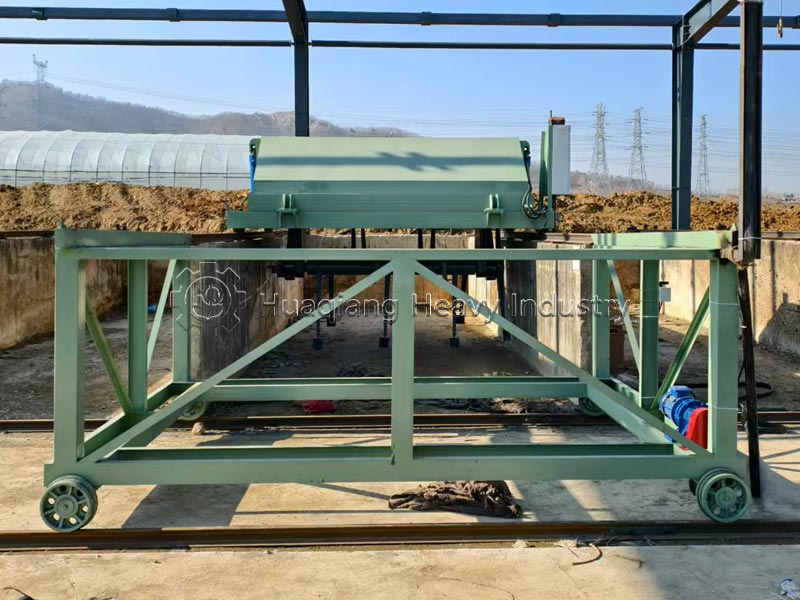
Trough Type Composting Turner Features: A trough type composting turner is a turning device installed on a fixed fermentation tank, consisting of a traveling track, turning rollers, and a transmission system. The equipment moves back and forth along the tracks on both sides of the fermentation tank. The blades or paddles on the rollers scoop up the material from the bottom and scatter it backward, achieving turning, aeration, and relocation.
The core advantages of the trough type composting turner are its compact structure and stable operation. Fermentation tanks are typically designed to be 3-6 meters wide and 30-80 meters long. Each turn can process material covering the entire width of the tank, with a traveling speed of approximately 3-8 meters per minute. Due to the track guidance, the equipment’s running trajectory is fixed, making operation simple and requiring no operator. It can be automatically controlled via remote control or PLC.
Another advantage of the trough process is its high site utilization. Fermentation tanks can be arranged side-by-side, with material entering from one end and exiting from the other, achieving continuous production. Combined with a bottom aeration system, fermentation temperature and oxygen supply can be precisely controlled, resulting in a relatively stable fermentation cycle. The trough-type compost turner has low energy consumption, with approximately 0.5-1 kWh of electricity consumed per cubic meter of material per turn.
However, trough-type compost turners require civil engineering investment; the walls and track foundations of the fermentation tank increase initial construction costs. Additionally, the turning depth of trough-type equipment is limited by the drum diameter, generally between 0.8-1.5 meters, making it difficult to handle excessively tall piles.
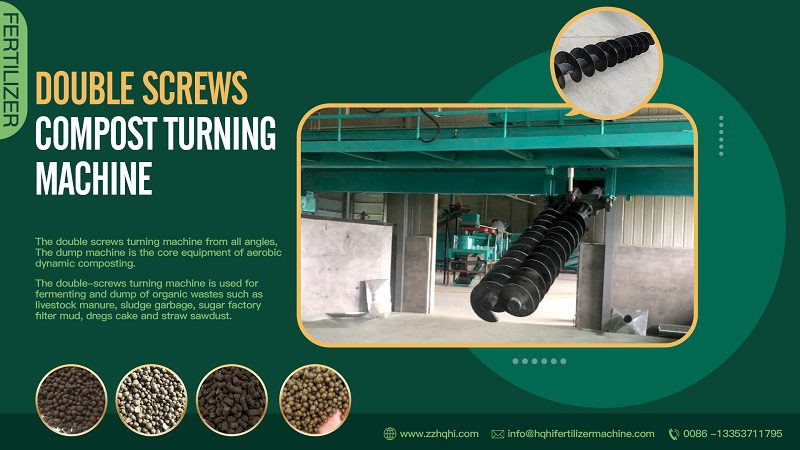
Double Screws Compost Turning Machine Performance
The double screws compost turning machine is an improved type of trough-type compost turner. Its core components are two parallel spiral shafts with counter-arranged spiral blades. During operation, both spiral shafts rotate simultaneously, pushing the material from the center to the sides or from the sides to the center, while the lifting action of the spiral blades causes the material to tumble up and down.
The biggest advantage of the double-helix design is its high uniformity of turning. The counter-rotating spiral shafts create convection, ensuring the material is thoroughly stirred and mixed within the trough, avoiding the “deviation” or “dead zones” that can occur with traditional drum-type compost turners. The turning depth can reach 1.8 meters, more than 30% greater than that of a single-drum trough type composting turner, which is beneficial for increasing the processing capacity of a single trough.
In terms of energy consumption, the double screws compost turning machine is more efficient because the helical blades directly cut and lift the material. It consumes about 15%-20% less electricity than a drum type for processing the same volume of material. Furthermore, the double-helix structure has less crushing effect on the material, making it suitable for raw materials with high fiber content such as straw and coconut coir.
The disadvantages of the double screws compost turning machine are its more complex structure, the need for regular inspection and repair of the helical blades due to wear, and slightly higher maintenance costs than a regular drum type.
The choice of which compost turning equipment to use mainly depends on the following factors:
Production scale: For organic fertilizer plants with an annual output of less than 3,000 tons, a regular trough type composting turner can meet the needs, making the investment more economical. For enterprises with an annual output of more than 5,000 tons, especially those with continuous production, the high efficiency and deep turning capacity of the double screws compost turning machine are more advantageous.
Raw material characteristics: For materials mainly composed of livestock and poultry manure with low fiber content, both types of machines are suitable. If the raw materials contain a large amount of coarse fibers such as straw and rice husks, the double screws compost turning machine is less prone to clogging and provides a better turning effect.
Site conditions: For existing fermentation workshops without troughs, the windrow compost turner may be more flexible; for newly built factories with limited land, the trough layout maximizes space utilization.
Investment budget: The ordinary trough type composting turner has the lowest investment; the double screws compost turning machine is 30%-50% more expensive, but has advantages in long-term energy consumption and maintenance costs; the windrow wheel compost turner requires no civil engineering, and the initial investment is dispersed.
The choice between a standard trough-type compost turner and a double screws compost turning machine is a key decision in implementing trough-type aerobic fermentation composting technology. Both are specialized fermentation composting turning technology systems. The standard trough turner offers a simple, robust design with low energy consumption, ideal for smaller operations. The double screws compost turning machine provides higher turning uniformity, greater depth, and lower electricity consumption per volume, making it suitable for larger, continuous production, especially with high-fiber materials like straw. This contrasts with open-air methods. A windrow composting machine or a large wheel compost turner is used for open-air windrows, offering flexibility but lacking odor control. After successful composting, the mature material becomes the ideal feedstock for a disc granulation production line. The choice of composting technology directly impacts the downstream granulation process. For producers in environmentally sensitive areas, the trough system’s ability to contain odors is a critical advantage. The decision between a standard trough turner and a double screws model depends on production scale, raw material fiber content, and investment budget. Understanding the unique strengths of each fermentation composting turning technology is essential for building an efficient, compliant, and high-quality organic fertilizer production system.
It is recommended that after determining the fermentation process, you request actual operation videos and case studies from the equipment manufacturer, based on the key points of fermentation technology. If possible, conduct on-site inspections of fermentation sites with similar raw materials to observe the uniformity of turning and the reliability of the equipment before making a final selection. The compost turning equipment is a crucial link in the organic fertilizer production line; proper selection can effectively ensure fermentation quality and production efficiency.