
Q: What are the unique physical properties of cow dung as an organic fertilizer raw material?
A: Cow dung is the excrement of herbivores, and its most prominent characteristic is its extremely high crude fiber content. Cow dung is rich in undigested forage and straw fibers, such as lignin and cellulose. Compared to chicken and pig manure, cow dung has a higher carbon-to-nitrogen ratio (approximately 20-30:1), a higher cellulose content, and a slower decomposition rate. At the same time, cow dung is loose and tough, belonging to a typical coarse fiber material. These characteristics determine that the challenges faced by cow dung in the pelletizing process are completely different from those of other livestock and poultry manure.
Q: Why does the high fiber content of cow dung make it “more difficult to pelletize”?
A: The reason why the high fiber content of cow dung makes it difficult to pelletize can be understood from three aspects: First, the physical structure hinders pellet formation. Coarse fibers are characterized by their long, thin shape, high toughness, and resistance to breakage. Unrefined long fibers entering the granulation process directly damage the internal structure of the granules—the fibers act like a “skeleton,” stretching the granules and resulting in a loose, easily pulverized, and poor-quality finished product. In disc or drum granulation, materials with high coarse fiber content cannot bind together to form granules through the rotation of the equipment; even if they manage to form granules, the surface is rough and uneven.
Secondly, cow dung has extremely weak binding force. Fermented and decomposed cow dung is not only coarse in fiber but also has poor viscosity. Traditional wet granulation (such as disc granulators) relies on the material’s own viscosity and plasticity to form granules during rolling. However, cow dung lacks sufficient binding force, making it difficult to form stable granule nuclei in discs or drums, resulting in a generally low granulation rate.
Thirdly, traditional equipment is ill-suited for high-fiber materials. Disc and drum granulators were originally designed for granulating chemical fertilizers and compound fertilizers, and are poorly adapted to organic coarse-fiber materials. Ordinary granulation equipment is prone to problems such as wall adhesion, machine blockage, and low granulation rate when faced with the high-fiber characteristics of cow dung. Surveys show that over 90% of livestock and poultry manure organic fertilizer companies use disc or drum granulators, but the yield rate is only 50% to 70%.
Q: In which stage before granulation is the fiber problem most likely to cause problems?
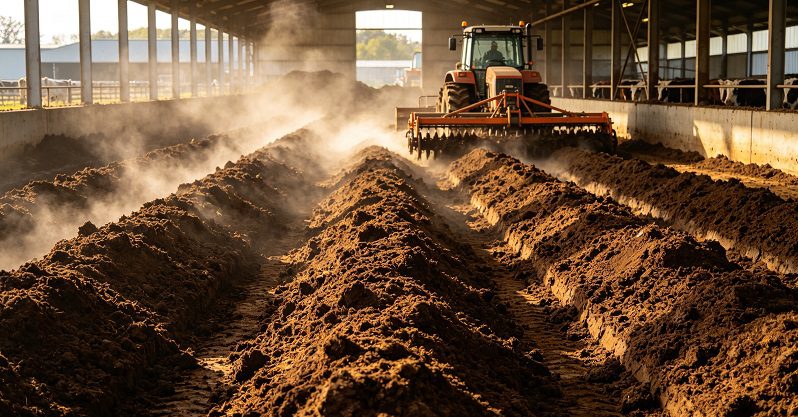
A: The problems mainly lie in the two pre-fermentation and crushing stages. If the fermentation time is insufficient or the decomposition is incomplete, there will be more coarse fibers, directly affecting the subsequent granulation effect. Incompletely decomposed cow manure fibers can also easily entangle the equipment, causing blockages and shutdowns. Furthermore, the fineness of the raw material is a key indicator determining the granulation effect—the coarser the material fibers, the worse the granulation effect, the more difficult the forming, and the more fragile the granules. Therefore, the raw material must be thoroughly crushed and screened before granulation to remove coarse fibers and hard lumps.
Q: What are some mature solutions for the high-fiber characteristics of cow manure?
A: Currently, the industry mainly addresses the problem from two directions: “pre-treatment refinement” and “selection of specialized equipment”: Strengthening crushing pre-treatment. Fermented cow manure needs to be processed in a specialized semi-wet material crusher for cow manure. These devices employ a screenless, high-torque hammer mill structure, specifically designed for high-fiber, fluffy, wet materials. They powerfully cut and knead long fibers, completely solving the problems of fiber entanglement and machine blockage common in traditional pulverizers. The pulverized material is fine and uniform, free of long fiber clumps, laying the foundation for subsequent granulation.
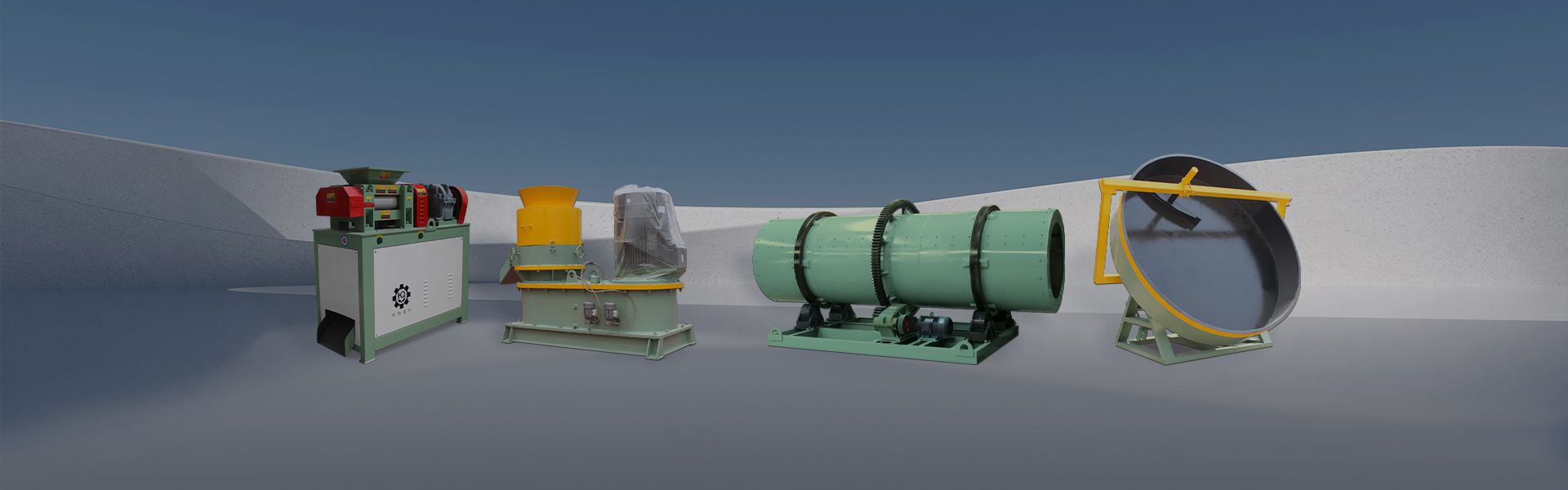
Specialized granulation equipment is selected. Addressing the industry challenge of poor adhesion and difficulty in pelletizing cow dung, there are currently three mainstream technical routes:
Extrusion + Rounding Combination Process: First, a roller extrusion granulator or flat die granulator uses thousands of tons of mechanical extrusion force to forcibly compress the dry powder material into shape; then, it is fed into an organic fertilizer rounding machine to remove sharp edges, forming rounded granules. This dry granulation method requires no binder, resulting in a low moisture content in the finished product.
Dedicated Drum Granulator: Relying on the layered coating and binding of the material to form the pellets, the inherent fiber toughness of cow dung enhances granule compactness. Combined with a uniform spraying system, the powder and binder are fully integrated, resolving the problems of long fibers causing difficulty in forming and brittleness.
Stirring Tooth Granulator: Employing a high-speed stirring tooth wet impact granulation process, this granulator is specifically designed for high-moisture, high-fiber livestock and poultry manure materials. Renowned as a “wet material nemesis” and “fiber expert,” it can achieve one-time granulation of materials with a moisture content of 30% to 40% or straw powder with coarse and long fibers.
Q: What other precautions should be taken in production management?
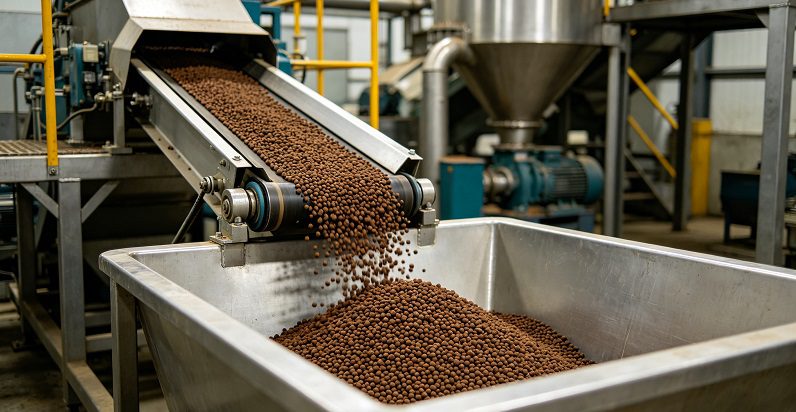
A: In addition to equipment selection, the following should be noted: The moisture content of the raw material before granulation must be controlled between 30% and 35%—too high a moisture content will cause sticking and clumping, while too low a moisture content will prevent proper binding and granulation. Appropriately extending the fermentation time and increasing the number of fine grinding cycles can effectively reduce fiber entanglement problems. For insufficient granule strength, humic acid or a small amount of inorganic powder can be added to the formula.
Overcoming the granulation challenges of high‑fibre cow dung requires a holistic approach that begins long before the pelletiser. A well‑managed fertilizer manufacturing process must integrate thorough composting, where dedicated animal manure compost turner and fertilizer composting turning machine equipment ensure complete decomposition and fibre breakdown, reducing toughness and improving binding properties. After maturation, specialised cow manure fertilizer machine — such as high‑torque semi‑wet crushers, extrusion granulators, or stirring‑tooth granulators — tackle the remaining fibrous structure, converting loose, refractory material into uniform, strong granules. By combining extended fermentation, fine grinding, and the right granulation technology, producers can transform cow dung from a “difficult” feedstock into a high‑quality organic fertiliser, achieving granulation rates above 85% and delivering consistent, market‑ready products that enrich soil health and boost crop productivity.