
The fermentation turning machine is the core power equipment in a bio-organic fertilizer production line, directly affecting the fermentation cycle, the degree of material decomposition, and the overall operating cost of the production line. Faced with a wide variety of models on the market—trough type, chain plate type, wheel type, tracked type—different equipment varies significantly in processing capacity, power configuration, and unit energy consumption. For enterprises intending to build or expand their organic fertilizer plants, accurately selecting the right model based on their scale and raw material characteristics is a crucial step in determining the return on investment.
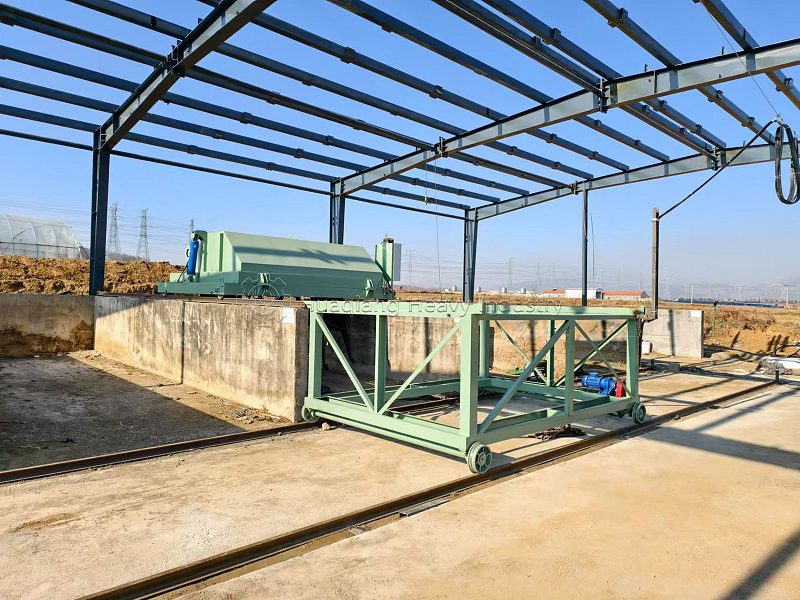
Trough Type Turning Machine: A Cost-Effective Choice for Small and Medium-Scale Fermentation
The trough type turning machine is currently the most widely used model, consisting of a moving fermentation trough, tracks, and a turning mechanism. Its turning depth is generally 1.2 to 1.8 meters, the turning width can be customized from 2 to 6 meters, and the moving speed is adjustable between 5 and 15 meters per minute. Power configurations cover 15 to 55 kW, suitable for fermentation scales with a daily processing capacity of 50 to 200 tons.
The advantages of trough-type compost turners lie in their compact structure and turning uniformity of over 85%. However, their trough construction cost is relatively high, and the single operation cycle is relatively long. Trough-type compost turners are suitable for small and medium-sized fermentation workshops with limited space and are the first choice for most organic fertilizer start-up projects.
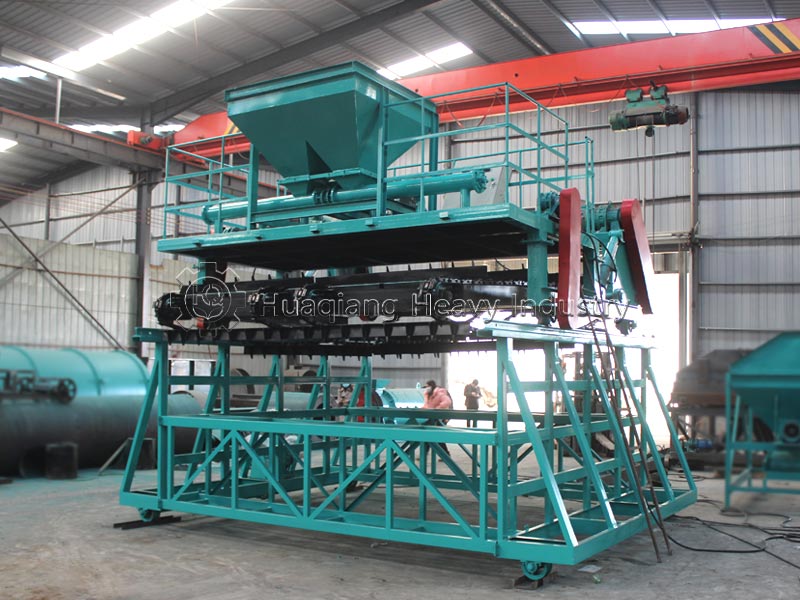
Chain-plate compost turners: Efficiency engines for large-scale continuous fermentation. Chain-plate compost turners are heavy-duty equipment designed for large-scale continuous fermentation. Their turning depth can reach 1.5 to 2.5 meters, turning width 4 to 12 meters (modular design), moving speed 8 to 20 meters/minute, and power configuration 30 to 110 kW. Taking the BFD-5000 model as an example, the equipment span is 5000 mm, the material thickness is 1500 to 2000 mm, the power is 30 kW × 2 + 4 kW, and the compost turning capacity reaches 150 to 300 cubic meters/hour. The core advantage of chain-plate compost turners lies in their efficiency—composting efficiency is 40% to 60% higher than trough-type turners, with a daily processing capacity of 500 to 2000 tons. The chain plate structure is more adaptable to high-moisture materials, reducing clogging rates by 70%. However, the equipment is relatively heavy (approximately 8 to 15 tons), requiring high site foundation bearing capacity, and the annual replacement cost of the chain plates is approximately 20,000 to 50,000 yuan. For large-scale continuous fermentation projects with a daily output of over 300 tons, chain-plate compost turners are the only option that can meet capacity requirements.
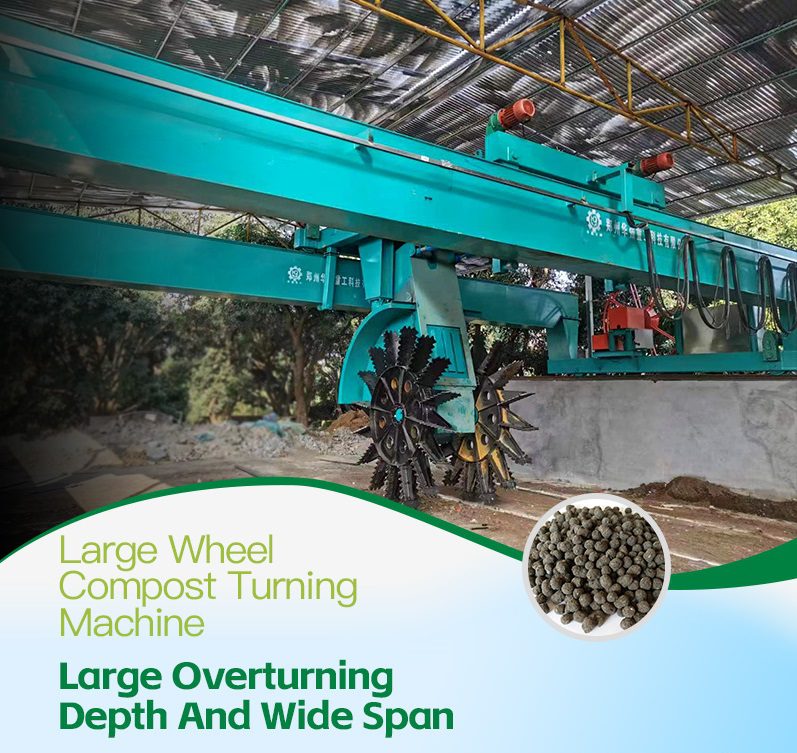
Wheeled Compost Turners: A Flexible and Mobile Solution for Small and Medium-Sized Compost Yards
Wheeled compost turners (including disc-type) are characterized by their flexible movement and high mobility. Their composting depth is typically 0.6 to 1.2 meters, composting width is approximately 1.5 meters, and moving speed can reach 0 to 20 meters per minute, with a power configuration of approximately 30 kW. Disc-type compost turners have high efficiency and low maintenance costs. Self-propelled compost turners can turn 200 to 300 cubic meters of fermentation material per hour. For an organic fertilizer plant producing 30 tons of finished fertilizer per day, the energy consumption per ton of fertilizer is less than 1 kW, and the average fuel consumption is only 0.03 yuan per cubic meter.
The limitation of wheeled compost turners lies in their relatively limited turning depth (mostly 0.8 to 2 meters) and their tendency to slip in piles with a moisture content exceeding 65%. Wheeled compost turners are suitable for small to medium-sized intermittent fermentation scenarios with a daily processing capacity of 20 to 100 tons.
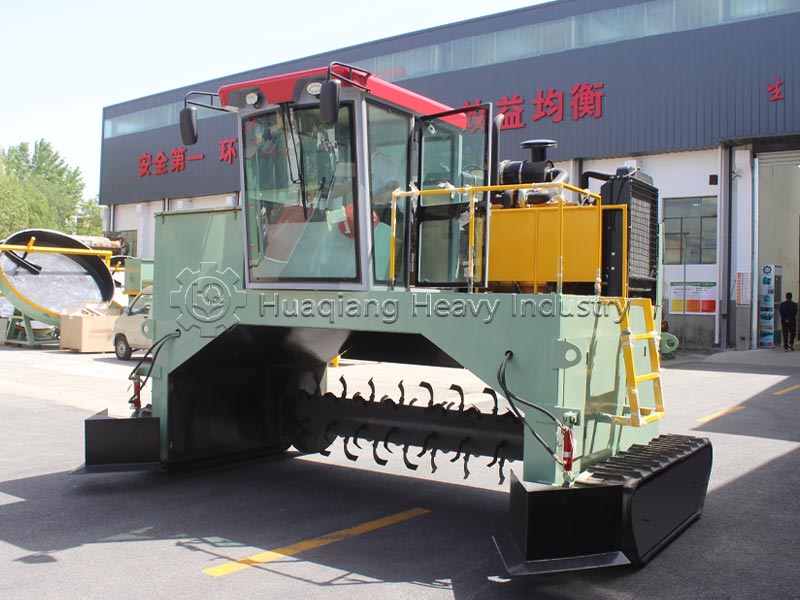
Tracked Compost Turners(windrow composting machine): A Flexible Solution for Complex Terrain Tracked compost turners do not require fixed tracks and can adapt to open-air or non-standardized site operations. They have a small turning radius (≤3 meters) and are suitable for long and narrow piles. Their turning depth is 1.0 to 1.5 meters, turning width is 2 to 4 meters, climbing ability is ≤25°, and power configuration is 22 to 45 kW. However, their turning efficiency is relatively low, approximately 60% to 70% of that of trough-type machines. The XGFD-2600 tracked compost turner has a processing capacity of 1000 to 1200 cubic meters per hour. The tracked model is particularly suitable for windrow fermentation processes that require movement between different sites.
Key Data Comparison of Energy Consumption and Operating Costs
The energy consumption differences between different models directly determine long-term operating costs. Self-propelled compost turners generally consume less than 1kW per ton of fertilizer, with an average fuel cost of only 0.03 yuan per cubic meter. For an organic fertilizer plant producing 30 tons of finished fertilizer per day, the actual turning time is only a dozen minutes to meet the entire day’s needs. Some models can achieve a minimum fuel consumption rate as low as 190g/kW·h. Regarding power selection, diesel power is suitable for field operations but is noisy and has high emissions; electric drive offers zero emissions and is suitable for indoor fermentation workshops.
Selection Recommendations and Summary
The core logic for selecting a fermentation turner is “scale matching, raw material adaptation, and site compatibility.” For small to medium-sized projects with a daily processing capacity of 20 to 100 tons, wheeled compost turners are the preferred choice due to their flexibility, mobility, and low cost. For medium-sized projects with a daily processing capacity of 50 to 200 tons, trough-type compost turners achieve a good balance between cost-effectiveness and uniformity of turning. For large-scale projects with a daily processing capacity of 100 to 500 tons or even larger, chain-plate compost turners are the only option due to their overwhelming efficiency. For open-air or non-standard sites, tracked compost turners offer unparalleled flexibility. Only by accurately aligning equipment performance parameters with one’s own production needs can optimal control of energy consumption and cost per unit capacity be achieved while ensuring fermentation quality.