
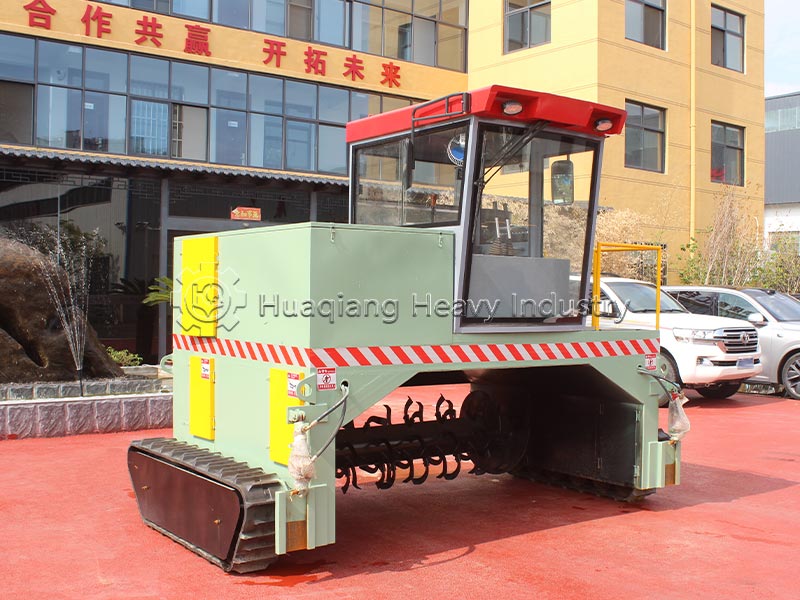
Equipment Introduction
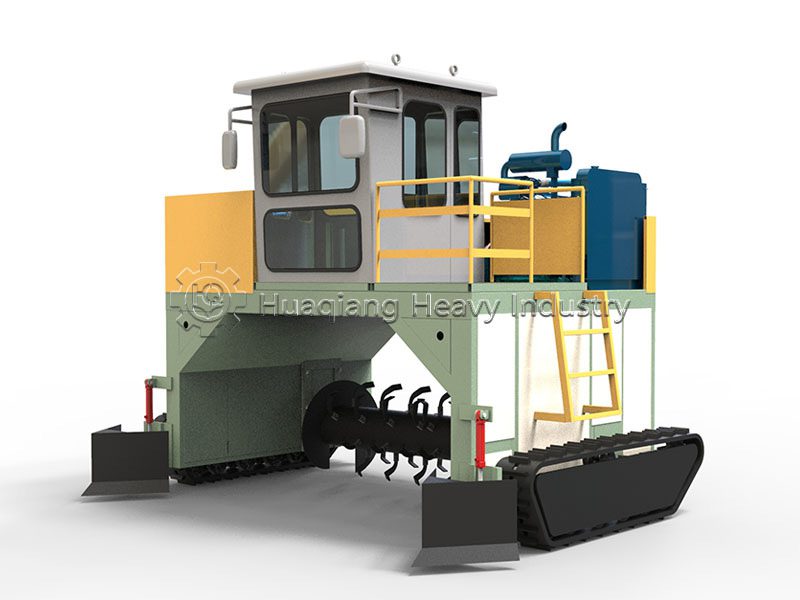
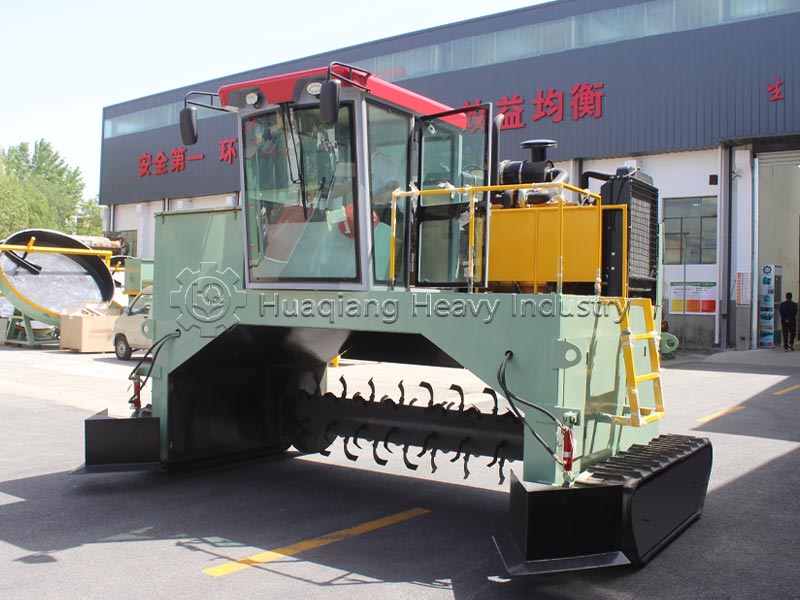
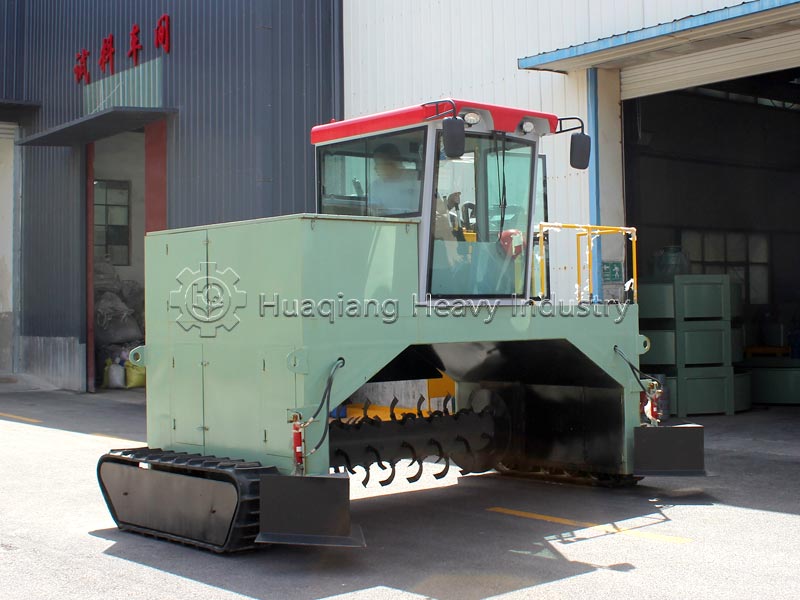
The windrow compost turner (tracked compost turner) is the core unit for windrow aerobic fermentation. It is a heavy-duty, self-propelled ground-based organic fertilizer fermentation machine, designed for high-temperature composting of organic waste such as livestock and poultry manure, straw, mushroom residue, and biogas residue. It integrates four functions: material turning, crushing, aeration, and stacking, replacing manual loaders and small trough-type compost turners. It is the mainstream fermentation equipment for large-scale organic fertilizer plants, livestock farms, and environmental solid waste treatment projects.
The machine uses a diesel-powered tracked self-propelled chassis, hydraulically adjustable turning shaft height, continuously variable transmission for both walking and turning, and a self-enclosed cab with 360° on-the-spot turning capability. It is suitable for open-air, strip-shaped composting sites, not limited by factory buildings or tanks, and requires minimal infrastructure investment.
Core Differentiating Advantages (Comparison with Trench-Type and Wheeled Compost Turners)
1. Strong Site Adaptability: No need to build fermentation tanks; operation is possible only on leveled and hardened ground, reducing infrastructure costs by 70%; low ground pressure from tracks prevents the machine from getting stuck in muddy or wet fermentation sites.
2. Flexible Steering: 360° turn-around with lever, allowing free turning in narrow spaces; wheeled compost turners cannot turn in place and require more space.
3. Intelligent Dual Stepless Speed Control: Independent speed adjustment for the walking and turning drums, matching the speed according to the material’s moisture content and maturity stage, ensuring even oxygen supply during fermentation.
4. Heavy-Duty, Durable, and Corrosion-Resistant: Thickened national standard steel plates for the frame and guard plates, suitable for highly corrosive manure fermentation environments, with a service life far exceeding that of ordinary light-duty compost turners.
5. Large Processing Capacity: 600-1500 cubic meters of material per unit per hour, suitable for large-scale organic fertilizer production lines with an annual output of 10,000-100,000 tons.
6. User-Friendly Configuration: Standard cab, optional onboard air conditioning, diesel water-cooled engine with ample power and low fuel consumption.
Equipment Structure and Composition
The windrow compost turner (tracked compost turner) mainly consists of the following major systems:
| System Name | Main Components | Function Description |
|---|---|---|
| Power System | Diesel Engine (R4102/R4105/R6105 series), Pulley, Split Power Box | Supply power for the whole machine, power range: 54–156 HP |
| Composting Turning System | Turning roller (left-right reverse spiral + straight throwing teeth in the middle), cutter shaft, working blades | Turn, crush and mix raw materials |
| Hydraulic System | Hydraulic pump, hydraulic valve group, roller lifting cylinder, clutch cylinder, travel drive motor | Control roller lifting, clutch switching and walking driving |
| Travel System | Crawler chassis, travel motor, two-speed high/low transmission mechanism | Provide stable traveling performance, adapt to complex ground conditions |
| Operation Control System | Lever steering wheel, hydraulic lever control group, driving cab | Single-person operation, support forward, reverse, turning and in-situ U-turn |
| Frame System | Main frame, lifting frame, protective cover | Bear the whole machine structure, adopt integral lifting frame design |
Key Structural Features: The turning drum consists of two counter-rotating spiral sections on the left and right sides and a straight throwing tooth section in the middle. During rotation, it gathers the material from the windrow towards the center and turns it backward, achieving thorough mixing and aeration.
Fully hydraulic design, virtually no mechanical wear, low failure rate, and minimal maintenance.
Main technical parameters of the equipment
| Item | HQ-FD 2500 | HQ-FD 2600 | HQ-FD 3000 |
|---|---|---|---|
| Model | HQ-FD 2500 | HQ-FD 2600 | HQ-FD 3000 |
| Compost Turning Width (mm) | 2500 | 2600 | 3000 |
| Compost Turning Height (mm) | 500-1000 | 500-1100 | 500-1200 |
| Stack Spacing (m) | 1.0-1.2 | 1.0-1.2 | 1.0-1.2 |
| Max Particle Size of Raw Material (mm) | 250 | 250 | 250 |
| Power | R4102 Turbocharged 90HP Diesel Engine | R4105 Turbocharged 105HP Diesel Engine | R6105 Turbocharged 136HP Diesel Engine |
| Rated Power Speed (r/min) | 2200 | 2200 | 2200 |
| Working Travel Speed (m/min) | 6-18 | 6-18 | 6-18 |
| Transfer Driving Speed (m/min) | 50 | 50 | 50 |
| Processing Capacity (m³/h) | 400-600 | 600-800 | 1000-1200 |
| Overall Dimension (m) | 3.64×2.6×2.7 | 3.75×2.6×2.7 | 4.36×2.75×2.95 |
Equipment Applications
1. Organic Fertilizer Production Industry: Used in high-temperature windrow fermentation processes for large-scale organic fertilizer plants, bio-fertilizer plants, amino acid organic fertilizer processing plants, and humic acid fertilizer enterprises.
2. Livestock and Poultry Farming Environmental Protection Industry: Resource-based treatment of manure from large-scale pig farms, chicken farms, and cattle and sheep farms; on-site fermentation of chicken, cow, and sheep manure to solve environmental pollution discharge problems.
3. Agricultural Straw Resource Utilization Projects: Composting and composting of corn stalks, wheat stalks, rice husks, and garden fallen leaves; processing straw into organic fertilizer for returning to the field.
4. Environmental Solid Waste Treatment Industry: Harmless composting treatment of biogas residue, mushroom residue, traditional Chinese medicine residue, kitchen waste, urban green waste, and sludge.
5. Planting Bases and Ecological Farms: Self-made organic fertilizer in large orchards and vegetable bases; small-scale windrow fermentation to reduce fertilizer procurement costs.
6. Feed and Auxiliary Material Processing Industry: Pre-treatment of fermented protein feed and raw materials for fermented organic fertilizer carriers.
Applicable Raw Materials
The windrow compost turner (tracked compost turner) can handle a wide variety of raw materials, mainly including:
1. Livestock and Poultry Manure: Pure manure such as chicken manure, pig manure, cow manure, and sheep manure. Viscous manure can be mixed with auxiliary materials before turning.
2. Agricultural Waste: Various crop straws (bundled straws should be unbundled and chopped before turning), mushroom residue, etc.
3. Urban Organic Waste: Urban sludge, kitchen waste, contaminated soil, etc.
4. Other Organic Materials: Peat moss, oilseed cake, green manure, biochar, etc.
Initial Requirements for Raw Materials: The material length should not be too long; bundled straws should be unbundled and chopped. The bottom width of the material pile should not exceed the working width of the compost turner (2.4-3.0 meters), and the top height should not exceed 0.8-1.3 meters, and it should be piled in strips.
Working Principle of the Equipment
The windrow compost turner (tracked compost turner) operates based on aerobic fermentation technology. The core mechanism is as follows:
1. Power Transmission Principle: The diesel engine power is divided into two outputs:
Main Output: Drives the turning drum to rotate via a belt pulley reduction gearbox.
Side Power Output: Drives the hydraulic pump via a side power box, providing pressurized oil to the hydraulic system.
2. Turning Operation Principle
Saddle Operation: The machine straddles a pre-placed long strip of material.
Spiral Gathering: The drum spirals in opposite directions, gathering the material from both sides of the stack towards the center.
Turning and Mixing: The straight section of the throwing teeth in the middle turns the material backward, achieving:
Fully mixing of the top layer material with the internal material
Fully contact between the material and oxygen
Effective dissipation of heat (moisture) from the stack
Crushing Function: The crushing device on the cutter shaft effectively breaks up the compacted material formed in the later stages of fermentation.
3. Aerobic Fermentation Principle: The turning machine, through regular turning and tossing, rapidly raises the temperature of the compost pile to 50–65℃. Under these high-temperature conditions: Pathogens, insect eggs, and weed seeds are effectively killed; Microorganisms fully decompose organic matter; The fermentation cycle is shortened to 15–20 days; The oxygen content of the compost pile is maintained within the ideal range of 8%–18%.
Common Equipment Problems and Solutions
| Fault Phenomenon | Core Fault Causes | Standard Solutions |
|---|---|---|
| Difficult to start or fail to ignite the diesel engine | 1. Low battery power; 2. Mismatched engine oil / diesel grade; 3. Starter damaged by long single startup time; 4. Clogged filter element | 1. Charge immediately and disconnect the negative pole during long-term shutdown; 2. Replace matched oil according to ambient temperature; 3. Strictly control the duration of single startup; 4. Replace diesel filter and air filter |
| Black smoke and insufficient power during operation | 1. Over-thick material pile leads to equipment overload; 2. A large amount of straw wrapped around the roller increases resistance; 3. Insufficient diesel supply | 1. Step on the clutch to reduce load at idle speed and slow down the traveling speed; 2. Stop the machine to clean the straw wrapped on the roller; 3. Clean the diesel filter and check the oil circuit |
| Worn or broken composting blades | 1. Hard substances such as bricks and stones mixed in raw materials; 2. The roller height is too low to rub against the ground; 3. Loose fixing bolts of blades | 1. Remove hard impurities through screening in raw material pretreatment; 2. Adjust the hydraulic roller to be 5cm above the ground; 3. Tighten blade fixing bolts before each operation, replace worn blades in time |
| Crawler deviation and vehicle skidding | 1. Uneven, muddy and waterlogged site; 2. Uneven tightness of crawler belt; 3. Worn supporting wheels | 1. Level and harden the composting site and control water content; 2. Adjust the tightness of crawler tension wheel; 3. Replace worn supporting wheels and guide wheels |
| Weak hydraulic lifting and the roller cannot be lifted | 1. Insufficient hydraulic oil liquid level; 2. Clogged hydraulic filter element; 3. Oil leakage of hydraulic pipeline and aging sealing parts | 1. Supplement No.46 special hydraulic oil; 2. Clean or replace the hydraulic filter element; 3. Replace oil seals and fasten pipeline joints |
| Fracture and slipping of transmission belt frequently | 1. Too loose or too tight belt tension; 2. Offset pulley; 3. Excessive resistance caused by materials stuck on roller | 1. Recalibrate belt tension, readjust tension of new belt after 2 weeks; 2. Calibrate coaxiality of transmission wheel; 3. Stop the machine to clean materials wrapped on roller |
| Abnormal noise and severe vibration of the whole machine | 1. Loose bolts of frame and transmission shaft; 2. Lack of lubricating grease leading to bearing wear; 3. Unbalanced roller due to missing composting blades | 1. Fully tighten all frame bolts; 2. Fill lubricating grease for bearings; 3. Replace the missing composting blades |
| Short circuit and electrical malfunction of circuit | 1. Damaged wire insulation in humid compost environment; 2. Loose and corroded battery wiring; 3. Electric control panel soaked by rainwater | 1. Wrap damaged wires and take waterproof protection; 2. Polish wiring terminals and coat anti-rust grease; 3. Keep the cab dry and install rain shield on rainy days |
Equipment Operation Method
1. Pre-operation Preparation
Break-in Period Requirements (First Use of New Machine):
Perform 5-6 hours of break-in (moving, reversing, turning, etc.)
Actual turning operations are strictly prohibited during the break-in period
After the break-in period, change the gearbox oil and check the tightness of all connections.
Operator Qualifications:
Must have a motor vehicle driving license
Must have 5-6 hours or more of practical operating experience
Recommendation: Drivers with experience driving combine harvesters are the best choice
Pre-start Inspection:
Check whether the transportation has affected the machine, and whether all parts are securely fastened.
Check electrical facilities, whether the circuit connections are intact, and whether the insulation is reliable.
Check whether the drive belt tension is normal, and whether there is serious wear or breakage.
Use diesel, engine oil, and coolant according to the diesel engine instruction manual, and check the engine oil level.
Adjust the distance between the turner’s shaft cutter head and the ground to about 5cm.
2. Starting Operation
When starting, fully depress the main clutch.
The starter motor ignition engagement time should not exceed 10 seconds, and consecutive starts should not exceed 3.
The interval between each two starts should be greater than 2 minutes.
After starting, allow the equipment to idle for 10 minutes.
When the equipment is working, increase the throttle to approximately 2400 RPM, then slowly release the main clutch; the turning shaft will begin to rotate.
3. Walking and Turning Operations: Engage the “1” gear on the walking clutch and slowly release it to begin walking and turning.
If black smoke is emitted from the diesel engine exhaust, it indicates overload. Depress the clutch and wait for the speed to return to normal before continuing.
High/Low Speed Switching: “Up” for low speed, “Down” for high speed.
Turning Shaft Gear Shift: Press down on the operating lever and pull to the left.
Turning Operation Specifications:
Use low speed in principle. The operator can select an appropriate speed based on the material’s type, moisture content, and actual condition.
After starting, idle for 3-5 minutes under no-load parking conditions.
After adjusting the turning speed and idling for 1 minute, proceed with the turning operation.
The machine should straddle the material stack; forcing it onto the material pile is strictly prohibited.
The material width must not exceed the turning machine’s operating space.
If the engine is under strain, do not force the turning operation. Quickly reduce speed or stop walking, bringing the turning machine to parking mode and turning/throwing the material in place.
4. Post-operation inspection:
Cleanse the tangled material and hardened deposits from the turning shaft.
Check for damage to the turning blades and loose bolts.
Check for damage to pins and cotter pins in all parts.
Check the oil and water tank levels.
Check the electrical facilities and wiring for proper functioning and insulation.
Check the tension of the drive belt for severe wear and breakage.
Check the track tension for proper function.
5. Safety Precautions:
Before using the compost turner, carefully check that all parts are secure.
When the machine is running, especially around high-speed rotating parts, no one is allowed to stand around the equipment.
When performing compost turning operations, no one is allowed to stand directly in front of or behind the machine to prevent injury from falling objects.
Power must be disconnected when inspecting the blades, drive shaft, and gearbox components.
If parts need to be replaced, the engine must be turned off; never replace parts while the engine is running.
If any abnormal noise is detected during operation, stop the machine immediately for inspection. Work can only continue after the fault has been rectified.
6. Site Requirements:
The turning and piling area must be flat and firm; work on slopes is strictly prohibited.
The work area must not have any uneven surfaces greater than 5 cm.
The material length should not be too long; bundled rice straw should be unbundled and chopped.
Material stacking requirements: The base width should not exceed 2.4–3.0 meters, and the top height should not exceed 0.8–1.3 meters; it should be stacked in strips.
Equipment Application in the Production Line
The windrow compost turner (tracked compost turner) is used in the fermentation section of an organic fertilizer production line and is an indispensable core piece of equipment in the entire organic fertilizer production process.
Complete Organic Fertilizer Production Process

Process Segment Description
1. Pre-treatment Stage: This stage involves crushing and removing impurities from organic raw materials such as livestock manure, straw, and mushroom residue. The mixture is then homogenized according to the carbon-to-nitrogen ratio and transported to the fermentation tank for stacking, preparing for fermentation and composting.
2. Core Fermentation Turning Stage: The tracked compost turner continuously turns, aerates, crushes, and mixes the materials in the pile, providing sufficient oxygen for aerobic microorganisms. This achieves material heating and composting, deodorization, and harmless treatment, degrading large molecular organic matter.
3. Post-fermentation Fertilizer Forming Stage: The fermented and composted materials are successively crushed and screened to remove lumps and impurities, then granulated, dried, cooled, and finely screened before finally being packaged to produce commercial organic granular fertilizer.
Fermentation Process of the Equipment
I. Aerobic Fermentation Process Flow
1. Raw Material Pretreatment: Mix livestock and poultry manure with straw powder and other auxiliary materials in a certain proportion, adjusting the moisture content to 50-65% and the C/N ratio to approximately 25:1.
2. Inoculation with Microorganisms: Add a special organic fertilizer fermentation agent.
3. Composting: Pile the mixture into long windrows, with a base width of 2.4-3.0 meters and a top height of 0.8-1.3 meters.
4. Turning and Fermentation: Use a tracked turner to turn the compost regularly, generally every 2-3 days.
5. Temperature Monitoring: Raise the compost temperature to 50-65℃ and maintain it, with the high-temperature period lasting 5-7 days.
6. Post-Ripe Aging: After the temperature drops below 40℃, the aging stage begins.
7. Maturity Testing: Test the material’s color, odor, and temperature to confirm the degree of maturity.
II. Key Fermentation Control Parameters
| Parameter | Control Range | Regulation Method |
|---|---|---|
| Carbon-Nitrogen Ratio (C/N) | About 25:1 | Adjust by adding straw, rice husk and other carbon-rich materials |
| Moisture Content | 50%–65% | Adjust by adding dry raw materials or spraying water |
| Aeration Oxygen Content | 8%–18% | Controlled by compost turning frequency |
| Fermentation Temperature | 50–65℃ | Adjust heat dissipation by turning piles or heat preservation measures |
| pH Value | 6–9 | Adjust by adding lime or acidic materials |
| Compost Turning Frequency | Once every 2–3 days | Adjust according to material temperature and material condition |
III. Fermentation Cycle
High-Temperature Fermentation Period: 7–10 days (Temperature 50–65℃)
Post-Ripe Aging Period: 7–10 days
Total Fermentation Cycle: 15–20 days (Can be significantly shortened using a professional compost turner)
Equipment Maintenance and Upkeep Methods
1. Daily Maintenance (once daily for high-frequency operations, once weekly for low-frequency operations)
10-Hour Half-Check: Tighten all connecting bolts and drain plugs;
Check for missing or damaged cotter pins and latches; replace damaged parts immediately, do not use substitutes;
Inspect the turning blades for wear and looseness; repair/replace any missing parts promptly;
Clean the rollers and frame of slab material; clean the electrical connectors in the cab;
Check the track tension and for aging or cracked drive belts.
2. Quarterly Regular Maintenance (Complete maintenance after one quarter of continuous operation)
Oil Change: Add 68# hydraulic oil to the travel gearbox, add 46# hydraulic oil to the hydraulic oil tank, and replace the gearbox with 220# gear oil;
Disassemble and clean the bearings and chains, apply new lubricating grease, and replace worn parts directly;
Remove the equipment dust cover, tighten all bolts on the drive shaft and cab base to prevent the drive shaft from breaking;
Winter Antifreeze: Add antifreeze to the water tank, stop the machine and drain the coolant from the machine body and water tank to prevent freezing and cracking;
Adjust the drive belt tension, and tighten the new belt again after 2-3 weeks of use to eliminate looseness.
3. Specialized Maintenance for Core Components
Diesel Engine: Strictly follow the original Weichai/Changxing diesel engine manual for maintenance, regularly replacing the oil filter and air filter;
Vehicle Air Conditioning (Optional): Clean the filter and add refrigerant according to the air conditioning manufacturer’s manual;
Battery Maintenance: Securely fasten the battery, keep the terminals clean; for frequent short-term starts, periodically top up the battery; for long-term shutdowns, disconnect the negative terminal wiring to prevent battery drain and damage.
4. Long-Term Shutdown Protection
Apply rust-preventive oil to all exposed metal parts of the machine; for outdoor storage, fully cover with a rainproof and dustproof tarpaulin; disconnect the battery wiring.
The target audience for the equipment
| Customer Type | Demand Characteristics |
|---|---|
| Large-scale Livestock & Poultry Farms | Dispose self-produced livestock and poultry manure, meet environmental compliance requirements |
| Organic Fertilizer Manufacturers | Commercial mass production, focus on high output and operation efficiency |
| Sludge Disposal Centers | Treat municipal sludge, crushing function is required |
| Waste Treatment Plants | Composting treatment of organic solid waste |
| Horticulture / Planting Bases | Self-use organic fertilizer production with small production scale |
| Sugar Mills / Food Processing Plants | Treat filter mud and food processing waste residues |
| Agricultural Cooperatives | Straw returning to field and resource utilization of manure sewage |
Core Advantages of the Equipment
1. Extremely Low Infrastructure Investment: No need to build concrete fermentation tanks; only a leveled and hardened ground is required for production, saving 80% of civil engineering costs compared to trough-type fermentation equipment.
2. Highly Flexible and Versatile Sites: 360° on-the-spot turning capability; suitable for open-air sites and simple sheds; the tracked chassis prevents the vehicle from getting stuck in muddy areas.
3. Stable Fermentation Effect: Independent stepless speed regulation for walking and turning; uniform material crushing and sufficient oxygen supply; rapid high-temperature composting in 7 days, thoroughly killing insect eggs and pathogens.
4. Durable, Corrosion-Resistant, and Heavy-Duty Design: The entire machine is made of thickened national standard steel plates, suitable for highly corrosive manure-producing environments; core components use domestically renowned Weichai power; comprehensive after-sales service system.
5. Humanized Operation Configuration: Enclosed cab; optional vehicle-mounted air conditioning; isolates dust and odors, reducing operator workload.
6. Low Operating Costs: The water-cooled diesel engine provides ample power and low fuel consumption; the overall machine has a low failure rate; easy replacement of wear parts; low maintenance costs.
7. Environmentally compliant and zero-pollution: The entire process of turning and disposing of livestock and poultry manure is completely enclosed, with no secondary dust diffusion, achieving the resource recycling of livestock and poultry manure and meeting the environmental inspection standards of various regions.
Equipment Safety Prohibitions and Important Supplementary Instructions
1. Unauthorized modification of the machine structure or addition of external equipment is prohibited. The manufacturer will not be liable for after-sales service for damage caused by modifications.
2. Operation on sloping ground or areas with unevenness exceeding 20cm is strictly prohibited to prevent track rollover and chassis damage.
3. This equipment is a site-specific fermentation machine and is prohibited from long-distance road travel. Cross-site transport must be carried by flatbed trailer.
4. When the equipment is running, no one is allowed to stand around the rollers or tracks. Personnel are prohibited from staying in front of or behind the operating area to prevent injury from falling materials.
5. In damp, sewage-filled working environments, the circuit insulation must be checked regularly to prevent short circuits that could burn out the electrical control system.
6. Overloading, exceeding width limits, and exceeding height limits are strictly prohibited. Long-term overloading will damage the reducer and hydraulic system.
Windrow compost turners (tracked compost turners), as core equipment in the fermentation section of organic fertilizer production lines, have become the preferred choice for large-scale organic fertilizer plants, large-scale livestock farms, and sludge treatment centers due to their advantages such as fully hydraulic drive, tracked movement, on-the-spot turning, and high-power turning. Their aerobic fermentation technology can convert organic raw materials such as livestock manure and agricultural waste into high-quality organic fertilizer within 15-20 days, achieving the dual goals of resource utilization and environmental protection.
If you have any questions about fertilizer production equipment, fermentation equipment, production processes, granulation processes, or fermentation processes, or would like to learn more about customized solutions, please contact us immediately. Whether it’s equipment selection and quotation, installation, commissioning and operation training, or after-sales maintenance and process upgrades, we can provide you with professional and timely answers and support, offering full-process services.