
In the fertilizer production process, granulation often receives the most attention; however, the seemingly simple screening step that follows is what ultimately determines whether the product is ready to leave the factory floor. No matter how sophisticated the granulation equipment is, unscreened granules remain merely semi-finished products; the scientific application of screening technology represents the critical leap that transforms these semi-finished goods into marketable, high-quality fertilizer.
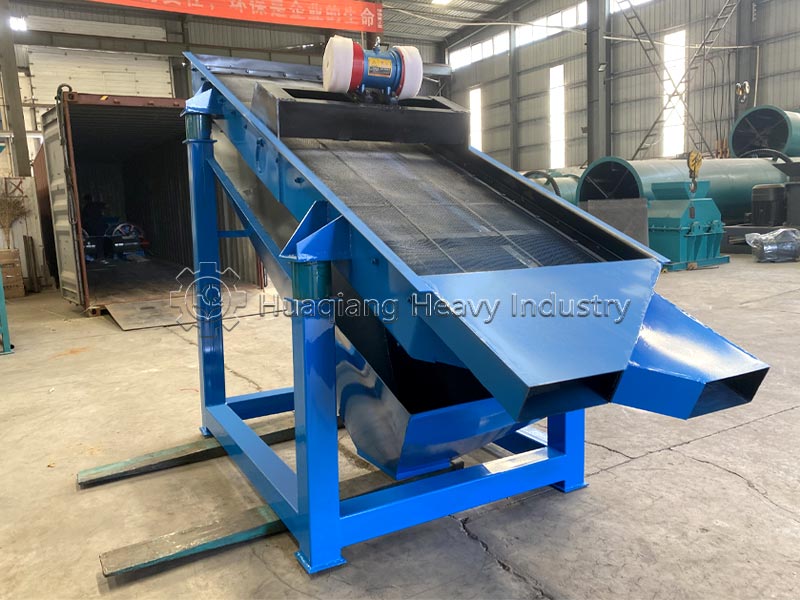
Selecting fertilizer screener machine is not simply a matter of choosing the most expensive option; rather, the choice should be based on matching the equipment to material characteristics and production goals. Drum fertilizer screener machine utilize the rotation of an inclined drum to tumble the material—allowing small particles to fall through the mesh while discharging large particles from the end. Highly tolerant of moisture and stickiness, they are particularly well-suited for materials with complex compositions and fluctuating moisture content, such as organic fertilizers, and are frequently used for coarse screening and impurity removal. In contrast, vibration fertilizer screener machine rely on excitation forces to make material bounce across the screen surface. They offer superior screening precision—making them ideal for final screening stages where product uniformity is critical—but are sensitive to material moisture content and are typically installed after the drying process. Each type of equipment has its own strengths, and production line designs often combine the two to create a “coarse screening plus fine screening” dual-stage system.
The number of screening stages also impacts product yield and raw material utilization. The simplest production lines feature only a single-layer screen, which can only remove oversized particles and offers limited screening effectiveness. Two-stage screening employs a dual-layer structure: the upper coarse screen (typically with 5–8 mm apertures) captures large impurities, while the lower fine screen (1–3 mm apertures) removes powder, leaving the material retained in the middle as the qualified finished product; this is currently the standard configuration for small- and medium-sized production lines. Large-scale production lines often utilize three-stage screening, adding an intermediate screen (3–5 mm apertures) between the coarse and fine screens to sort material into three categories—coarse, medium, and finished—thereby achieving more refined classification control. Many domestic granular phosphate and compound fertilizer enterprises rely on this three-stage screening process to ensure precise quality control of the product’s physical appearance right up to the final stage. In terms of process parameters, screening efficiency depends on the frequency of effective contact between particles and the screen apertures. The vibration frequency for fine screening is typically set between 1,200 and 1,500 revolutions per minute; if the frequency is too low, screening is incomplete, whereas if it is too high, particles are thrown off the screen, thereby reducing efficiency. Stainless steel is the preferred material for the screen to prevent rust contamination, and laser cutting is used for the apertures—keeping tolerances within 0.1 mm—to ensure a screening pass rate exceeding 95%. Of particular note is the recycling of oversized material: coarse particles separated during screening are fed directly back into the crusher for reprocessing. This closed-loop design not only minimizes raw material loss but also provides robust support for the thermal balance and production stability of the entire granulation system.
The value of screening technology extends far beyond the simple task of sorting particles into large, medium, and small sizes. From the impact of particle uniformity on nutrient release curves and the prevention of size-based segregation during transport to meeting the rigorous particle-size requirements of modern precision fertilization, screening plays a vital role throughout the fertilizer’s entire lifecycle—from the production plant to the field. Precise particle size control serves as the key benchmark for the modern fertilizer industry’s evolution from merely being able to manufacture a product to achieving excellence in quality.