
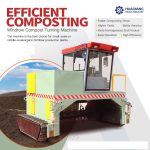
Across the global landscape of organic waste management, one piece of equipment stands as the undisputed workhorse of large scale aerobic composting: the windrow compost turner. Unlike in vessel or agitated bay systems, windrow composting relies on the simplest of geometries—long, triangular piles of organic material—and the turner is the mobile engine that keeps these rows alive, oxygenated, and actively decomposing. From municipal yard waste facilities to sprawling agricultural operations, the windrow turner has proven itself an indispensable tool for transforming heterogeneous organic residues into stable, highquality compost.
Fundamental Operating Principle
The windrow compost turner operates on a deceptively simple yet highly effective mechanical concept. As the machine travels along the length of a windrow, its rotating drum, flail, or elevating face lifts material from the base and interior of the pile, aerates it, and then redeposits it to form a new, reshaped windrow behind the machine. This single pass accomplishes four critical objectives simultaneously:
Bulk aeration – Atmospheric oxygen is forcibly introduced into the pore spaces of the material, revitalizing aerobic microbial metabolism.
Mechanical size reduction – Agglomerated clumps and larger particles are broken down, increasing surface area for decomposition.
Homogenization – Peripheral, drum fertilizer dry, or cooler fractions are blended with the hot, moist core, eliminating anaerobic pockets and thermal stratification.
Windrow reshaping – The pile is reformed into an optimal trapezoidal or triangular cross section, maintaining structural integrity and surface to volume ratio.
Most modern turners achieve this through a hydraulically driven, highspeed rotor equipped with replaceable, wear resistant tines or paddles. As the rotor spins, material is violently thrown upward and backward, passing through the air before being deposited by an adjustable hood or deflector.
Major Types of Windrow Turners
Windrow turners have evolved into three principal configurations, each suited to specific operational scales and site conditions.
Why Windrow Turners Dominate Large Scale Composting
While alternative systems (static aerated piles, agitated bays, in vessel reactors) offer certain advantages, the windrow turner remains the preferred technology for high volume organic waste treatment due to:
Unmatched throughput – A single large self propelled turner can process between 2,000 and 5,000 cubic meters per hour, making it the only viable choice for major municipal or industrial facilities.
Lowest capital cost per ton – Compared to enclosed systems, windrow composting requires minimal infrastructure; the turner itself is the primary investment.
Exceptional flexibility – Windrow turners accommodate an extremely wide range of feedstocks, moisture contents, and particle sizes without risk of mechanical jamming or process failure.
Pathogen reduction and weed seed elimination – The combination of sustained thermophilic temperatures (55–65°C) and thorough mixing ensures compliance with stringent sanitation regulations (e.g., US EPA 40 CFR Part 503).
Operational Excellence and Best Practices
To achieve optimal composting kinetics and consistent product quality, operators adhere to several key principles:
Turning frequency – During the active thermophilic phase, turning every 2–4 days is typical; frequency is reduced as the material cures. Excessive turning can cool the pile and dry it prematurely.
Moisture management – Windrow turners often incorporate a water injection system mounted on the rotor hood, allowing precise moisture addition during the turn to maintain 50–60% moisture content.
Windrow geometry – Base width is generally 3.0–5.0 m, height 1.5–2.5 m; dimensions are matched to the turner’s design clearance and rotor reach.
Site layout – Proper pad design (sloped, impervious surface with leachate collection) is essential to prevent nuisance ponding and allow year round access.
Recent Innovations and Future Trajectory
Contemporary windrow turner engineering is focused on three fronts:
Intelligent automation – Machine guidance using GPS and real time kinematic positioning automates steering and pass repetition, reducing operator fatigue and optimizing windrow alignment.
On board sensors – Near infrared spectrometry, temperature probes, and moisture sensors mounted on the rotor provide instantaneous feedback on compost quality, enabling recipe adjustments during the turn.
Hybrid and electric propulsion – Several manufacturers have introduced diesel electric or fully electric drive systems to lower carbon footprint and noise levels, particularly important for facilities near residential zones.
Data integration – Modern turners transmit operational data (fuel consumption, hours, turning counts) to cloud based fleet management platforms, facilitating predictive maintenance and process documentation.