
As organic fertilizer production transitions from small workshops to large-scale factories, the fermentation process is no longer simply about “piling up and turning over.” How can we ensure that every ton of raw material is uniformly decomposed while minimizing labor costs under large-scale processing conditions? Trench fermentation technology provides the answer. Designed specifically for large-scale production, it enables continuous and automated operation, transforming the fermentation process from “labor-intensive” to “technology-controlled.”
Trench Fermentation: The Inevitable Choice for Large-Scale Production
Compared to open-air windrow fermentation, trough fermentation has unparalleled advantages:
High Space Utilization: Fermentation troughs can be arranged in multiple layers, doubling the processing capacity within the same floor space. Controllable Environment: Once covered, it is unaffected by rain or snow, reducing environmental pressure. High Degree of Mechanization: Automation is achieved from feeding to discharging. Uniform Decomposition: Materials are forcibly turned within the trough, eliminating dead zones.
The key to achieving these advantages is a chain turner that can operate stably and efficiently.
Fermentation Tank Design: Good Process Starts with the Tank
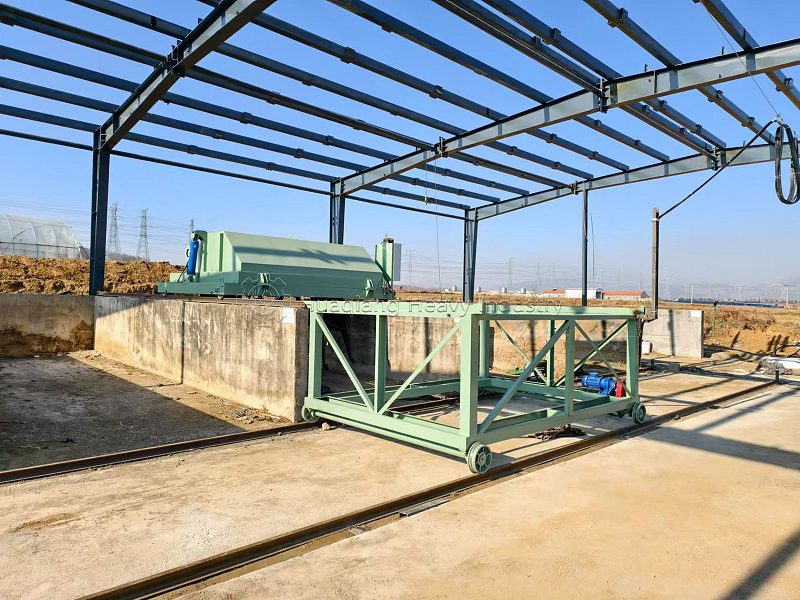
The chain-type turning machine needs to move on a track above the fermentation tank, therefore, the planning and design of the fermentation tank directly affects the equipment’s operating efficiency and fermentation effect.
Tank Width Design: Huaqiang chain-type turning machines can adapt to fermentation tanks of different widths from 3 to 6 meters. Width selection needs to comprehensively consider processing capacity and site conditions: the wider the tank, the larger the single processing capacity, but the higher the requirement for uniform turning. For production lines with a daily processing capacity of over 50 tons, a width of 4-5 meters is recommended, balancing efficiency and uniformity.
Tank Length Planning: The length of the fermentation tank can be “designed on demand” according to site requirements, ranging from 30 meters to 100 meters. It is generally recommended that the length of each tank be controlled at 50-60 meters. Too long a tank will lead to uneven material residence time within the tank, while too short a tank will result in frequent tank changes, affecting efficiency.
Multi-Tank Layout: Large-scale production requires at least 2-3 parallel fermentation tanks. One tank for feeding, one for fermentation, and one for discharging, achieving continuous operation. A 2-3 meter passageway should be left between the fermentation tanks for easy equipment maintenance and material transfer. Huaqiang Heavy Industry can provide free site design drawings to plan the most suitable tank layout based on your actual terrain and production capacity targets.
III. Key Points for Chain Turner Operation: Continuous, Uniform, and Adjustable
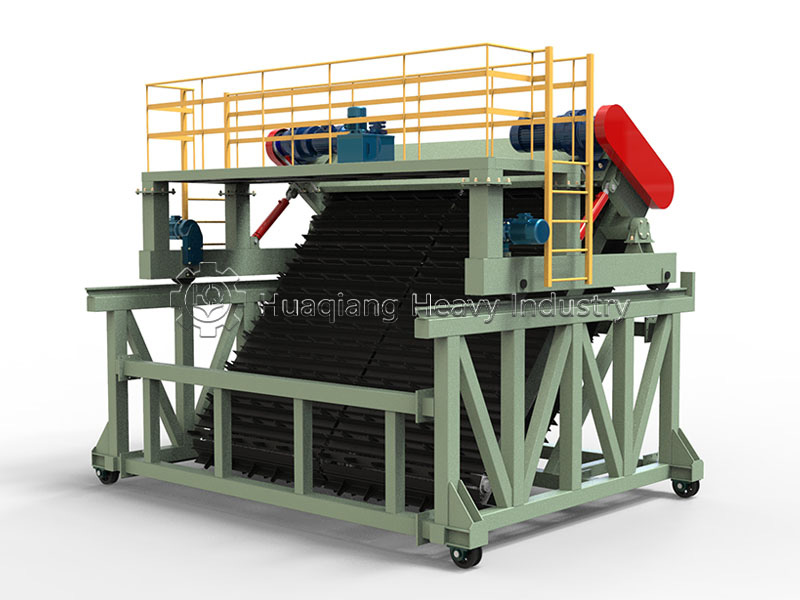
Synchronized Travel and Turning: The chain turner travels along a dedicated track at the top of the fermentation tank. The turning chain blades rotate continuously during travel, turning, breaking up, and throwing the material from the bottom to the rear. This process simultaneously completes three tasks: breaking up clumps, supplementing oxygen, and mixing materials. The equipment’s travel speed is infinitely adjustable between 0.5-3 meters per minute, allowing users to flexibly adjust according to the fermentation stage.
Turning Depth Control: The chain blades can penetrate deep into the bottom of the material, thoroughly turning up the material in the lowest anaerobic zone. Huaqiang equipment can achieve a turning depth of 0.8-1.2 meters, ensuring uniform air contact throughout the tank. The hydraulic lifting system allows for real-time adjustment of the turning depth during operation to adapt to changes in material volume.
Phased Operation Strategy: In the early fermentation stage (first 7 days), it is recommended to turn the material once a day to quickly raise the temperature; in the middle fermentation stage (days 8-15), turn it once every 2 days to maintain a high temperature; in the later fermentation stage (after day 16), turn it once every 3 days to gradually lower the temperature. Huaqiang equipment is equipped with an intelligent control system that can preset the turning frequency and travel speed, achieving “unattended” operation.
Process Support Advantages: From Single Machine to System
The value of the chain-type turning machine is amplified when integrated with other equipment.
Automatic Feeding System: An automatic material spreader is installed at one end of the fermentation tank to evenly spread the pre-treated raw materials into the tank. The spreading width is adjustable to match the turning machine’s travel speed, achieving continuous “feeding and turning simultaneously” operation.
Automatic Discharge System: After fermentation, the turning machine, in conjunction with a trough-type discharge machine, transfers the fermented material from the tank to a conveyor belt, directly feeding it into the next process. The entire process involves no material touching the ground, eliminating secondary pollution.
Fully Automated Operation: From feeding to discharging, one chain-type compost turner paired with 2-3 fermentation tanks can replace more than 10 workers. Operators only need to monitor the equipment’s operation and handle any abnormalities from the central control room.
Shorter Fermentation Cycle: Compared to open-air natural fermentation, forced turning in the tanks provides more oxygen and higher microbial activity. Actual data shows that using a chain-type compost turner can shorten the fermentation cycle by 5-7 days compared to open-air fermentation, significantly improving site turnover efficiency.
Case Study: 50 Tons/Day Processing, Only 2 People Required
A large organic fertilizer plant planned to process 50 tons of raw materials per day, aiming to ensure both the quality of composting and control labor costs. Huaqiang Heavy Industry designed three fermentation tanks (4.5 meters wide and 60 meters long), equipped with one chain-type compost turner, and an automatic feeding and discharging system.
Post-production results far exceeded expectations:
Production efficiency increased by 60%: The entire process from feeding to discharging is automated, with a daily processing capacity consistently exceeding 50 tons.
Labor costs were drastically reduced: The entire fermentation line requires only 2 operators (1 for central control and 1 for inspection).
Composting uniformity reached 98%: Continuous sampling and testing showed highly consistent material composting levels.
Annual processing capacity exceeded 15,000 tons, strongly supporting the raw material supply for subsequent granular fertilizer production lines.
Customized Services: Adapting equipment to your needs
Every organic fertilizer plant has different site conditions and production capacity targets. Huaqiang Heavy Industry’s chain compost turners offer a full range of customized services:
Customized Tank Width: From 3 meters to 6 meters, in 0.5-meter increments, precisely matching your fermentation tank dimensions.
Adjustable Turning Depth: Standard depth 1 meter, can be increased to 1.5 meters depending on material characteristics.
Rail Configuration: Pre-embedded or ground-mounted track solutions are available based on site conditions.
Intelligent Upgrades: Optional intelligent modules such as remote monitoring and automatic cruise control enable a higher degree of automation.
From the planning and design of a single fermentation tank to the stable operation of a chain compost turner, and the automation of the entire production line—Huaqiang Heavy Industry is committed to providing large-scale organic fertilizer plants with “one-stop solutions for the fermentation process.” When your production line operates efficiently with a daily processing capacity of 50 tons, and when a fermentation workshop that once required a dozen workers now only needs a handful, you will understand: choosing the right equipment is choosing the right passport to large-scale production.
The detailed description of the trough system and its chain turner perfectly illustrates the principles of trough-type aerobic fermentation composting technology. This method represents a significant advancement in fermentation composting turning technology, offering a controlled, efficient alternative to open-air methods. The chain compost turner itself is a specialized trough-type compost turner, designed for consistent, high-throughput operation within the concrete channels. This contrasts with the more flexible but less controlled windrow composting machine, which is a type of large wheel compost turner used for open-air windrows. The choice between these technologies depends on the scale of operation and the need for environmental control. For a large-scale plant processing 50 tons per day, the trough-type aerobic fermentation composting technology with its automated chain compost turner provides the necessary uniformity, space efficiency, and process control, enabling a true “technology-controlled” fermentation process and forming the cornerstone of a modern, industrial-scale organic fertilizer manufacturing system.