
You know that wet, sticky, gooey fermented material that stretches when you grab it? A regular crusher takes one look and shakes its head – inlet clogged, screen blinded, motor groaning but nothing comes out. But one machine isn’t afraid of it. Meet the half wet material crusher. Today, let’s walk into its installation site and see how this old hand that “refuses to lose” tames the clingiest troublemakers.
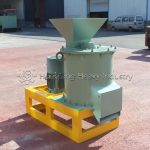
On site, the half wet material crusher stands out with its stocky, powerful frame. It has no screen – yes, you heard that right, no screen. That’s exactly why it dares to take on wet, sticky materials. Inside the housing are two sets of high speed rotors, covered with blade like hammers that look like rows of iron teeth. Once material enters, it gets bitten, slammed, and flung by the upper and lower hammers in rapid succession. From inlet to outlet, in just milliseconds, it’s smashed into fine particles. Workers are busy hoisting a rotor into the housing. An old hand squats by the coupling, measuring the alignment between motor shaft and main shaft with a dial indicator: “Deviation can’t exceed 5 hundredths of a millimeter – otherwise, at high speed, the bearings won’t last.” A younger worker tightens the bolts one click at a time, the wrench making a crisp ratcheting sound.
What this crusher prides itself on is that it doesn’t clog and doesn’t fear moisture. A regular crusher uses a screen to control particle size, but wet material instantly blinds the screen. This machine relies on hammer tip speed and the material colliding with itself inside the housing – no screen needed. During installation, the gap between the hammers and the inner wall has to be adjusted repeatedly. Too small, and the hammers scrape the wall; too large, and the crushing is incomplete. A worker with a feeler gauge moves like a surgeon, turning the rotor and measuring, muttering, “This gap – 2.5 millimeters – just right.”
Of course, the crusher never works alone. Upstream, there’s a horizontal mixer or dewatering machine – it homogenizes the fermented wet material, breaks up large clumps, and keeps moisture around 50%. Too wet, and crushing efficiency drops; too dry, and dust flies everywhere. Downstream, a belt conveyor and a screener wait. The fine powder from the crusher goes to the screener, which removes any remaining coarse fibers or plastic pieces (if present in the raw material). Only the qualified fines move on to the disc granulator or ring die pellet machine. The coarse rejects go back to the front, to be mixed and crushed again. The whole line just keeps cycling – nothing wasted.
On test day, the crew runs the crusher empty first. The motor starts, both rotors spin up, and a sharp whine fills the air – like a jet engine. The old hand cocks his ear – no odd noises, no vibration. Then they feed material. Wet, sticky fermented compost goes into the inlet, and a rapid “crackle pop” comes from inside the housing. Out of the discharge pours a stream of fine, dark brown powder – loose, not sticky at all. A worker catches a handful, squeezes it, smells it. “Hey – no clogging! And way finer than manual crushing.” The old hand stops the machine, opens the inspection door. The inner wall and rotors have only a light dusting of powder – no wet mud caked on. He nods. “That’s it. This thing was born to do the dirty work.”
So don’t underestimate this screenless crusher. It’s not picky – wet, sticky, a little fibrous, it takes them all. It doesn’t complain – spinning fast, iron teeth and all, never tired. With this machine, those troublesome materials that make ordinary crushers cry turn quietly into fine powder, waiting to be pelletized, bagged, and sent to the fields. Isn’t that the ultimate “sticky monster slayer”?