
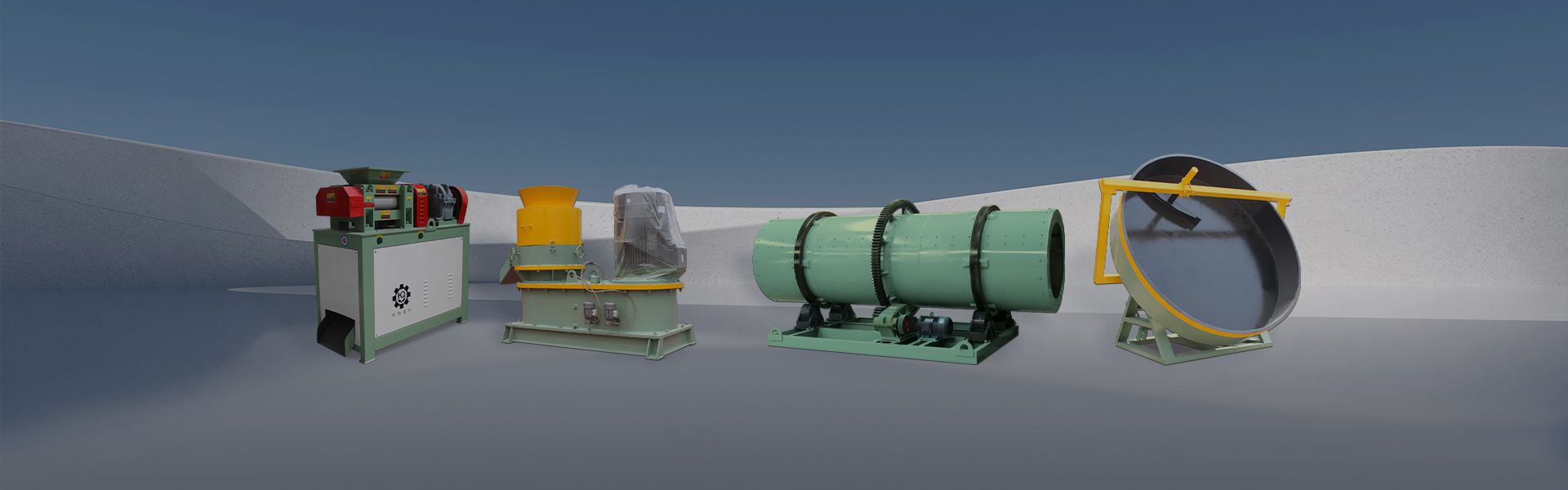
Have you ever seen a granulator that can “split” itself into two?
At today’s installation site, I met just such a machine—the new type two-in-one organic fertilizer granulator. It sat quietly in a corner of the workshop, surrounded by wrenches, levels, and unpacked cables. But don’t let its silence fool you: this machine can both extrude sticks and roll out round pellets. One unit does the job of two, like a Transformer among fertilizer equipment.
Walking onto the site, the first thing you see is a busy installation crew. They are fixing the main unit firmly onto its foundation. Nearby, a belt conveyor, a rotary screen, and a cooler are already in place. Unlike other fertilizer machines, this two-in-one granulator hides two sets of forming dies inside: one for extrusion into rods, the other for rounding into pellets. The installers have to calibrate the die gaps repeatedly, keeping errors within two millimeters—otherwise, the output pellets would be misshapen and uneven.

“Tighten the chain a bit more… Good, stop!” With the shouts of commands, the drive system begins a trial run. I notice a variable-frequency feeder sitting next to the granulator, acting like a savvy butler that adjusts the feed rate automatically based on the material’s moisture. Behind it, a hot-air stove is being tuned, with drying ducts snaking toward the cooler—every piece of the line interlocks like an orchestra waiting for its conductor.
The most interesting moment came when an experienced installer pulled out a clear sample bottle filled with freshly made organic fertilizer pellets. “Look,” he said, shaking the bottle, “the round ones are rolled, the short sticks are extruded. Changing the dies is like swapping a blade—it takes ten minutes.” So the secret of the two-in-one lies in that quick-change mechanism. Other equipment—cage crusher, rotary screener machine, bagging scales—are already in position, just waiting for the granulator to give the signal, and the whole production line will “sing.”
Of course, installation didn’t go without challenges. Because this new model uses a dual-mode structure, it demands near perfect leveling. The workers used laser levels to align it repeatedly, even removing one bolt to start over. By evening, the motor finally started smoothly, and two pellets—one round, one rod—popped cheerfully out of the discharge port. Everyone breathed a sigh of relief, and applause broke out in the workshop.
So, one granulator, two roles—how does it pull it off? With clever mechanical design and every drop of sweat at the installation site. Next time you see an organic fertilizer line, keep an eye out: that machine that seems to perform magic might just be standing quietly right in the middle.