
Premium WordPress theme for construction companies, contractors, builders, and a variety of other construction-related businesses.
-
28238 Kelsie Lane Apt. 451,
Port Annabelport
-
Call Us: (210) 451-123
(Sat - Thursday)
-
Monday - Friday
(10am - 05 pm)
Cage Crusher


Equipment Introduction
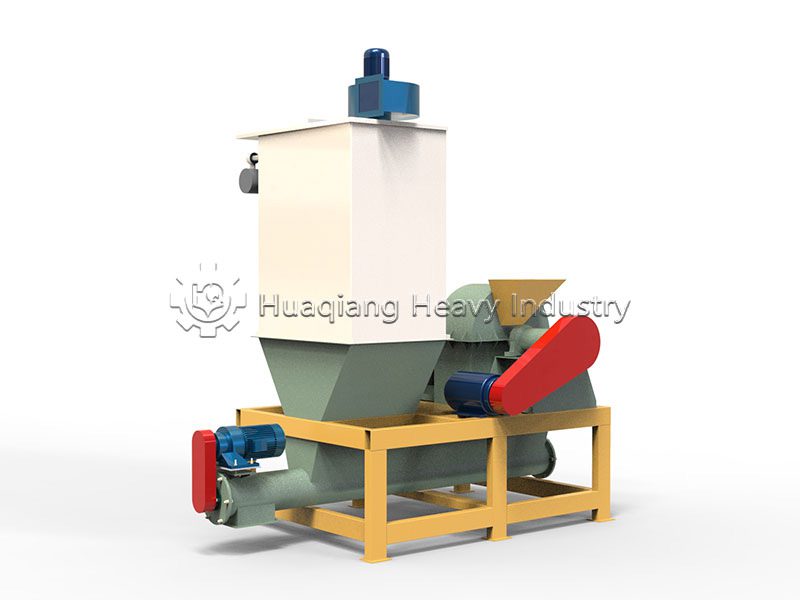
A cage crusher, also known as a cage coal mill or cage dispersant, is a high-speed impact crushing device. Its core feature is the presence of two or more sets of staggered, nested “cage”-shaped rotors. It is widely used in compound fertilizer production, mining machinery, and building materials industries, and is particularly adept at processing materials with a moisture content of approximately 6% to 12% and moderate hardness. Compared to traditional hammer mills or ball mills, it not only has crushing capabilities but also possesses extremely strong mixing and dispersing effects. Due to its compact structure, large crushing ratio, and high production efficiency, it has become a key piece of equipment in modern compound fertilizer and fine material processing production lines.
Structural Components of the Equipment
The overall structural design of the cage crusher focuses on functionality, durability, and ease of maintenance, and mainly consists of the following key components:
- Frame and Housing
The frame provides the basic support for the entire equipment, ensuring operational stability; the housing adopts a metal enclosed structure, with a feed port at the top and a discharge port at the bottom, and is typically lined with high-manganese steel wear-resistant plates to extend its service life.
- Cage Wheel Assembly (Core Working Component)
The core of the cage crusher consists of two sets of cage rotors (large cage wheel assembly and small cage wheel assembly):
Each cage is composed of a steel disc fixed to a hub, and each disc is fixed with two or three rings of steel bars (cage bars/impact rods).
The steel bars are arranged concentrically and perpendicular to the disc, with the other end of each ring of steel bars fixed by a steel ring to increase strength.
The steel bar rings of the two cages are arranged alternately to form a crushing chamber.
The diameter of the steel bars is generally around 3cm, and they are the main wear parts, with a typical service life of 400-800 hours.
- Transmission System
Two electric motors drive the large and small cages respectively.
One motor drives the large cage to rotate clockwise, and the other motor drives the small cage to rotate counterclockwise.
Power is transmitted through pulleys, belts, and a reduction gear.
The rotational speed is typically around 2000 r/min.
- Bearing and Support Structure
Each cage is mounted on its own spindle via a hub.
The spindle is supported by bearing housings; the two shafts are on the same axis but independent of each other.
The bearing housings are designed for easy maintenance and replacement.
- Adjustment and Maintenance Devices
Equipped with devices for easy loading and unloading of the cages, such as screws, handwheels, and nuts, allowing the bearing bracket to move the bearings, shafts, and cages horizontally on the base.
This facilitates adjustment of the gap between the two cages and replacement of worn parts.
- Auxiliary Devices (New Equipment)
Cyclone Dust Collection Device: Equipped with the new dust-free cage pulverizer, it separates dust from the airflow using centrifugal force, achieving low-dust or even dust-free operation.
Lubrication system, cooling system, dust removal system, etc.
Working Principle of the Equipment
The cage crusher is designed based on the principle of impact crushing. Its complete working process is as follows:
- Material Input and Initial Crushing
The material enters the central part of two opposing rotating cages through the feed inlet, first falling onto the innermost ring of steel bars. In some models equipped with a spiral feeding sleeve, the material is coarsely crushed while being propelled axially through the gap between the spiral feeding sleeve and the machine base.
- Multi-stage Impact Crushing
Due to the high-speed rotation of the cages, the material is violently crushed by the impact of the steel bars. Under centrifugal force, the material is thrown onto the next ring of steel bars (i.e., the innermost ring of the other cage), where it is subjected to the same impact, but in the opposite direction.
The material passes through each ring of steel bars sequentially from the inside out, continuously subjected to impacts and shearing effects from the counter-rotating steel bars. The two opposing rotating cages repeatedly impact the material, causing it to be repeatedly crushed under centrifugal force.
- Multiple Crushing Methods
Material crushing in the cage crusher is achieved through three methods:
Steel Bar Impact: Crushed by the violent impact of high-speed rotating steel bars.
Material Self-Collision: Crushed by the collision between material particles.
Casing Impact: Crushed by the impact of material against the inner wall of the casing.
- Finished Product Discharge
After being crushed stage by all the steel bars in each ring, the qualified crushed material falls to the bottom of the casing and is discharged from the outlet.
- Key Operating Parameters
Steel Bar Linear Velocity: The circumferential velocity of the outermost steel bar is typically 2237 m/s, with a suitable linear velocity of 2540 m/s.
Influence of Rotation Speed: Increasing the cage rotation speed and the number of steel bar rings results in finer product particle size; however, excessively high rotation speeds make it difficult for material to move from the center to the periphery, reducing productivity and accelerating steel bar wear.
Specification: The specifications of the cage crusher are expressed as the working disc diameter × cage width (mm).
Equipment operation and maintenance methods
| Cage Crusher Pre-start Checklist | ||||
|---|---|---|---|---|
| Inspection Category | Inspection Item | Inspection Standard | Inspection Result | Remarks |
| Equipment Inspection | Fastening of All Components | All connecting screws are free of looseness and falling off. | Focus on bearing base, machine housing and cage assembly bolts. | |
| Steel Bar Condition | Steel bars on the cage shall have no fracture or slack and be firmly installed. | Stop the machine immediately if steel bar breakage or looseness is found. | ||
| Drive Belt Condition | Proper belt tension, no cracking, slipping or abnormal wear. | Too loose causes slipping; excessive tension increases bearing load. | ||
| Inlet & Outlet Smoothness | Feed inlet and discharge outlet are unobstructed without foreign object jamming. | Thoroughly clean residual materials. | ||
| Lubrication System Inspection | Lubricant Level | Oil level stays within the normal range marked on the equipment. | Replenish oil promptly if below lower limit. | |
| Oil Quality Status | Clean oil free of sludge, impurities and leakage. | Replace oil immediately once abnormal oil quality appears. | ||
| Lubrication of Moving Parts | All moving parts are fully lubricated to avoid dry-running risks. | Add lubricant one by one at each lubrication point. | ||
| Material Inspection | Material Adaptability | Materials to be crushed meet the applicable scope; no ultra-hard or highly sticky materials. | Materials with compressive strength>150MPa are prohibited. | |
| Foreign Object Control | No metal blocks, stones and other hard impurities mixed in materials. | A magnetic separator must be installed at the feed inlet. | ||
| Moisture Content Control | Material moisture content shall be controlled within allowable range; ≤12% is optimal. | Pre-dry high-moisture materials in advance. | ||
Applicable Raw Materials for the Equipment
The cage crusher can process a wide variety of raw materials, mainly including:
- Mineral Raw Materials
Industrial slag, dry clay, shale, medium-hard coal gangue
Limestone, gypsum and other medium-low hardness minerals
Kaolin, clay, bentonite
Diatomite, chalk, asbestos, coal, asphalt
- Fertilizer Raw Materials
Fermented and decomposed organic fertilizer (decomposed livestock and poultry manure, decomposed straw powder, mushroom residue, etc.)
Compound fertilizer granules, monoammonium phosphate, diammonium phosphate, urea and other chemical fertilizers
Potassium sulfate, potassium chloride and other potassium fertilizers
- Other Raw Materials
Animal manure, plant branches and leaves
Vitreous siliceous raw materials, soft limestone, coke
Some chemical crystal blocks
- Raw material moisture content requirements:
The moisture content requirement for raw materials is not strict; generally, a content below 12% will not affect crushing efficiency.
Compound fertilizer crushing requires a moisture content below 6%.
Some models can handle materials with a moisture content of 10%~20%.
When processing high-moisture materials, it is recommended to control the moisture content between 8% and 12%.
Typical Application Layout of Cage Crusher in Production Lines
Scenario 1: Compound Fertilizer (NPK) Production Line Layout
Raw Material Bin → Belt Conveyor → Cage Crusher → Mixer → Granulator → Dryer → Screening Machine Coarse material from the screening machine is returned to the cage crusher for further crushing, forming a closed loop.
Scenario 2: Organic Fertilizer Granulation Production Line Layout
Fermented and composted raw materials → Screening → Cage Crusher for fine crushing → Mixer → Granulation Equipment → Post-processing
Function: Crushes large pieces of composted manure and bacterial residue into uniform powder, significantly improving granulation rate and reducing residue.
Scenario 3: Fertilizer Agglomeration Breaking Process
Bagged agglomerated fertilizer → Bin → Belt Conveyor → Cage Crusher → Finished Product Bin / Packaging Line Replaces manual crushing, achieving automated breaking of agglomerated fertilizer.
Common Equipment Problems and Solutions
| No. | Fault Phenomenon | Root Cause | Solution | Preventive Measures |
|---|---|---|---|---|
| 1 | Reduced crushing efficiency, unqualified particle size Symptoms: Output lower than rated value; proportion of oversized materials increases | 1. Severe wear of hammer bars, large clearance 2. Screen mesh damaged or blocked 3. Uneven feeding, material surging | 1. Dismantle rotor assembly and replace worn hammer bars 2. Clean or replace screen mesh 3. Optimize feeding device to ensure uniform feeding | Implement “Three Checks per Shift”: inspect gap, bearing temperature and feeding uniformity before startup, during operation and after shutdown |
| 2 | Severe equipment vibration & abnormal noise Symptoms: Obvious vibration during running, harsh impact sound | 1. Rotor unbalance (uneven weight after replacement or excessive unilateral wear) 2. Bearing failure or damage 3. Uneven clearance between rotor & shell causing periodic impact 4. Loose anchor bolts or unstable foundation | 1. Install matched hammer bars and perform dynamic balance test 2. Replace damaged bearings and fill proper grease (2/3 of bearing housing) 3. Adjust gap between rotor and shell 4. Fully tighten anchor bolts | Check rotor balance monthly; match new bearings with proper grease to reduce vibration abrasion |
| 3 | Feeding blockage & frequent material jamming Symptoms: Feed inlet blocked, production interruption | 1. Excess material moisture (>15%) or bulk lumps 2. Excessive feeding speed and overload 3. Poor material discharge and clogged finished outlet 4. Blockage of screen holes | 1. Stop machine to clear blocked materials; never clear blockage while running 2. Install drying equipment to control moisture within 8%–12% 3. Install pre-screening device at feeding inlet to remove large impurities 4. Inspect discharge pipeline to ensure smooth flow | Strictly enforce material pretreatment standards; control feeding rate and moisture; prohibit clearing blockage during operation |
| 4 | Overheated bearings Symptoms: Bearing temperature rises continuously, exceeding 70℃ | 1. Uneven bearing base or rotor misalignment 2. Overfilled / insufficient or deteriorated lubricant 3. Excessive fitting clearance between bearing housing and shaft 4. Long-term overload operation | 1. Shut down and check & eliminate rotor misalignment 2. Fill grease according to specification (70%–80% of bearing housing) 3. Repair matching clearance between bearing housing and shaft 4. Adjust feeding volume to avoid continuous overload | Regularly inspect lubrication system and replace grease periodically; monitor running status of bearings during operation |
| 5 | Heavy dust emission (enclosed model) Symptoms: Severe dust leakage during crushing | Poor sealing of enclosed feeding structure; massive dust generated during crushing | 1. Upgrade to fully enclosed crusher equipped with dust collection system 2. Reinforce equipment sealing and replace aged sealing strips | Select new equipment matched with dust removal system; regularly check equipment sealing performance |
| 6 | Fast wear of hammer bars Symptoms: Service life shorter than expectation (normal: 400–600 hours) | 1. Excessive material hardness beyond equipment range 2. Improper rotor speed setting 3. Hammer bars fail to meet manufacturing requirements | 1. Select wear-resistant hammer bars made of qualified alloy material 2. Adjust rotor speed to suitable value for materials 3. Forbid feeding ultra-hard foreign materials | Purchase standard spare parts from formal manufacturers; strictly control material hardness; prevent hard foreign materials entering crushing chamber |
Target Customers:
- Fertilizer Manufacturers: Especially those producing NPK compound fertilizers and controlled-release fertilizers.
- Chemical Raw Material Suppliers: Companies that need to further break up clumps of raw materials stored in warehouses.
- Production Line Integrators: Mechanical engineering companies responsible for turnkey projects of fertilizer production lines.
- Feed Processing Companies: In situations where certain processes require the dispersing of additives.
Analysis of the advantages and disadvantages of the equipment
| Cage Crusher Advantages & Disadvantages Summary Table | |||
|---|---|---|---|
| Category | No. | Key Feature | Detailed Description |
| Advantages | 1 | Simple Structure | Compact overall structure with small floor space occupation |
| 2 | High Crushing Efficiency | Double-cage reverse impact design, large reduction ratio (i=10~50); realizes conversion from coarse particles to fine powder in a single pass | |
| 3 | Good Sealing Performance | Reduces dust leakage and noise pollution, improves working environment | |
| 4 | Stable Operation | Stable and reliable equipment running status | |
| 5 | Easy Cleaning & Maintenance | Equipped with devices for convenient disassembly and cleaning | |
| 6 | Low Requirement on Moisture Content | Crushing efficiency will not be affected generally when moisture content is within 12% | |
| 7 | Built-in Mixing Function | Capable of crushing multiple raw materials while mixing simultaneously | |
| 8 | Low Energy Consumption | Energy consumption is more than 30% lower than traditional crushing equipment | |
| Disadvantages | 1 | Relatively Low Production Capacity | Limited output for single unit |
| 2 | High Power Consumption | High operation cost | |
| 3 | Severe Wear of Wearing Parts | Short service life of steel bars (normally 400~800 hours), frequent replacement required | |
| 4 | Inconvenient Replacement & Maintenance | Replacement of vulnerable parts requires professional skills and time | |
| 5 | High Usage Cost | High overall maintenance and component replacement cost | |
| 6 | Dust Problem | Generates a large amount of dust during crushing | |
| 7 | Limited Application Scope | Not suitable for crushing hard materials and high-viscosity fibrous materials | |
Cage crushers, as a classic impact crushing equipment, occupy an irreplaceable position in industries such as fertilizer, chemical, and building materials due to their advantages of simple structure, high crushing efficiency, and uniform particle size. Although traditional limitations such as rapid steel bar wear and high noise levels exist, the development of technologies such as dust-free operation, intelligent systems, and wear-resistant materials has significantly improved modern cage crushers in terms of environmental friendliness, reliability, and automation. When selecting a model, users should fully consider material characteristics, production capacity requirements, environmental requirements, and maintenance costs to choose the most suitable model for their production scenario. Through standardized operation and scientific maintenance, long-term stable and efficient operation of the equipment can be ensured.
We have been deeply involved in the fertilizer equipment field for many years, and our products cover process design, equipment manufacturing, installation, commissioning, and after-sales maintenance for multiple categories of production lines, including organic fertilizer, compound fertilizer, BB fertilizer (blended fertilizer), and bio-fertilizer, providing you with full-process services.