
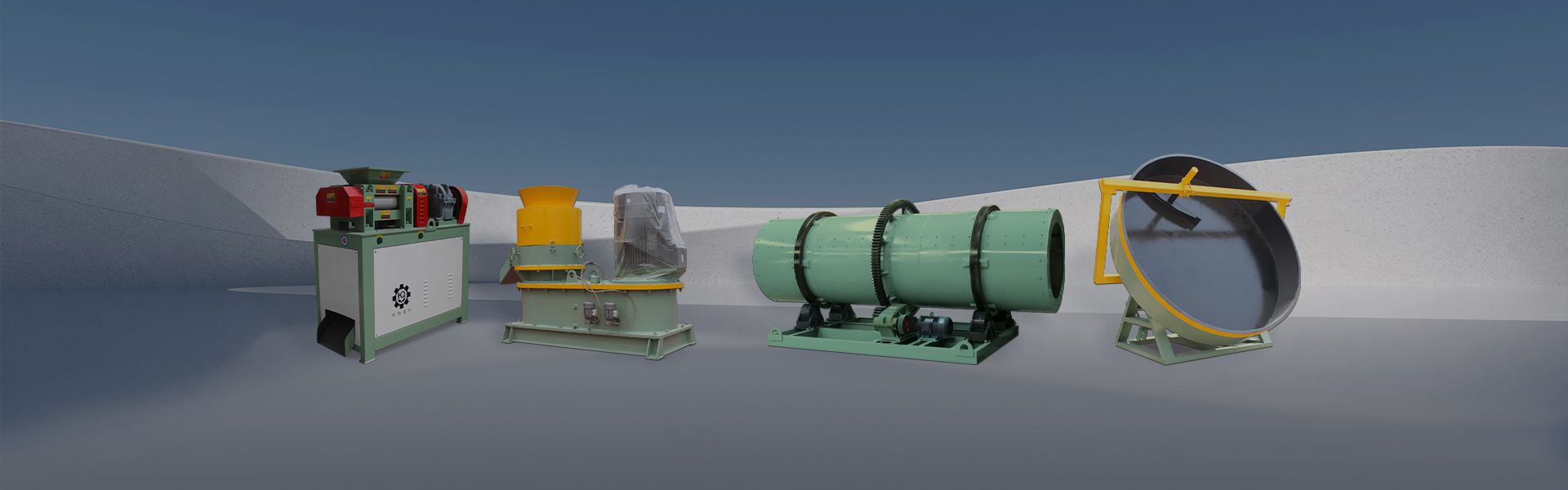
Have you ever watched a river stone grow smoother over time? Tumbled by current, knocked against other stones, it slowly loses its rough edges and becomes something round and perfect. That same principle—tumble, polish, grow—drives the most reliable workhorse in the fertilizer industry: the rotary drum granulator.
Walk into any medium-to-large scale fertilizer plant, and you’ll likely hear it before you see it. The deep, rumbling roar of a massive steel drum rotating on its axis, filled with tumbling material that rolls and folds like ocean waves. This isn’t the delicate ballet of a disc granulator or the high-pressure squeeze of a flat die. This is heavy lifting. This is volume. This is the rotary drum doing what it does best: turning mountains of powder into rivers of granules.
The Journey Begins: Breaking It Down
But before any granulation happens, the raw materials need preparation. That’s where the cage crusher enters the story. Walk over to the front of the line, and you’ll find this aggressive piece of machinery waiting like a sentinel. Inside its steel cage, rows of pins or bars rotate at high speed, slamming into lumps and clumps with relentless force.
What makes the cage crusher special? It’s brutally effective. Those lumps of recycled oversize from the screening stage? Crushed. Sticky urea cakes that sat too long in storage? Smashed. Hard phosphate rock that refuses to break? Pulverized. The cage crusher doesn’t negotiate—it simply wins, reducing everything to consistent, free-flowing powder that can move smoothly through the rest of the line.
Stand next to one during operation, and you’ll feel the vibration in your chest. It’s raw power applied with precision, preparing the way for everything that follows.
The Art of Blending: Double Axis Mixer
From the crusher, material flows to the double axis mixer. And here, something interesting happens. Where the crusher uses brute force, the mixer uses finesse.
Picture a long trough with two counter-rotating shafts running its length. Each shaft carries specially shaped paddles arranged in a spiral pattern. As the shafts turn—one clockwise, one counterclockwise—the paddles create a fluidized zone of movement. Material gets lifted, thrown, folded, and re-folded dozens of times per minute.
This isn’t just stirring. This is homogenization at its finest. Nitrogen sources, phosphorus, potassium, micro-nutrients, binders, recycled fines—every particle gets intimately acquainted with every other particle. By the time material reaches the discharge end, the mixture is so uniform you couldn’t pick out individual components if you tried.
Operators love the double axis mixer because it handles sticky formulations that would clog other equipment. Those organic-rich blends that farmers increasingly demand? The double axis handles them without complaint, its self-cleaning paddle design preventing buildup that would stop lesser machines cold.
The Main Event: Rotary Drum Granulator
Now the prepared, uniformly blended material reaches the star of the show—the rotary drum granulator.
This is where the magic happens. A massive steel cylinder, often 10 to 20 meters long and 2 to 4 meters in diameter, rotates slowly on heavy-duty trunnion rollers. Inside, the tumbling action is constant, relentless, and beautiful to watch.
As the drum turns, lifters inside the shell carry material upward, then release it in a controlled cascade. Fine particles tumble, collide, and under the influence of precisely applied steam or water, begin to stick together. Small seeds attract smaller particles, growing layer by layer like rolling snowballs.
But here’s what separates the rotary drum from other granulation methods: residence time control. Because the drum is long and the material moves through it gradually, operators can fine-tune exactly how long granules stay inside. Need larger granules? Slow the rotation, adjust the angle, let them tumble longer. Want smaller, denser product? Speed things up, change the moisture profile.
And the volume is staggering. A single rotary drum granulator can produce 20, 30, even 50 tons of granules per hour. This isn’t boutique production—this is feeding the world.