
What is a large wheel compost turning machine?
A large wheel compost turning machine is a fermentation treatment device used in large-scale organic fertilizer production. It uses a rotating wheel with a diameter of several meters as its core working component, for turning and mixing materials. Its core working principle is: the continuous rotation of the wheel drives the turning teeth on its edge to throw, break up, and re-pile the material in a windrow-like shape, allowing the material to fully contact the air, regulating the temperature and humidity of the pile, and accelerating the aerobic decomposition and maturation process of microorganisms.
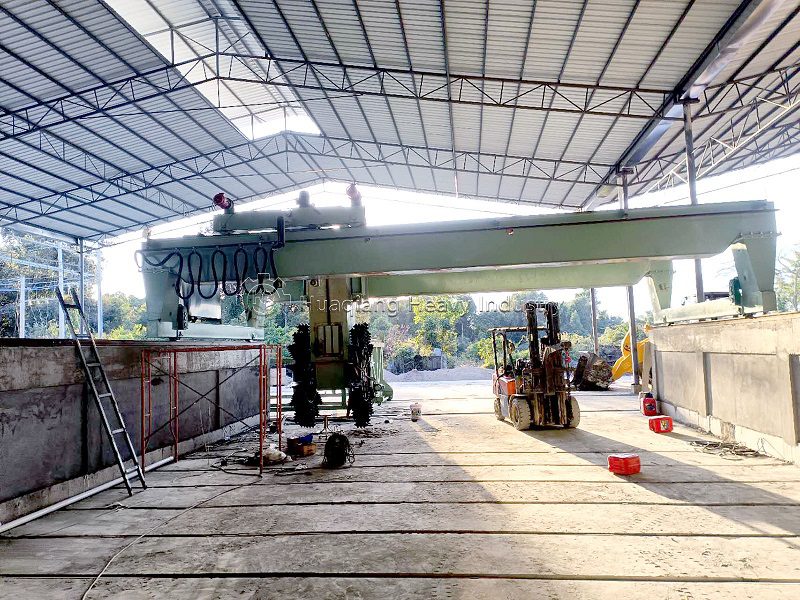
- Processing Capacity and Applicable large wheel compost turning machineshave a large coverage area in a single operation, processing 100 to 200 tons of material per hour, which is 3 to 5 times the processing capacity of tracked compost turners. This characteristic makes it particularly suitable for large-scale organic fertilizer production bases with an annual output of over 10,000 tons. According to process data, a single unit can complete the turning operation of 500 to 1000 tons of material per day, significantly reducing the labor and time costs of large-scale fermentation. Compared to trough-type compost turners, the disc-type system eliminates the need for concrete fermentation tanks, increasing site utilization by approximately 30%.
- Applicable Raw Material Types The large wheel compost turning machine’s powerful turning capacity efficiently processes a variety of organic raw materials. For livestock manure, it can process chicken, pig, and cow manure from large-scale farms, using high-temperature fermentation to kill pathogens and insect eggs, with a daily processing capacity of several hundred tons. For crop straw, it can process corn stalks, wheat straw, and rice straw, breaking up bundles of straw and mixing them evenly with manure to promote cellulose degradation. It can also process industrial organic waste such as distiller’s grains, sugar residue, and medicinal residue, as well as municipal sludge and garden waste that have passed quality testing.
III. Core Components and Maintenance Points The disc body is welded from high-strength steel, typically with a diameter of 5 to 10 meters. Turning teeth are evenly distributed along the edge, and the rotation speed is controlled at 10 to 20 revolutions per minute. The turning teeth are made of wear-resistant alloy steel and should be replaced promptly when wear exceeds one-third of their original length. The walking mechanism is equipped with large-diameter wide tires or tracks, resulting in low ground pressure and adaptability to soft ground. The power system includes a wheel drive motor (30 to 75 kW) and a walking drive motor (15 to 30 kW), available in both diesel and electric power options. Routine maintenance includes daily checks for looseness and wear of the turning teeth, weekly checks for transmission component lubrication, and monthly checks for wheel welds and structural deformation.
Scaling Aerobic Fermentation with Industrial Precision
The large wheel compost turning machine represents a decisive evolution in fermentation composting turning technology, bridging the gap between artisanal composting and industrial-scale organic waste valorization. By processing 100–200 tons per hour across open windrows, this equipment eliminates the civil infrastructure burden of trough systems while delivering the aeration intensity required for high-throughput composting process for animal manure—whether managing nitrogen-rich streams from poultry operations via a dedicated chicken manure fertilizer machine workflow, or processing bulky fiber-laden substrates through a cow manure fertilizer machine configuration. The wheel’s rotating teeth achieve thorough pulverization and homogenization, accelerating thermophilic phases and pathogen inactivation across diverse feedstocks including straw, distiller’s grains, and municipal sludge. For operations not yet requiring disc-scale throughput, a versatile windrow composting machine offers comparable aeration logic with lower capital commitment. Once fermentation reaches maturation, advanced fertilizer granulation technology transforms stabilized compost into uniform, marketable pellets—completing the circular journey from waste stream to agronomic input. By matching turning equipment capacity to raw material volume and site constraints, producers build a scalable bioconversion platform that converts environmental liability into sustained soil fertility value.
We offer large wheel compost turning machines with diameters from 5 to 10 meters and matching power systems, supporting customized diesel and electric options. We can also provide wear-resistant solutions for the turning teeth and full life-cycle maintenance guidance tailored to your raw material type and site conditions, helping you achieve efficient large-scale fermentation operations with lower operating costs.