
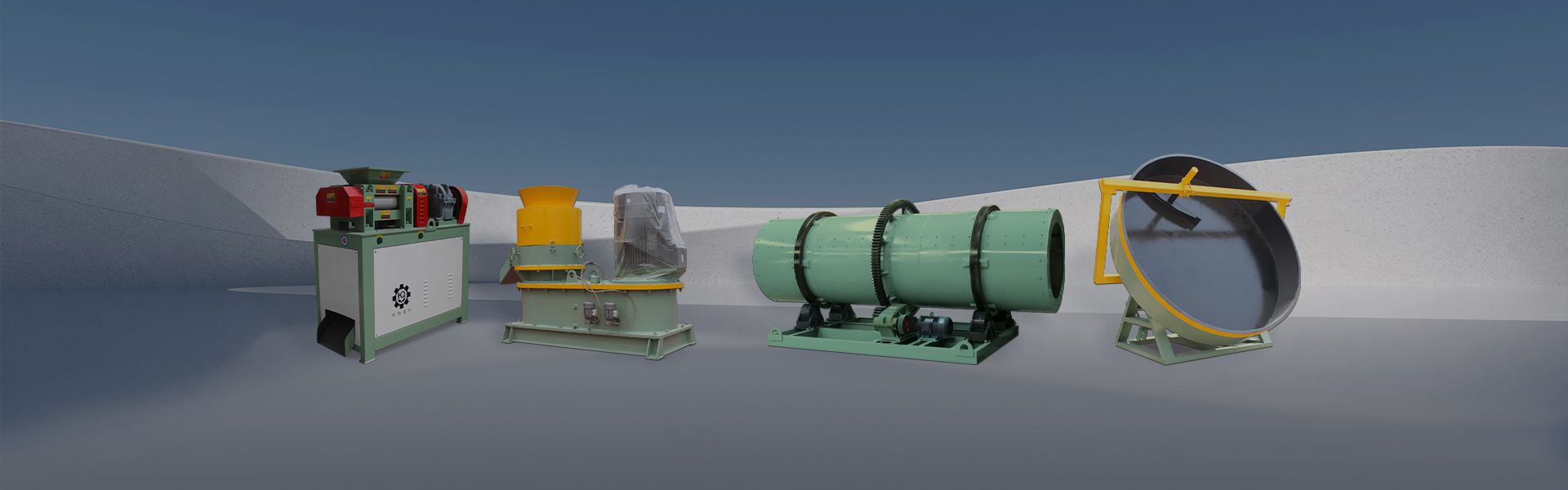
In the wave of agricultural waste resource utilization, converting livestock manure and straw into high-value organic fertilizer has become a crucial part of green agriculture. However, the process from wet raw materials to uniform granular fertilizer involves complex technological processes and specialized equipment combinations. This article will systematically outline the organic fertilizer production process and detail the key points for selecting core equipment at each stage.
What is the Organic Fertilizer Production Process?
The organic fertilizer production process refers to the complete technical route that uses organic waste such as livestock manure, agricultural straw, and sludge as raw materials, and transforms them into stable, harmless, and easily stored and transportable commercial organic fertilizer through a series of physical and biological treatment processes, including fermentation and maturation, crushing and mixing, granulation, drying and screening, and cooling and packaging.
A complete organic fertilizer production line typically includes the following standard stages: raw material pretreatment → aerobic fermentation → crushing and batching → mixing and stirring → granulation → drying and cooling → screening and packaging. The process parameters and equipment selection at each stage directly affect the quality and production efficiency of the final product.
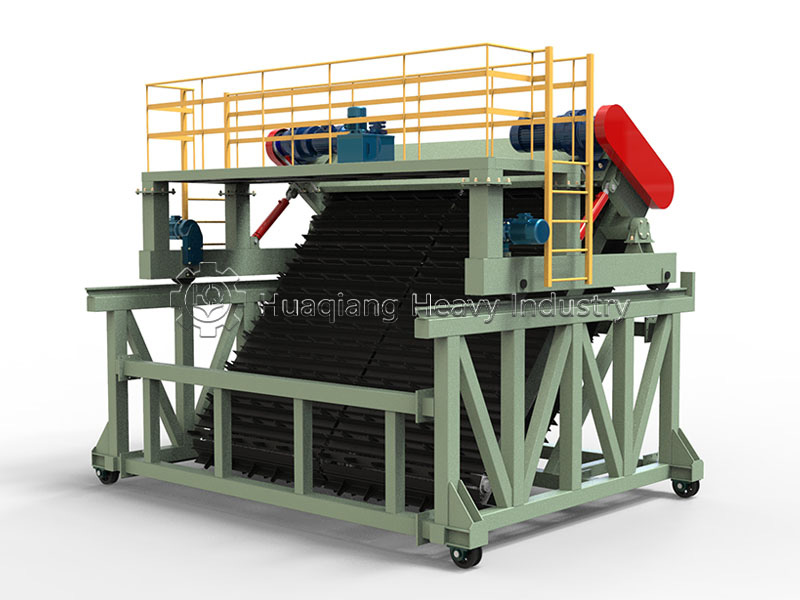
Core Equipment 1: Chain Plate Compost Turner
Fermentation is the “soul” of organic fertilizer production, its core task being to allow microorganisms to fully decompose organic matter under aerobic conditions. The key tool for accomplishing this task is the chain plate compost turner.
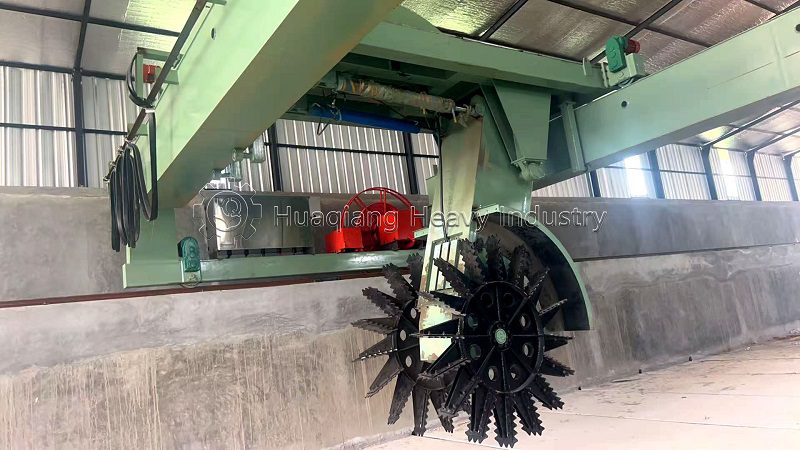
The chain plate turner is suitable for fermentation tank processes, with the equipment moving back and forth across tracks on both sides of the fermentation tank. Its core working component is the chain plate turning mechanism—a steel turning plate driven by a high-strength chain. During high-speed operation, it scoops up the material from the bottom of the tank, lifts it to the top, and then scatters it, while simultaneously moving it backward a certain distance. This process achieves three main functions: forced oxygen supply to restore the oxygen concentration in the compost pile to above 15%; mixing and homogenization to ensure a more uniform temperature distribution in the compost pile; and moisture evaporation to reduce the moisture content of the material by 3-5 percentage points each time.
The core advantage of the chain-plate compost turner lies in its deep-trench operation capability: typical turning depth can reach 1.5-2.2 meters, working speed is 50-100 meters/hour, turning span can be customized to 2-6 meters or even 30 meters, and single-unit processing capacity reaches 400-500 cubic meters/hour. Compared with other compost turner models, the chain-plate compost turner is more adaptable to high-fiber, high-viscosity materials (such as cow dung and straw).
III. Core Equipment Two: Semi-Wet Material Crusher Before fermented materials enter the granulation stage, there are often problems of agglomeration and uneven particle size. The semi-wet material crusher is a powerful tool specifically designed to solve this problem. It is a crushing equipment specifically designed for high-moisture materials (moisture content 25%-55%), adopting a two-stage rotor series structure and a screenless design, fundamentally solving the problem of wet materials clogging the screen holes.
Its core technologies include: two-stage crushing—the upper rotor coarsely crushes and breaks up large clumps, while the lower rotor finely crushes to the target fineness (≤0.5-1.0mm); a screenless structure—relying on the impact force of the high-speed rotating hammers and the gap between the liner plates to control the output particle size; and highly wear-resistant hammers—using high-alloy forged hammer blades, with wear resistance more than 50% higher than ordinary hammers. Common models range in power from 22kW to 75kW, with capacity covering 1-8 tons/hour, and output fineness reaching 50-80 mesh. Semi-wet material crushers are particularly suitable for the pretreatment of fermented raw materials such as chicken manure, pig manure, cow manure, humic acid, sludge, straw, distiller’s grains, medicinal residue, and mushroom residue.
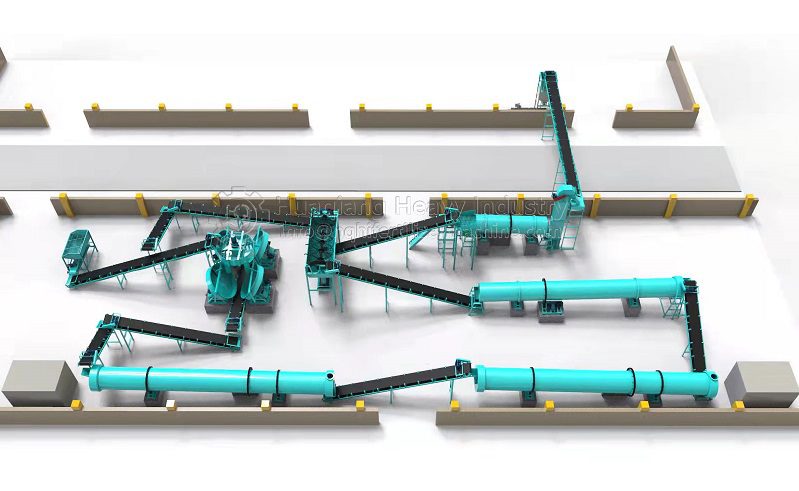
Disc Granulation Production Line: The Key Transformation from Powder to Granules Fermented, decomposed, and crushed materials are in powder form, which cannot meet the requirements of commercial storage, transportation, and mechanized fertilization. The disc granulation production line is the core system that completes this transformation.
A disc granulator is a shallow, tilted disc granulation device. Driven by a motor, the disc rotates, and the material inside is subjected to a combination of centrifugal force, friction, and gravity, adhering and compacting layer by layer like a snowball, ultimately growing into uniform spherical particles. This is a typical wet granulation process—by spraying an appropriate amount of water or binder solution, the powder agglomerates and forms particles in a moist state.
Taking a typical medium-sized disc granulator (3-meter disc diameter) as an example, the single-machine capacity can reach 1.5-3 tons/hour, with a pelletizing rate exceeding 93%. The finished particle size can be adjusted within the range of 1-8mm, the disc tilt angle is 35°-55°, and the rotation speed is 15-25 rpm. Its key performance indicators include: over 93% of the material can be granulated in a single pass (minimal return material); particle size distribution can be precisely controlled by adjusting the tilt angle and rotation speed; and a non-powered scraper design saves approximately 15%-20% in energy.
A complete disc granulation production line typically includes the following equipment combination: a chain plate turner and a semi-wet material crusher in the pre-fermentation stage; a batching system, a horizontal mixer, and a disc granulator in the granulation stage; and a post-processing stage equipped with a rotary dryer (to reduce moisture content to below 15%), a rotary cooler (to reduce temperature to below 40℃), a drum screen, and an automatic packaging scale.
Based on production capacity targets, the following configuration options are recommended: For an annual production capacity of 5,000-10,000 tons (1-2 tons per hour), a 2-3 meter wide compost turner, a TDSF-40 crusher, and a 2.2-meter diameter disc granulator can be selected, with a total investment of approximately 250,000-400,000 yuan; for an annual production capacity of 10,000-30,000 tons (2-5 tons per hour), a 3-4 meter wide compost turner, a TDSF-60/90 crusher, and a 2.5-3 meter diameter disc granulator can be selected, with a total investment of approximately 500,000-800,000 yuan; for an annual production capacity of 30,000-60,000 tons (5-10 tons per hour), a 4-6 meter wide compost turner, a TDSF-120 crusher, and a 3.5-meter diameter disc granulator can be selected, with a total investment of approximately 1,000,000-1,500,000 yuan.
When selecting equipment, please remember: the equipment configuration must be precisely matched with the characteristics of the raw materials, the target production capacity, and the site conditions. It is recommended to take raw material samples to the equipment supplier’s pilot plant for small-batch testing before purchasing, and use the actual test data to guide equipment selection. This is the most reliable way to avoid investment mistakes.
From Waste to Value Through Precision Equipment
The organic fertilizer production journey begins and ends with intelligent equipment selection. At the fermentation stage—the biological heart of the process—choosing the right fermentation composting turning technology is paramount. For massive industrial composting yards, a large wheel compost turning machine delivers the depth and throughput required for high-volume decomposition; for standardized fermentation troughs, a trough-type compost turner or robust chain compost turning machine excels at breaking up fibrous, viscous substrates like cow manure and straw while maintaining aerobic conditions below 2.2 meters. Meanwhile, open-field operations benefit from a versatile windrow composting machine or agile self propelled compost production machine, which adapts to irregular terrain without fixed infrastructure. Once maturation is complete, advanced fertilizer granulation technology—exemplified by the disc granulation systems detailed above—transforms stabilized powder into uniform, market-ready pellets with >93% spheronization rates. By aligning the specific turning and granulation technologies with raw material characteristics, capacity targets, and site constraints, producers build not merely a production line, but a resilient, scalable bioconversion platform that turns agricultural waste into agronomic value.