
What role does a compost turner play in organic fertilizer production?
The compost turner is the core equipment in the aerobic fermentation stage. Its fundamental function can be summarized as follows: by mechanically turning the material, it increases the oxygen content inside the compost, regulates the temperature, and promotes moisture evaporation, thereby shortening the fermentation cycle and improving the quality of organic fertilizer. Specifically, the compost turner undertakes the following four key functions in organic fertilizer production:
Forced Oxygen Supply to Maintain Aerobic Fermentation
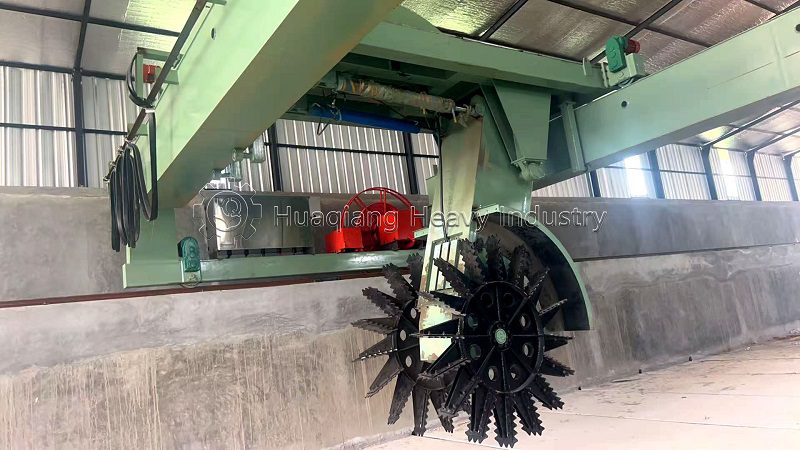
Organic fertilizer fermentation relies on the active metabolism of aerobic microorganisms, and microbial activity requires sufficient oxygen. The compost turner uses a spiral cutter shaft or rollers to turn the material up and down and move it left and right, changing the material from a piled state to a loose state. A large amount of fresh air is brought into the interior of the compost, and the oxygen concentration quickly increases to the ideal range of 10%–15%. Regular turning ensures that the fermentation process is always in an aerobic state, avoiding anaerobic fermentation due to lack of oxygen, which produces malodorous gases such as hydrogen sulfide and reduces fertilizer efficiency.
Regulating Pile Temperature to Prevent Burning or Overcooling
During fermentation, microorganisms decompose organic matter, generating a large amount of heat, with the core temperature reaching 60℃–70℃. If the temperature remains too high (above 75℃), it will inhibit microbial activity; if the temperature is too low, fermentation will be slow. The turning machine turns the inner layer of material in the high-temperature layer to the outer layer, and the outer layer of material to the inner layer, achieving uniform heat distribution. Simultaneously, natural heat dissipation regulates the overall temperature, stabilizing it within the optimal range of 50℃–65℃, ensuring efficient fermentation while preventing “pile burning.”
III. Promoting Moisture Evaporation and Reducing Material Moisture Content
The initial moisture content of organic raw materials is typically 60%–70%, while mature organic fertilizer requires a moisture content below 30%. Turning the pile allows for full contact between the material and air, and internal water vapor escapes with the hot airflow. Each turn reduces the moisture content by 2%–5%, significantly shortening the time required for sun-drying or auxiliary drying, and saving subsequent energy consumption.
Breaking Up Clumps and Improving Material Uniformity During fermentation, materials easily clump together. The blade rollers or rotors of the compost turner have shearing and crushing functions, which can break up the clumps, making the inoculum, auxiliary materials, and main materials mix more evenly, creating favorable conditions for subsequent crushing and granulation processes.
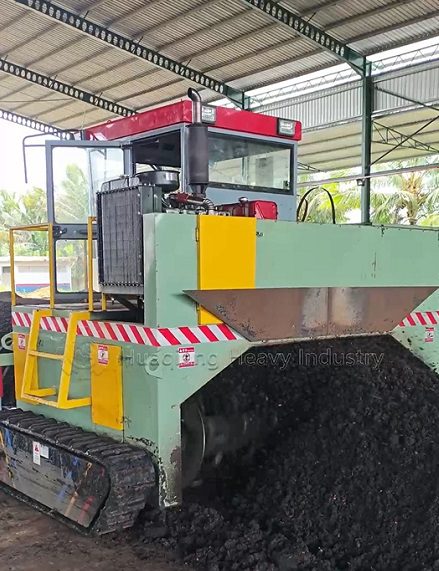
Compost Turner Types and Selection Considerations Mainstream compost turners are divided into three categories: wheeled compost turners are mobile and flexible with a small turning radius, suitable for indoor trough fermentation; tracked compost turners have strong climbing ability, suitable for open-air windrow composting; and drum compost turners have a large processing capacity, suitable for large-scale continuous production. Selection should be based on a comprehensive judgment of the fermentation site, compost pile width, processing capacity, and material characteristics.
Recommended Turning Frequency It is generally recommended to turn the compost every 1-2 days. During the high-temperature period in summer, the frequency can be appropriately increased to once a day, and during the low-temperature period in winter, it can be extended to once every 3 days. The specific frequency needs to be flexibly adjusted based on changes in compost temperature and oxygen monitoring data.
In summary, the compost turner is a crucial link connecting raw material pretreatment and finished product fermentation. It doesn’t simply “turn” the materials; rather, it precisely controls oxygen, temperature, moisture, and uniformity to create an optimal living environment for aerobic microorganisms, shortening the traditional 60-90 day fermentation cycle of natural composting to 15-20 days, significantly improving production efficiency and product stability. For any organic fertilizer production project, the compost turner is an indispensable “fermentation accelerator.”
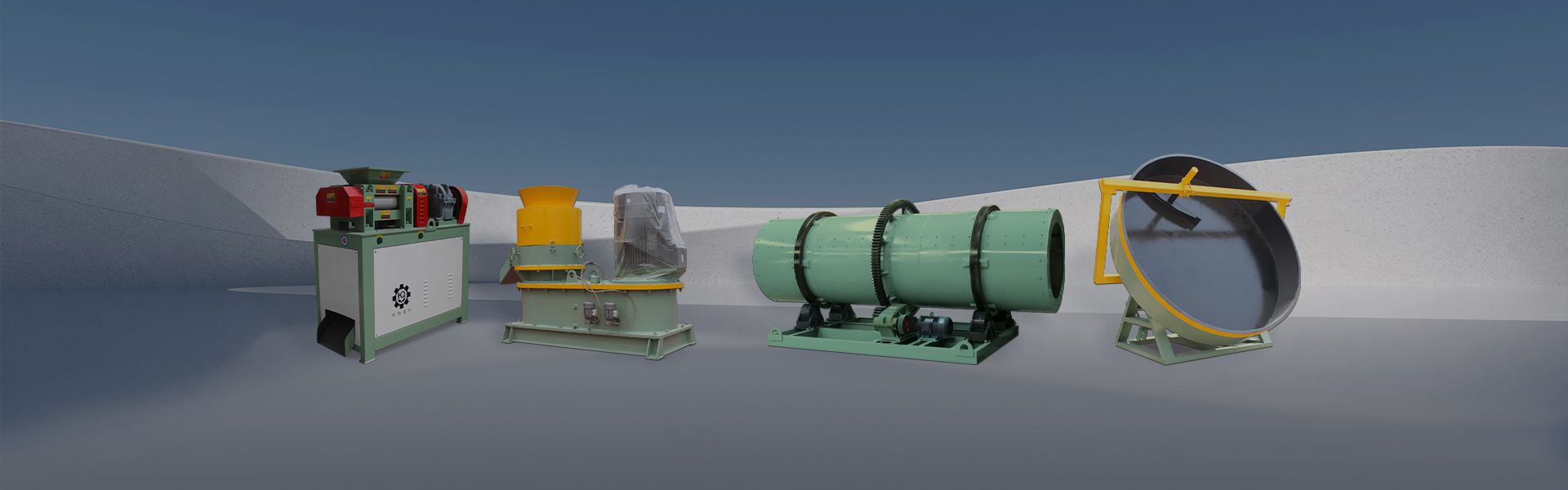
The compost turner is not merely a mechanical device — it is the metabolic engine of the entire fermentation composting turning technology system. Whether you choose a large wheel compost turning machine for high‑capacity trough operations, a trough-type compost turner for precise depth control, or a windrow composting machin for flexible outdoor windrow management, each design delivers the same core mission: forced aeration, temperature regulation, moisture removal, and homogenization. For poultry manure specifically, the chicken manure fermentation turning process benefits enormously from frequent, even turning — reducing ammonia loss and accelerating humification. After fermentation maturity is reached (indicated by temperature drop, dark brown colour, and GI ≥85%), the stabilized organic material can be transferred to a disc granulation production line or a rotary drum granulator for shaping into uniform pellets, with optional blending for compound fertilizer production. Selecting the right fertilizer composting turning machine equipment depends on your scale, material type, and site conditions — but in all cases, investing in a high‑quality turner reduces the fermentation cycle from 60+ days to just 15‑20 days, improves product consistency, and eliminates odour and phytotoxicity risks. Ultimately, the compost turner is the irreplaceable bridge between raw organic waste and safe, nutrient‑rich fertilizer — transforming a slow, unpredictable natural process into a reliable, industrial‑scale production step.