
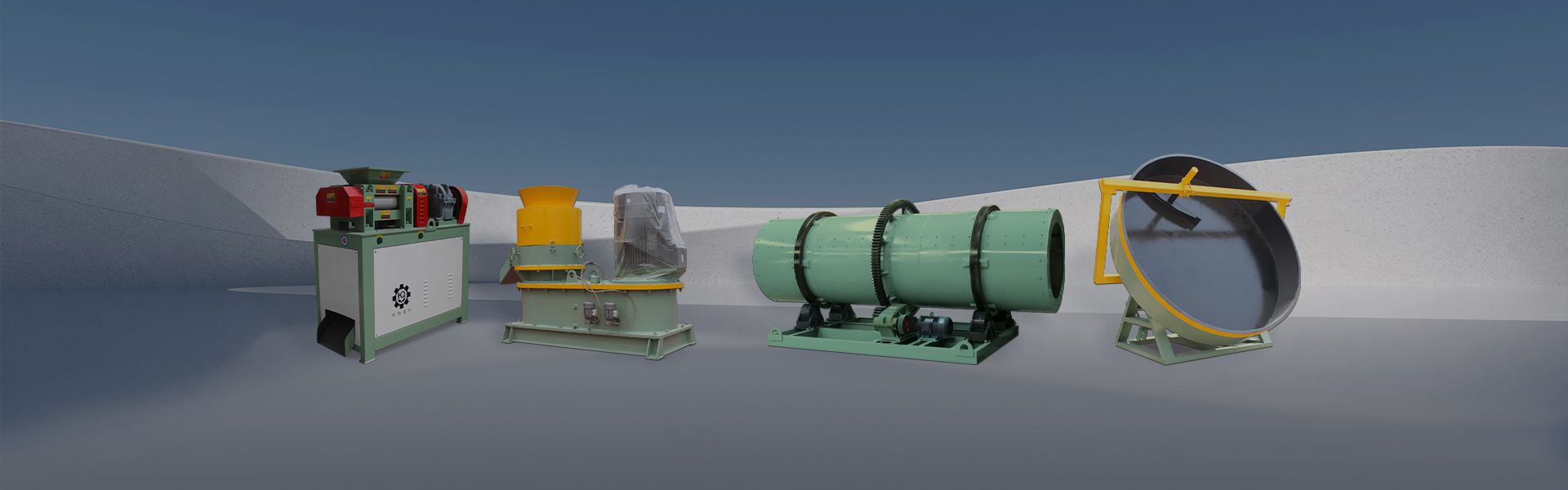
In the modern fertilizer industry, disc granulation production lines have become the core technical system for organic fertilizer, compound fertilizer, and bio-fertilizer production. This production line transforms raw powdered or slurry materials into uniform, stable, easily storable, and usable granular fertilizer through a series of precise process steps. Disc granulation technology holds an important position in the global fertilizer production field due to its high efficiency, flexibility, and energy-saving characteristics.
Production Line Workflow: Seven Steps to Perfect Transformation
Raw Material Reception and Storage
The disc granulation production line begins with the raw material receiving system. Organic materials (such as livestock manure, straw), inorganic raw materials (such as NPK base fertilizers), and additives are stored separately in dedicated silos. Equipped with automatic weighing systems to ensure precise proportions and moisture sensors to monitor raw material water content.
Crushing and Screening Pretreatment
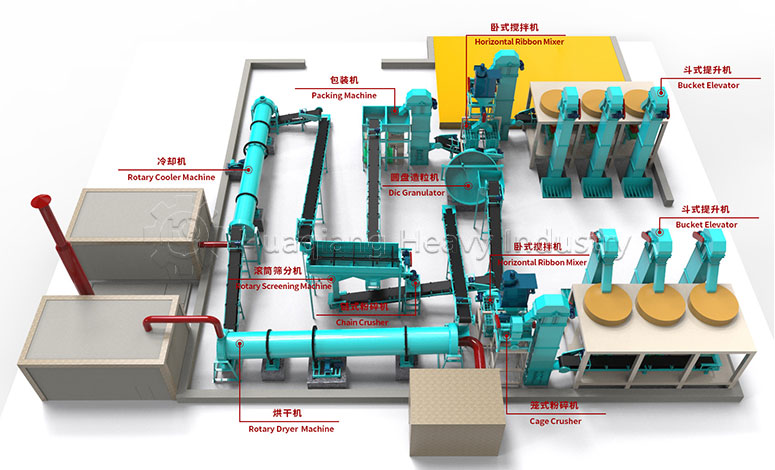
Large raw materials are crushed through chain crushers or hammer crushers, then enter trommel screens to remove impurities like stones and metals. This step ensures uniform particle size of raw materials, creating optimal conditions for subsequent mixing and granulation.
Precise Batching and Mixing
The computer control system precisely measures various raw materials according to the formula, feeding them into twin-shaft mixers or horizontal mixers via screw conveyors or belt conveyors. Mixing time, speed, and uniformity are precisely controlled by the PLC system, ensuring thorough material homogenization.
Core Disc Granulation Process
Uniformly mixed materials enter the disc granulator—the core equipment of the production line. The inclined rotating disc causes materials to continuously roll and agglomerate through centrifugal force and friction, gradually forming particles of desired size. By adjusting disc angle, rotation speed, and spray system, particle size and hardness can be precisely controlled.
Drying and Cooling Treatment
Moist particles enter the rotary dryer, removing excess moisture in hot air at 120-200°C. They then enter the counter-flow cooler, reducing particle temperature to near ambient temperature, preventing caking and extending shelf life. This step ensures stable physical properties of the particles.
Screening Grading and Coating
Cooled particles enter multi-layer vibration screener machine, separating qualified products, oversized particles (returned for crushing), and overly fine powder (returned for granulation). Qualified particles can optionally enter the coating machine to add anti-caking agents or slow-release coatings, enhancing product performance.
Weighing Packaging and Palletizing
Finished particles are weighed, bagged, and sealed through automatic packaging machines. Modern production lines are equipped with robotic palletizing systems that automatically stack packaged products on pallets, completing the entire production process.
Modern disc granulation production lines have achieved a high degree of automation, with the entire process from raw material feeding to finished product packaging managed by a central control system. Operators only need to monitor equipment operating status and process parameters in the control room, with production efficiency increased by over 300% compared to traditional production lines.
Core Advantages of Disc Granulation Production Lines
High Production Efficiency
Continuous production mode, 24-hour uninterrupted operation, annual production capacity up to 10,000-100,000 tons, 3-5 times more efficient than traditional processes.
Excellent Product Quality
High particle uniformity (≥95%), good sphericity, moderate strength, not easily broken, controllable dissolution rate, stable and long-lasting fertilizer efficiency.
Strong Adaptability
Can process various raw materials (organic/inorganic/bio-fertilizers), easy formula adjustments, particle size easily controlled by adjusting granulation parameters.
Energy-saving and Environmental Protection
30-40% lower energy consumption compared to extrusion granulation, dust emissions controlled below 10mg/m³, noise below 85dB, meeting environmental requirements.
Low Maintenance Cost
Simple and reliable equipment structure, wear-resistant design for main components, easy maintenance, low failure rate, comprehensive operating cost savings of over 25%.
Intelligent Control System
PLC + touch screen control, enabling real-time monitoring of production parameters, automatic adjustment, data recording, and remote diagnostics, easy and intuitive operation.
Application Fields and Material Adaptability
Disc granulation production lines are widely used in various fertilizer production fields:
Organic Fertilizers: Livestock manure compost, food waste fertilizer, sludge compost, agricultural waste fertilizer, etc. The production line can effectively process high-fiber, high-moisture organic materials, achieving good granulation by adding appropriate binders.
Compound Fertilizers: NPK compound fertilizers, blended fertilizers, specialized formula fertilizers, etc. Precise batching systems and mixing equipment ensure uniform nutrient distribution, meeting the nutritional needs of different crops.
Bio-fertilizers: Microbial agents, bio-organic fertilizers, functional bio-fertilizers, etc. Low-temperature drying systems protect microbial activity, coating technology enhances agent stability.
Other Fields: Feed pellets, chemical product granulation, mineral particles, soil amendments, etc. The production line can adapt to granulation needs of various materials through equipment adjustments.