
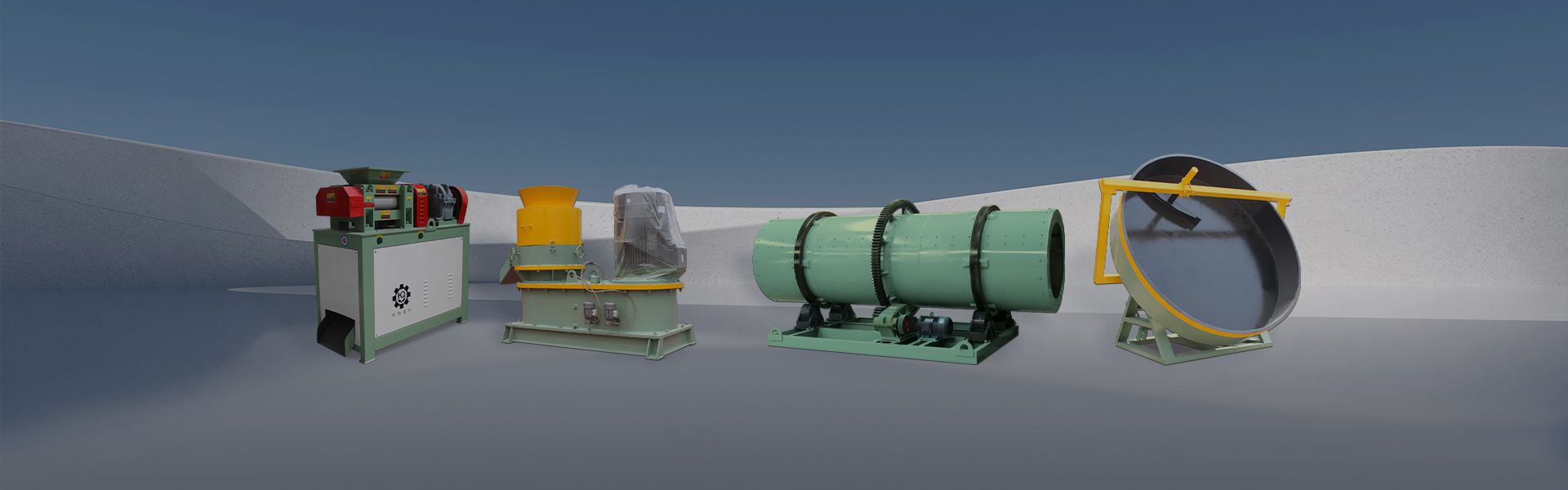
In the era of sustainable agriculture, the bio-organic fertilizer production line stands as a systematic and intelligent “life factory.” It transforms organic waste—such as livestock manure and crop stalks—through a series of precisely coordinated processes into high-quality fertilizer rich in active beneficial microbes and natural nutrients. This is more than just a production line; it is a complete ecosystem that realizes agricultural circular economy and creates green value.
The Scientific Rigor of the “Three-Stage” Core Process
The excellence of a complete bio-organic fertilizer production line lies in its interlocking, scientifically rigorous design, which primarily consists of three core stages:
Pre-treatment & Efficient Fermentation Stage
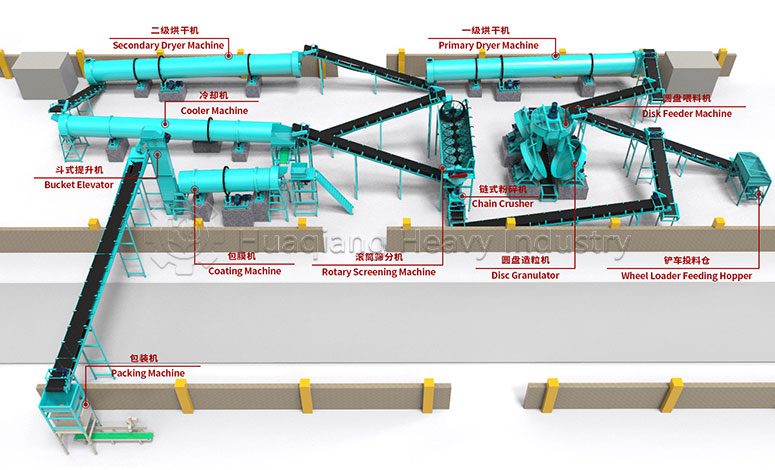
This is the starting point of the life cycle. Raw materials are first processed by a crusher and rotary screener machine to ensure uniformity and fineness. The well-mixed material then enters the core fermentation area. Here, the previously discussed Large Wheel Compost Turner comes into its own. Through efficient turning, it injects sufficient oxygen, distributes heat evenly, and manages moisture, creating an ideal environment for beneficial microorganisms to thrive. This achieves rapid and thorough sanitization and maturation—the key biological process that transforms waste into “organic matter.”
Deep Processing & “Life-Infusing” Stage
The matured compost proceeds to the refinement phase. A new vertical grinder pulverizes it finely, followed by a drum granulator or rounding machine that shapes it into uniform, sturdy granules suitable for storage and application. The most crucial and defining step in this stage is the addition of microbial inoculants. In a dedicated mixer, selected beneficial microbes—such as nitrogen-fixing bacteria, phosphate- and potassium-solubilizing bacteria—are precisely and evenly coated onto or adhered to the granules. This upgrades “organic fertilizer” into “bio-organic fertilizer” with specific soil amendment functions. Subsequently, the Drum Dryer and Cooler take charge of adjusting the final moisture and temperature of the granules to protect microbial viability.
Precision Finishing & Intelligent Packaging Stage
The dried and cooled granules are graded by a rotary screening machine. Qualified products move to the final steps. To prevent moisture absorption and further protect the microbial strains, a coating machine is often used to apply a protective film to the granule surface. Finally, fully automatic quantitative packaging scales complete weighing and bagging, resulting in market-ready products.
Systemic Advantages That Transcend Individual Machines
The core strength of the production line lies in the “1+1>2” benefit of system integration:
Full-process Automated Control: A central control system acts as the “brain,” directing all equipment to work in harmony, significantly reducing labor while enhancing stability and safety.
Resource Recycling & Near-Zero Waste: It genuinely achieves the resource recovery of agricultural waste. Exhaust gases from fermentation can be treated to meet emission standards or recovered, embodying the circular economy philosophy.
High-Value-Added Product: The resulting bio-organic fertilizer not only supplies nutrients but also improves soil health, suppresses pathogens, and enhances crop quality. Its market and agronomic value far exceed that of ordinary organic fertilizer.
Flexibility & Scalability: The modular design of the line allows for flexible configuration and future expansion based on raw material characteristics, capacity requirements, and product positioning.
Conclusion: Investing in the Future of Our Land
The bio-organic fertilizer production line is a model that integrates environmental responsibility, agricultural needs, and business acumen. It does not merely output products; it delivers a holistic soil health solution and promotes a sustainable agricultural practice. For enterprises committed to green agriculture, establishing such a production line means mastering the key to transforming “pollutants” into “treasures” and “costs” into “profits.” It is a genuine investment in the future vitality of our Earth Mother.