
In today’s booming bio-organic fertilizer industry, not all producers need to invest millions in large-scale fermentation equipment. For family farms, small-scale livestock farms’ supporting organic fertilizer workshops, or newly established startups, achieving efficient and stable fermentation within a limited budget is crucial to the project’s success. The chain compost turning machine was designed to address this pain point. With its “small and efficient” positioning, it has become the most widely used core equipment in small and medium-sized bio-organic fertilizer production.
Simple Structure, Extremely Low Investment Threshold
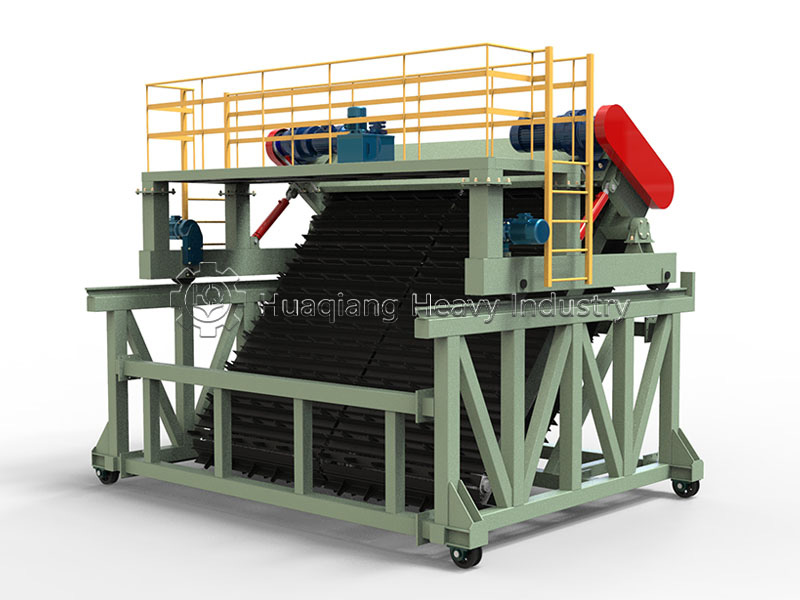
The design concept of the chain compost turning machine revolves around “practicality.” Its core working component is a chain-driven composting blade assembly mounted on a compact and flexible self-propelled chassis. During operation, the rotating blade assembly inserts into the material pile like a plow, turning the bottom layer of material to the surface, achieving forced ventilation and mixing. Compared to large wheeled compost turners that cost hundreds of thousands of yuan, the investment cost of a chain-plate compost turner is only one-fifth to one-third, making it easily equippable for small to medium-sized production lines with an annual output of 10,000 to 30,000 tons. More importantly, it is virtually undemanding in terms of operating site: no heavy concrete track foundation is required; it can operate directly on flat soil or ordinary cement ground, saving investors considerable infrastructure costs.
Flexible and efficient, adaptable to complex working conditions
Despite its compact size, the chain compost turner’s performance is by no means inferior. Its turning width can reach 1.5 to 3 meters, and its turning depth is nearly 1 meter. A single unit can process 20 to 30 cubic meters of fermented material per hour. Whether it’s sticky wet chicken manure or long-fiber straw and mushroom residue, it can handle it all with ease, effectively breaking up the material’s compaction layer and evenly distributing oxygen throughout the compost pile. In terms of process adaptability, it can be applied to both open windrow fermentation and, with simple modifications, to trough fermentation, shortening the traditional 60-day natural fermentation cycle to 25-35 days, ensuring efficient production turnover for small and medium-sized enterprises within limited space.
Convenient Operation and Maintenance, Controllable Overall Costs
For small and medium-sized production entities with limited technical capabilities, equipment maintenance is often a headache. The chain plate turner fully considers this need, minimizing the barriers to operation and maintenance. The equipment is easy to operate; a regular worker can operate it independently after a short training period. Its vulnerable parts are mainly concentrated in the chain and cutter head, both made of conventional wear-resistant steel, resulting in low procurement costs. Replacement does not require specialized technicians; on-site workers can complete the task using ordinary tools. Furthermore, some models can be equipped with a spray device to achieve simultaneous turning and inoculant addition, making it multi-functional and further enhancing process flexibility.
In actual production, the chain plate turner is often used in conjunction with simple equipment such as loaders to form a low-investment, high-return production combination. It is not only a beneficial supplement to large-scale production lines, but also a key tool for promoting the resource utilization of organic fertilizer at the grassroots level. It can be said that the chain compost turning machine, with its extremely low ownership cost and extremely high operational reliability, enables more small and medium-sized producers to overcome technical barriers and participate in the green cycle of turning waste into treasure, contributing real value to regional soil improvement and sustainable agricultural development.
The chain compost turning machine occupies a vital niche within the diverse landscape of fermentation composting turning technology. Its design prioritizes affordability and flexibility, making it an ideal entry-level machine for small to medium-scale producers. This specific chain compost turning machine is perfectly suited for simpler operations, such as windrow composting on flat ground, where it functions as a robust and economical windrow composting machine. While it can be adapted for use in channels, it is distinct from dedicated systems for trough-type aerobic fermentation composting technology. That technology typically employs a purpose-built trough-type compost turner that runs on fixed rails within concrete troughs, offering a more enclosed and continuous process. At the other end of the scale, large-scale industrial operations rely on the immense power and span of a large wheel compost turner to handle thousands of tons of material. The chain plate turner, therefore, fills the gap between manual methods and these capital-intensive systems. It democratizes access to efficient fermentation composting turning technology, empowering smaller farms and startups to adopt a mechanized, controlled approach to composting, transforming their organic waste into valuable fertilizer with a manageable investment.