
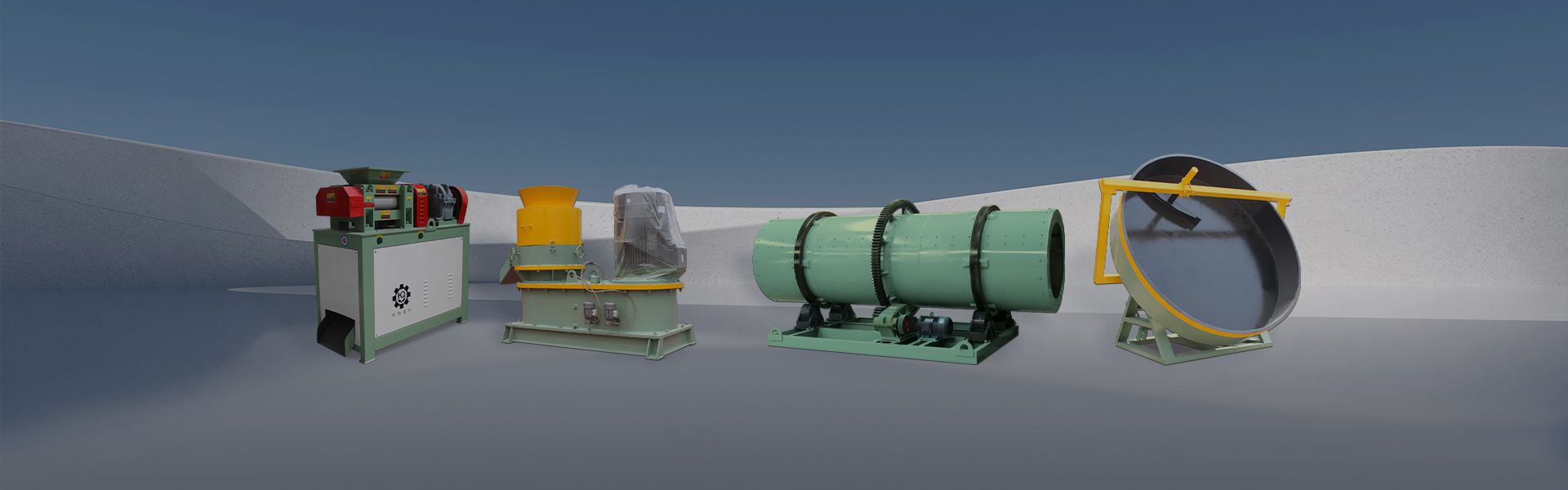
Although crushing and mixing equipment is located at the front end of the fertilizer production process, its operating performance directly determines the pelleting rate and particle uniformity in the subsequent granulation stage, making it the first line of defense for stable operation of the entire production line.
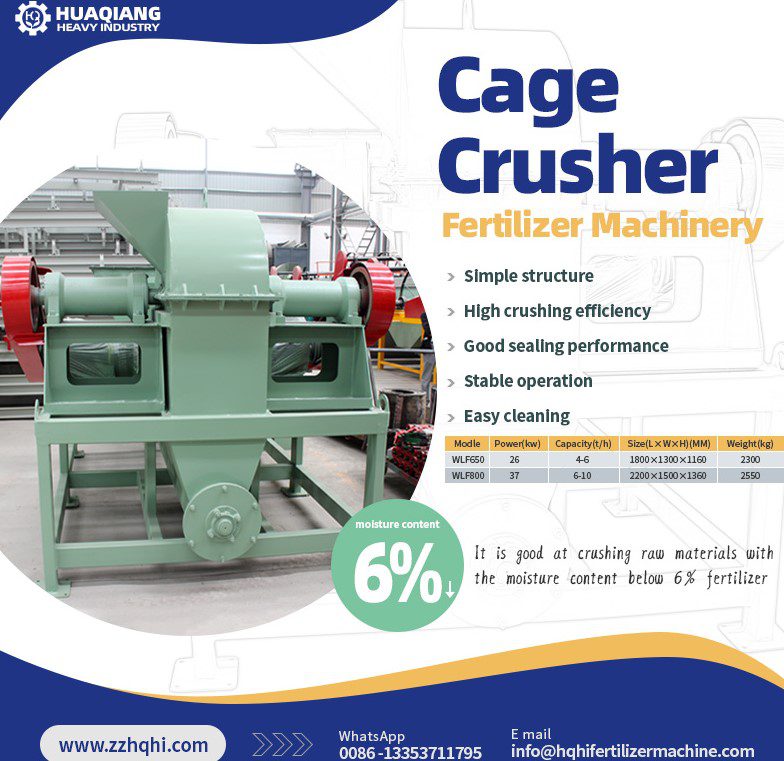
Before the material enters the granulator, it must be crushed to reduce its particle size to between 80 and 120 mesh, while mixing is used to achieve uniform distribution of each component in a micro-space. Crushing equipment has a clear division of labor for raw materials with different moisture contents and physical properties. The cage crusher is specifically designed for dry or low-moisture (below 6%) brittle materials. Its structure consists of two sets of steel bars forming a cage that rotates at high speed towards each other. Under centrifugal force, the material is thrown towards the cage bars and rapidly crushed through impact and shearing. The output fineness can be adjusted to over 100 mesh, and there is no internal screen, avoiding the risk of blockage by wet materials. The semi-wet material crusher fills the technological gap in crushing high-moisture raw materials. This equipment employs a dual-rotor structure, with blade and hammer assemblies hinged to the rotors. Under high-speed rotation, it shears, tears, and grinds organic materials with a moisture content as high as 25%. The crushed material is loose and flocculent, which is highly beneficial for subsequent mixing.
The mixing process typically uses a horizontal mixer or a twin-shaft mixer. The horizontal mixer uses a bottom auger or plow-type rotor to achieve axial and radial convection of the material, controlling the coefficient of variation of mixing uniformity to within 5%, making it suitable for material systems with small differences in specific gravity. The twin-shaft mixer utilizes two parallel, counter-rotating impeller shafts, applying strong shearing action while the material is being lifted. For formulations containing trace elements or biological agents and requiring extremely high mixing precision, the twin-shaft mixer can achieve an excellent CV value of less than 3% within 60 to 120 seconds.
The selection of crushing and mixing equipment must consider the matching of processing capacity with the subsequent granulator capacity. Typically, the design capacity of the pretreatment section should have a 10% to 15% margin to cope with fluctuations in raw material batches. Regarding maintenance, the crusher’s hammers and liners are wear parts and a regular replacement plan should be developed based on the abrasiveness of the raw materials. For the mixer, attention should be paid to the integrity of the shaft end seals to prevent powder leakage into the bearings. It is worth mentioning that a compact layout of the crushing and mixing processes, using pneumatic conveying or a closed screw feeder, can effectively reduce workshop dust and lower the intensity of manual handling. From production practice, many cases of granulation failure and unqualified nutrient content in the finished product ultimately trace back to insufficient crushing fineness or uneven mixing in the pretreatment section. Therefore, the importance attached to the crushing and mixing equipment should be no less than that attached to the granulator itself.