
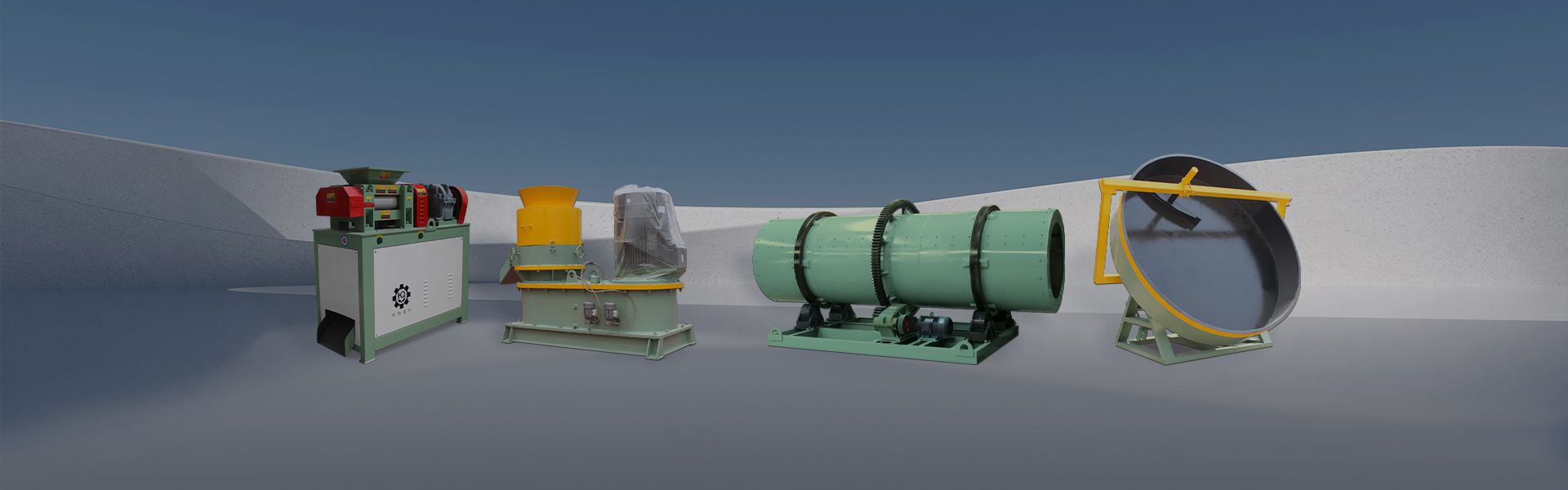
Fermentation is the soul of organic fertilizer production, directly determining the product’s maturity, harmlessness, and final quality. As the core equipment in the fermentation process, the selection of the turning machine directly affects fermentation efficiency and operating costs. This article details the three core elements of organic fertilizer fermentation and compares the applicable scenarios for three mainstream types of turning machines.
Three Core Elements of Aerobic Fermentation
The creation of high-quality organic fertilizer relies on precise control of three key elements. First is aerobic conditions—aerobic microorganisms are the main force in decomposing organic matter, and the oxygen concentration in the compost pile needs to be maintained between 8% and 15%. Turning operations can forcibly replenish fresh air and simultaneously exchange the outer layer material with the inner high-temperature material, promoting uniform fermentation. Second is temperature control—the compost pile temperature needs to go through three stages: a warming period (from room temperature to 50℃), a high-temperature period (maintaining 55-70℃ for 7-10 days), and a cooling period. The high-temperature period is crucial for killing pathogens, insect eggs, and weed seeds. Too low a temperature will prevent complete neutralization, while too high a temperature may trigger spontaneous combustion or inhibit microbial activity. Thirdly, moisture content management is essential—during the fermentation start-up phase, the moisture content should be controlled between 50% and 60%. Excessive humidity leads to oxygen deficiency, while insufficient humidity inhibits microbial activity. Turning and adding auxiliary materials can effectively adjust the moisture content to a suitable range.
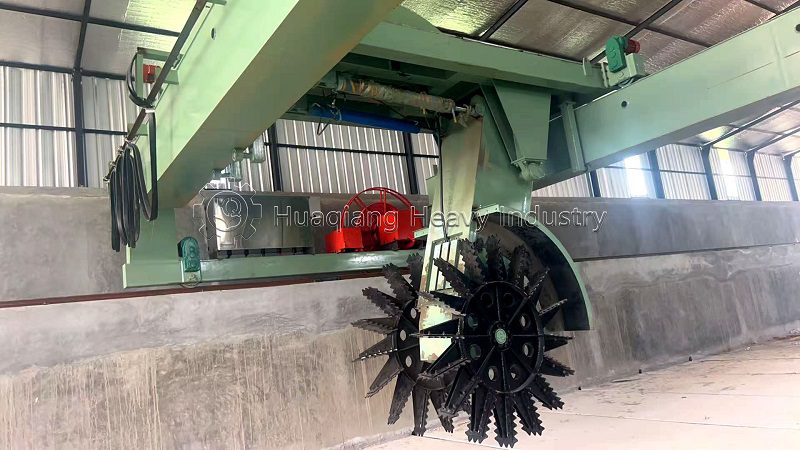
Large wheel compost turning machine: Flexible and mobile, suitable for small-scale windrow composting. The Large wheel compost turning machine is an entry-level choice for small to medium-sized organic fertilizer production lines, primarily suitable for open-air windrow composting. The equipment uses a wheeled walking mechanism, allowing it to work across stacks, with a typical turning depth of 0.8-1.2 meters. Its biggest advantage lies in its flexibility—no fermentation tanks and tracks are required, making it highly adaptable to different sites, and the investment cost is only about one-third that of a trough-type compost turner. Operation is done by tractor towing or self-propelled operation, requiring only one person and one machine to complete the turning task. Large wheel compost turning machines are suitable for production scales of 3,000-10,000 tons per year, especially for use in conjunction with livestock farms for on-site treatment of livestock and poultry manure. The disadvantages are limited turning depth and significant weather-related limitations, with operations restricted during the rainy season.
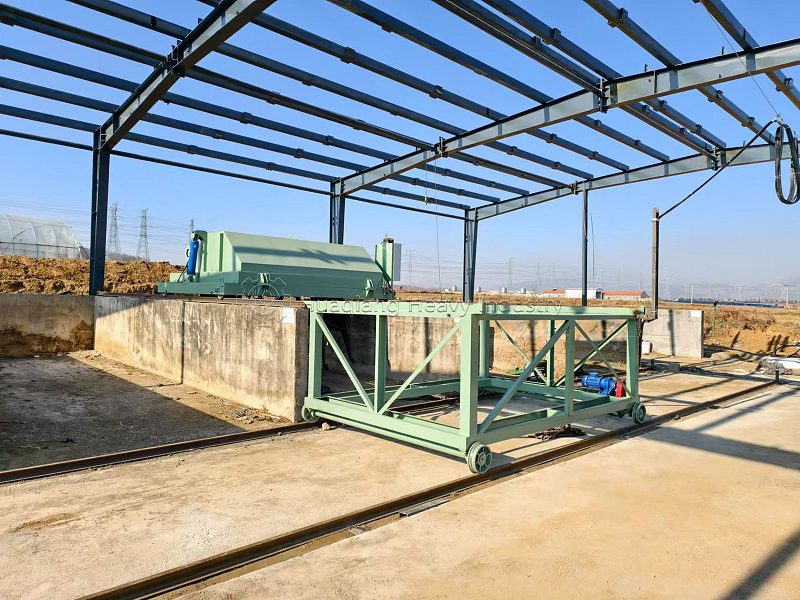
Hydraulic compost turners: Deep and efficient, suitable for medium-scale production. Hydraulic compost turners are an upgraded version of Large wheel compost turning machines, using hydraulically driven turning rollers. Turning depth can reach 1.5-2 meters, with a single turn width of 2-3 meters. The advantages of the hydraulic system are high torque and stable operation, easily handling high-moisture, high-viscosity fermentation materials. This type of turner is typically used in conjunction with fermentation tanks. The equipment travels along the track at the top of the tank, and the rotating turning rollers throw, break up, and convey the material backward, achieving continuous operation of turning and moving the pile simultaneously. Hydraulic compost turners have a high degree of automation, allowing for setting the turning frequency and time, and are suitable for medium-sized production lines with an annual output of 10,000-50,000 tons. Compared to wheeled models, its fermentation efficiency is increased by over 30%, the composting cycle is shortened to 15-20 days, and the working environment is cleaner.
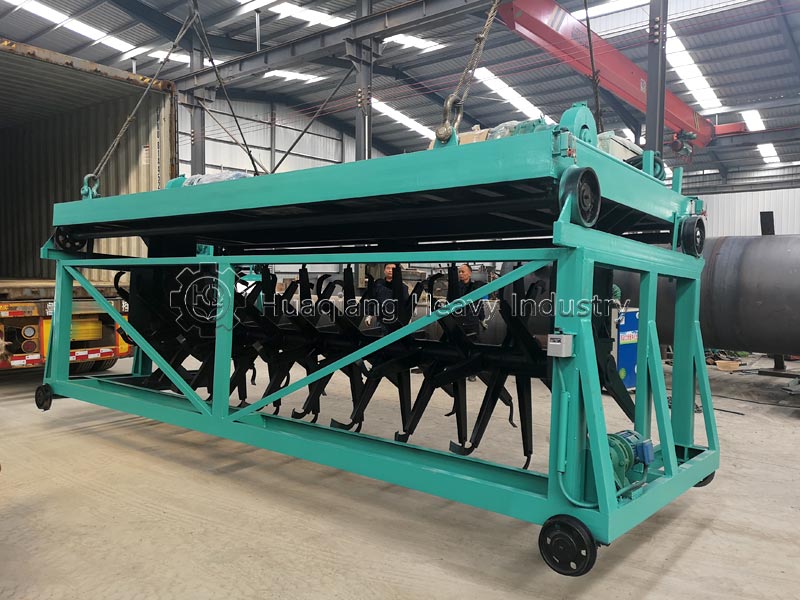
Trough-type chain plate compost turner: The preferred choice for large-scale continuous production.
Trough-type chain plate compost turners are heavy-duty equipment designed for large-scale continuous fermentation operations. Unlike hydraulic compost turners, chain plate turners use chain drive to move multiple rows of turning plates longitudinally along the fermentation trough, achieving deep turning (up to 2 meters or more) and forced aeration. It has extremely high turning uniformity and excellent material crushing effect, making it particularly suitable for processing high-fiber raw materials such as straw and branches. Chain plate compost turners are usually linked to an intelligent temperature control system—the pile has built-in temperature sensors, and when the temperature exceeds the standard, the system automatically starts the turner and aeration fans to achieve precise fermentation. This equipment has a higher investment, but a large single-machine processing capacity (50-100 cubic meters per hour), suitable for large production lines with an annual output of over 50,000 tons, and is also standard equipment in regional waste centralized treatment centers.
Four Key Decision-Making Points for Selecting a Compost Turner
Choosing the right compost turner requires considering four dimensions:
First, production scale—wheeled type for annual production under 10,000 tons, hydraulic type for 10,000-50,000 tons, and chain plate type for over 50,000 tons.
Second, site conditions—wheeled type is suitable for open-air windrows, while hydraulic or chain plate type is suitable for existing fermentation tanks.
Third, automation requirements—for “unattended” intelligent fermentation, a windrow chain plate compost turner with a temperature control system is the best choice.
Fourth, investment budget—wheeled compost turners have the lowest initial investment, while chain plate type has the highest, but chain plate type has a higher cost per unit capacity.
Operating Points: Achieving Rapid Composting in 7-10 Days
Regardless of the type of compost turner chosen, operational details determine the success or failure of fermentation. When building the compost pile, ensure the material is loose and well-aerated, and the pile height should not exceed the compost turner’s operating capacity. Perform the first turning on the 2nd-3rd day after fermentation begins. Thereafter, turn the pile according to temperature changes: every 2-3 days during the high-temperature period, and every 5-7 days during the cooling period. The entire fermentation cycle involves turning the compost pile 3-5 times, achieving initial decomposition in 7-10 days and complete decomposition in 20-25 days. Properly decomposed material should possess the following characteristics: the pile temperature drops below 40℃ and does not rise again; the color is dark brown or blackish-brown; there is no ammonia or manure odor; and it is loose and not sticky when squeezed. Using fully decomposed organic fertilizer ensures that it does not burn roots or seedlings and provides stable fertilization effects.
The three core elements of aerobic fermentation—oxygen supply, temperature control, and moisture management—are all managed through the application of fermentation composting turning technology. The choice of equipment determines how effectively these elements are controlled. A large wheel compost turner or a windrow composting machine provides a flexible, low-cost entry point for smaller-scale, open-air windrow operations. For medium-scale production requiring deeper turning and more consistent mixing, a hydraulic turner offers an upgrade in efficiency. For large-scale, continuous, and highly controlled operations, trough-type aerobic fermentation composting technology is the industry standard. This system, utilizing a trough-type compost turner or a robust chain compost turner, is designed for maximum process control, often integrated with intelligent temperature sensors and aeration systems to achieve precise, data-driven fermentation. The selection is not a matter of which machine is best in isolation, but which implementation of fermentation composting turning technology is the optimal match for the specific production scale, site constraints, and desired level of automation. Understanding the distinct roles of the large wheel compost turner for open-air flexibility and the trough-type compost turner for enclosed, high-efficiency production is the key to building a fermentation system that delivers consistent, high-quality compost.