
In organic fertilizer production, the selection of composting equipment directly determines fermentation efficiency and product quality. Even composting results in rapid material decomposition and no foul odor; improper composting can easily lead to anaerobic zones and prolonged fermentation cycles. Faced with two mainstream types of equipment—large-wheel compost turners and chain plate compost turners—how can you make the optimal choice based on your scale and site? This article will analyze this from three dimensions: core principles, parameter comparison, and suitable scenarios.
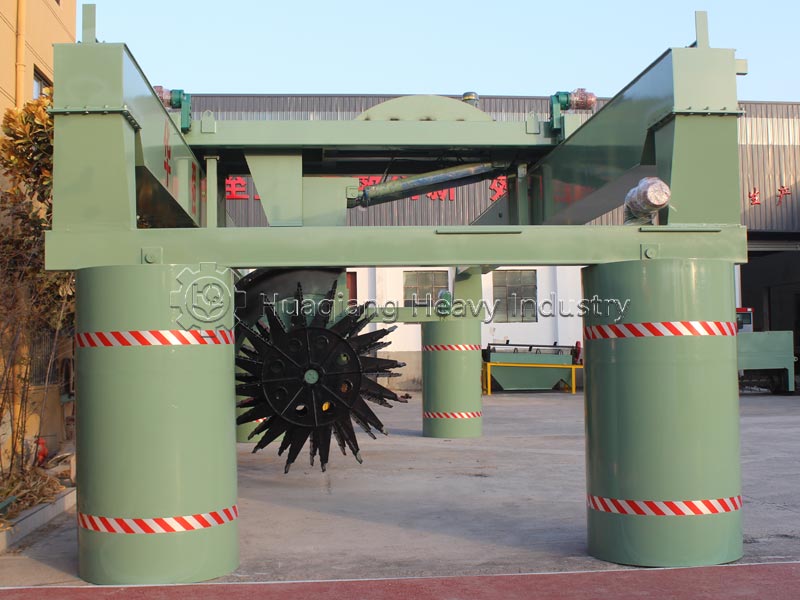
The large-wheel compost turner adopts a wheel-type compaction and composting structure. The equipment straddles the fermentation windrows and moves along the pile using large-diameter wheels. Rotating blades turn the material from the bottom to the surface, achieving forced ventilation and oxygen supply. Its core design lies in “wide-range and high-efficiency”—a single machine can achieve a composting width of 4-12 meters and a depth of 1.5-2 meters, with a daily processing capacity of up to thousands of tons.
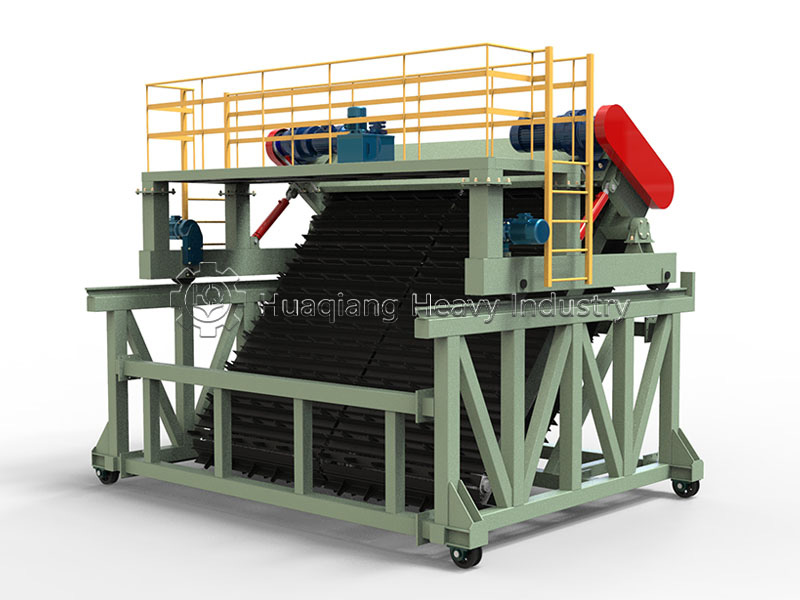
Chain-plate compost turners employ a chain-driven scraper structure, using the rotation of chain-type composting blades to turn and mix materials. The turning width is 1.5-3 meters, the depth is 0.8-1.2 meters, and a single unit can process 10-30 cubic meters per hour. Their design emphasizes “flexibility and precision”—the equipment is compact and lightweight, allowing direct operation on muddy or concrete surfaces without the need for a track foundation.
The most significant difference lies in production capacity: large-wheel compost turners can process 500-1500 tons per day, suitable for large-scale production exceeding 10,000 tons; chain-plate compost turners have a daily processing capacity of approximately 80-240 tons, suitable for small to medium-sized production lines with an annual output of 10,000-30,000 tons.
Regarding site requirements, large-wheel compost turners require open, flat ground, but do not require hardening; chain-plate compost turners have virtually no site requirements, operating on ordinary muddy ground and occupying only 100-200 square meters.
Energy consumption and operation and maintenance costs: Large-wheel compost turners employ a high-efficiency transmission mechanism, reducing energy consumption by 70% compared to traditional equipment for the same processing capacity, but the equipment investment is higher. Chain-plate compost turners require only 1/5 to 1/3 of the investment of large-wheel turners, and the replacement of easily worn parts (chains, cutters) is simple, resulting in low operation and maintenance costs.
Large-scale organic fertilizer plants (annual production of over 50,000 tons), large-scale livestock farm supporting processing centers, and municipal sludge treatment projects should prioritize large-wheel compost turners. Their wide-area operation capacity can meet the needs of large-scale continuous production, and combined with windrow fermentation technology, the fermentation cycle can be shortened to 15-20 days. A large farm in Brazil uses our large-wheel compost turners to process cow manure, with a daily processing capacity of 1,000 tons and a monthly production of 20,000 tons of high-quality organic fertilizer.

For small and medium-sized organic fertilizer enterprises, family farms, and livestock farm supporting production lines (annual production of 10,000-30,000 tons), chain-plate compost turners are more suitable. They have low investment, simple operation, no special site requirements, and can quickly achieve mechanized fermentation transformation. A palm oil processing company in Southeast Asia uses a chain-plate turner to process empty palm fruit bunches of fiber, combined with windrow fermentation, completing the composting process in 20 days, with an investment payback period of less than one year.
Our company offers a series of turner equipment to meet different production capacity needs. Large-wheel turners have a production capacity of 200-800 tons per hour, with turning widths of 4-12 meters, and come standard with an intelligent control system supporting automatic cruise and remote monitoring. Chain-plate turners have a production capacity of 20-30 tons per hour, a turning width of 2-3 meters, and can be equipped with a spray system for simultaneous addition of microbial agents.
The comparison between large wheel and chain plate turners highlights the diverse landscape of fermentation composting technology. Both are essential tools within the broader field of fermentation composting turning technology, but their optimal application differs greatly. A large wheel compost turner (or large wheel compost turning machine) is the powerhouse of large-scale operations, designed for immense throughput and wide windrows. It is a highly efficient windrow composting machine for industrial-scale production. In contrast, a chain compost turner offers a more flexible and affordable entry point, often configured as a self propelled compost production machine that can maneuver easily in smaller, less uniform sites. The choice between these two is not about which technology is “better,” but about which is the most appropriate implementation of fermentation composting technology for a given context. A large-scale centralized facility will naturally gravitate towards the power of a large wheel compost turning machine. A smaller farm or startup will find the agility and lower investment of a self propelled compost production machine or a simple chain compost turner to be a perfect match for its scale and budget. Understanding this spectrum of fermentation composting turning technology ensures that producers can select the tool that aligns perfectly with their operational reality.