
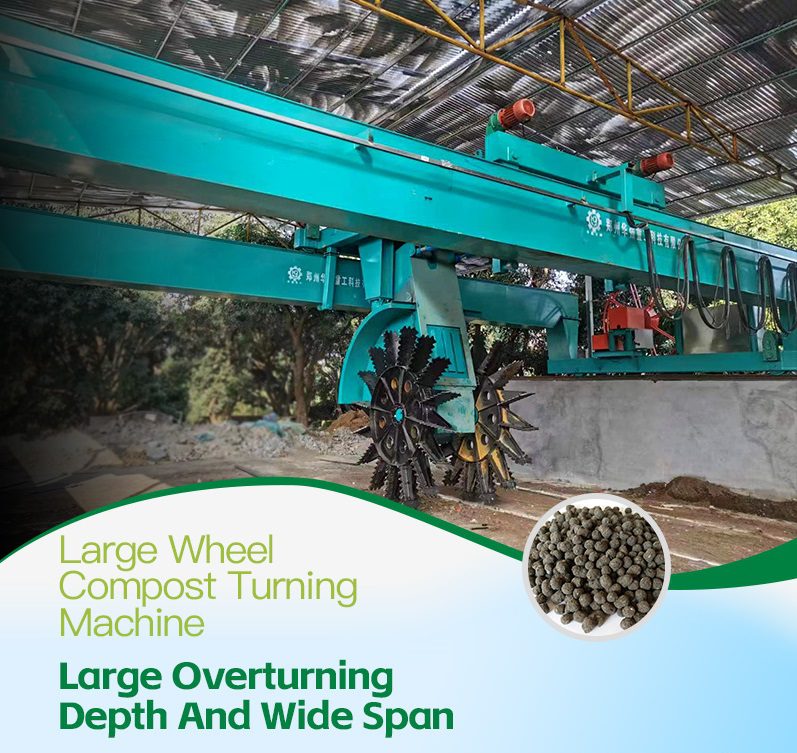
When organic fertilizer production reaches a scale of 10,000 tons, the challenges of the fermentation process change dramatically. To improve site utilization, the piles must be taller, wider, and longer. Ordinary compost turners often fall short in the face of these massive machines: insufficient wheel track, inadequate turning depth, and insufficient power lead to uneven fermentation and low efficiency. Huaqiang Heavy Industry’s large-wheel compost turner is designed for this situation. With its unique design of wide wheel track, high chassis, and large-diameter turning wheels, it has become the preferred tool for large organic fertilizer plants and environmental treatment centers handling 10,000-ton piles. This article will explain the operational advantages and key points of this equipment.
Core Advantages: Tailor-made for Large Pile Buildings
Wide Wheel Track Design for Easily Traversing Large Pile Buildings
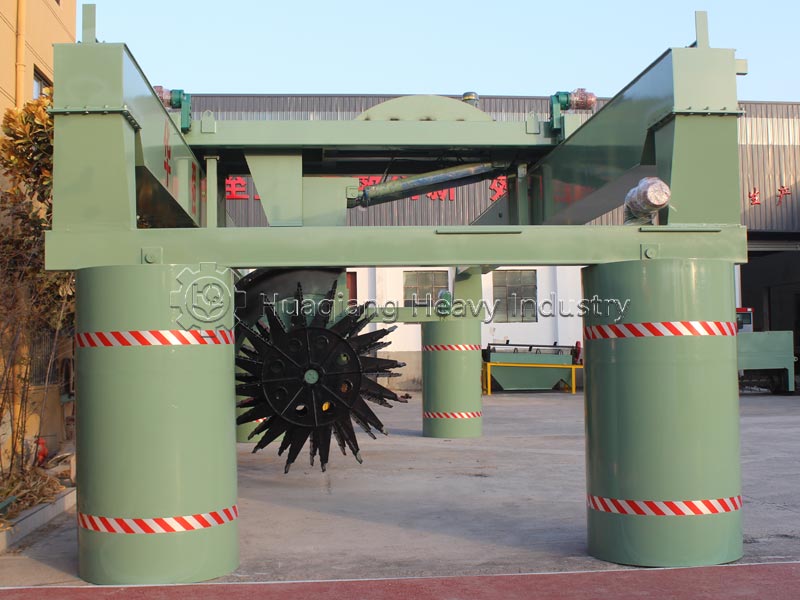
The large-wheel compost turner has a wheel track of 3-5 meters, allowing the machine to span the entire pile, with the side tires moving along the channels between the piles. This “straddle-type” design allows the equipment to easily handle ultra-large material piles 5-8 meters wide, eliminating the need for frequent turning or segmented operations like smaller equipment. The high chassis structure ensures smooth passage over uneven material pile surfaces without dragging.
Large-diameter turning wheel, turning depth up to 2 meters
The diameter of the turning wheel is key to determining the turning depth. The large-wheel turning machine is equipped with a large turning wheel with a diameter of 1.5-2 meters, reaching a depth of 1.5-2 meters into the bottom of the material pile, thoroughly turning over deep-layer materials. This depth far exceeds the 1-1.2 meters of ordinary turning machines, meaning taller material piles can be built, increasing throughput by more than 30% within the same footprint.
High-power drive, output exceeding 50 tons per hour
Equipped with a high-power hydraulic drive system, the turning wheel torque is 40% higher than that of a motor of the same power, maintaining stable operation even when dealing with large material piles with high moisture content and severe compaction. A single machine can produce over 50 tons per hour, easily exceeding 200 tons per day, fully meeting the continuous production needs of a 10,000-ton-level organic fertilizer plant.
Large Pile Planning Techniques: Maximizing Efficiency
Pile Width: 5-8 meters
Based on the span design of the large-wheel compost turner, the pile width should be controlled between 5-8 meters. Too narrow a pile wastes equipment width, while too wide a pile may not be able to turn the materials on both sides. It is recommended to set the pile width to the wheel gauge minus 1 meter, ensuring sufficient safety margin on both sides.
Pile Height: 2-2.5 meters
Utilizing the 2-meter turning depth, the pile height can be planned to be 2-2.5 meters. At this height, the turning wheel can reach the bottom, ensuring uniform fermentation of the entire pile. A height exceeding 2.5 meters may result in incomplete turning of the bottom material; a height below 1.8 meters wastes equipment capacity.
Aisle Width: 2 meters
The aisle between piles must meet the equipment’s movement requirements; a 2-meter width is recommended. Too narrow a path can easily scrape against the material pile, while too wide a path wastes space. The passageway surface should be flat and compacted, and attention should be paid to drainage during the rainy season to prevent tires from sinking.
Length Design: Plan as Needed
The length of the material pile can be “designed as needed,” ranging from 50 meters to 200 meters. Longer material piles reduce the number of times the equipment needs to turn around, improving continuous operation efficiency. It is recommended to leave 5-8 meters of turning space at both ends of the material pile.
III. Techniques to Improve Operational Efficiency: Upgrading from “Turning” to “Control”
Reciprocating Continuous Operation
The large wheel compost turner adopts a “one-trip” operation method: starting from one end of the material pile, it travels at a constant speed to the other end, completing one complete turn. It is recommended to use reciprocating continuous operation—after reaching one end, do not shut down the engine, but directly enter the adjacent passage to start turning the next pile, reducing idle time. A skilled operator can complete a single turn of a 100-meter-long material pile within 30 minutes.
Intensive Mixing Between Upper and Lower Layers
Pay attention to the discharge status during turning. Ideally, the material after turning should be fluffy and uniform, without obvious stratification. If the surface layer remains unchanged, it indicates insufficient turning depth; the walking speed should be reduced or the turning wheel’s penetration depth increased. Huaqiang equipment is equipped with a hydraulic lifting system, which can be adjusted in real time during operation.
Intelligent Temperature Measurement, Precise Turning
The core basis for turning is the pile temperature. It is recommended to set 3-5 temperature measurement points every 50 meters of material pile, monitoring the center temperature daily. Huaqiang equipment can be equipped with an intelligent temperature measurement system, displaying the temperature at each point in real time in the cab. When a certain area exceeds 65℃, an automatic alarm is triggered to remind turning. This function upgrades turning operations from a “timed” to an “on-demand” system, avoiding both high-temperature sterilization and ineffective turning.
Humidity Control, Synchronous Adjustment
During turning, the material moisture content can be observed: ideally, it should clump together when squeezed but crumble easily when lightly pinched. If too dry, water can be sprayed simultaneously with turning; if too wet, the turning frequency should be increased to accelerate moisture evaporation. Huaqiang’s wheeled compost turner can be equipped with a truck-mounted spray system, enabling turnover and water replenishment to be completed in one operation.
Real-world Case Study: 200 Tons/Day Processing, 20-Day Composting
A certain environmental treatment center undertakes the manure treatment tasks for 30 surrounding farms, with a daily input of 200 tons. Previously, multiple small compost turners were used for area-specific operations, resulting in high equipment investment and a fermentation cycle of up to 35 days, making site turnover difficult.
After introducing three large-wheel compost turners from Huaqiang Heavy Industry, the center redesigned its fermentation site:
Six parallel material piles were constructed, each 6 meters wide, 2.2 meters high, and 120 meters long.
The three machines worked collaboratively, each responsible for the daily turning of two material piles.
An intelligent temperature monitoring system was installed for precise operation.
The results were immediate:
Daily processing capacity stabilized at over 200 tons, completely resolving raw material backlog.
The fermentation cycle was shortened to 20 days, 15 days faster than before.
Site utilization increased by 50%, doubling the processing capacity for the same area.
Completeness uniformity reached 98%, significantly improving product quality.
Customized Services: Adapting Equipment to Your Material Pile
Every factory with a capacity of tens of thousands of tons has different raw material characteristics and site conditions. Huaqiang Heavy Industry’s large-wheel compost turners offer a full range of customized services:
Wheel gauge customization: 3m, 4m, 5m, and other specifications to match different material pile widths.
Turning depth: Standard 1.5m, can be increased to 2m or 2.5m.
Power configuration: 150-300hp engines available depending on daily processing capacity.
Intelligent upgrades: Optional intelligent modules such as automatic navigation, remote monitoring, and data recording.
Supporting equipment: Can be linked with automatic feeding systems and trough discharge machines to achieve full-process automation.
From the wide wheel gauge’s crossing capability to the depth advantage of the large-diameter compost turners, and the precise control of intelligent temperature measurement—every design detail of Huaqiang’s large-wheel compost turners responds to the special needs of 10,000-ton-level fermentation. When your production line operates efficiently with a daily processing capacity of 200 tons, when fermentation cycles are constantly shortened and site turnover is increasingly faster, you will understand: for large material piles, choosing the right equipment is choosing the right passport to large-scale production.
The large wheel compost turner represents a pinnacle of fermentation composting turning technology, specifically engineered for the demands of 10,000-ton-scale operations. This specialized large wheel compost turning machine excels at processing the massive, high-volume windrows characteristic of industrial-scale composting. Its design contrasts with other equipment within the ecosystem of equipments required for biofertilizer production. For example, a windrow composting machine (often referring to smaller, tractor-towed units) is better suited for flexible, smaller-scale open-air operations. More intensive, controlled systems rely on trough-type aerobic fermentation composting technology, employing a trough-type compost turner or a robust chain compost turner that operates within concrete channels. Each of these technologies plays a distinct role in the diverse landscape of fermentation composting turning technology. The large wheel compost turner, with its wide span and deep turning capability, carves out its own niche, enabling the efficient, uniform processing of the enormous piles that define large-scale, centralized organic waste treatment facilities.