
In many industrial sectors such as fertilizer, feed, and chemicals, the uniform mixing of materials is a critical step that determines the quality of the final product. In this process, the horizontal mixer, with its exceptional performance and reliable stability, plays an indispensable core role, earning the title of the “Mixing Artist” on the production line.
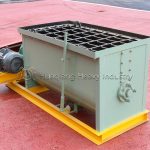
Imagine that tons of powdered or granular raw materials need to achieve near-perfect uniformity. Simple manual mixing or vertical disc mixer struggle to meet the demands of large-scale, high-efficiency production. This is where the horizontal mixer stands out with its unique design. It is named for its horizontally placed U-shaped or O-shaped mixing trough and the horizontally installed mixing shaft inside. When the drive unit starts, the shaft rotates, driving the carefully designed blades or ribbons attached to it. The materials within the trough are subjected to complex three-dimensional motion: both radial circular movement and axial back-and-forth convection. This intense shear and diffusion action allows materials of different compositions and specific gravities to achieve molecular-level uniformity in a short time, laying a perfect foundation for the next process step.
Horizontal mixers are not monolithic; based on their internal structure, they are mainly divided into two schools:
Horizontal Ribbon Mixer: Welded onto the mixing shaft are two ribbons with opposite spiral directions (inner and outer). During operation, the outer ribbon pushes material from both ends toward the center, while the inner ribbon pushes material from the center toward the ends, creating intense bidirectional convection. It offers fast mixing speed and high uniformity, making it particularly suitable for blending powders, granules, or mildly viscous materials.
Horizontal Paddle Mixer (also known as double axis mixer): Employs two parallel shafts that rotate in opposite directions, equipped with multiple sets of specially angled paddles. While being sheared and by the paddles, the material also undergoes violent tumbling and diffusion due to the asymmetric design of the dual shafts. It provides extremely high mixing intensity and excels in handling viscous materials, fibrous materials, or situations requiring the addition of liquid additives.
Its core advantages explain its widespread application:
Exceptionally High Mixing Uniformity: The three-dimensional motion ensures no dead corners, with a coefficient of variation (CV) as low as under 5%, which is fundamental for consistent product quality.
Large Capacity and High Efficiency: The horizontal design allows volumes ranging from a few hundred liters to tens of cubic meters, with single-batch processing capacity far exceeding that of vertical mixers and shorter mixing cycles.
Clean Discharge, Low Residue: Most models are equipped with large-opening pneumatic or mechanical discharge gates, with the pushing action of ribbons or paddles, achieving nearly 99% discharge efficiency and avoiding cross-contamination between batches.
Robust Structure and Stable Operation: The low center of gravity design ensures stable operation with low noise. The trough and shaft system have strong load-bearing capacity and long service life.
Good Sealing, Environmentally Friendly and Energy Efficient: The fully enclosed structure effectively prevents dust escape. Options like jacketed heating/cooling or liquid spray systems offer strong functional expandability.
In a modern fertilizer production line, the horizontal mixer is typically positioned after the crusher and before the granulator. It performs precise and uniform pre-mixing of nitrogen, phosphorus, potassium base materials, as well as trace elements and organic matter additives. It acts as the “gatekeeper” ensuring balanced nutrition in every single finished fertilizer pellet. Whether producing compound fertilizer, organic fertilizer, or bio-fertilizer, its precise operation is indispensable.