
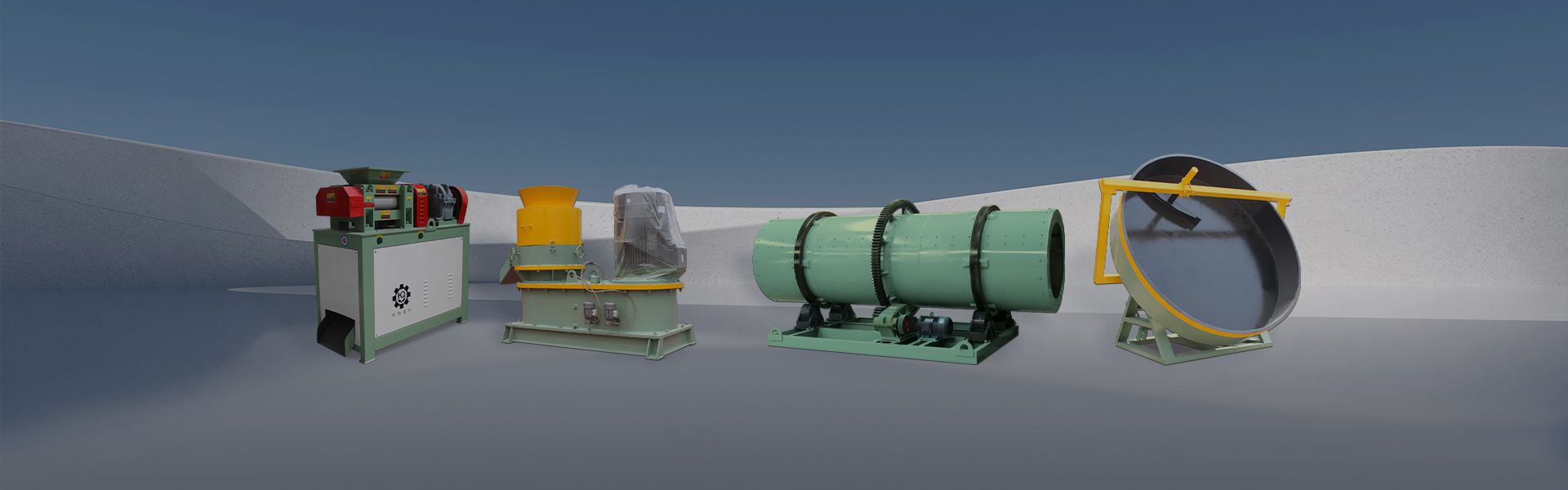
In organic fertilizer production, fermented materials often face a common problem: severe caking and uneven particle size. Some materials form hard lumps, while others remain fine powder. Directly entering the granulation stage often results in low granulation rate, poor particle strength, and inconsistent appearance. How to overcome this dilemma? The answer lies in “secondary crushing”—first, coarse crushing to break up hard lumps, then fine crushing to adjust the fineness. The linked combination of Huaqiang Heavy Industry’s semi-wet material crusher and chain crusher is the optimal combination to achieve this process. This article will explain in detail the key points of operation and parameter matching of this combination, helping you to improve your granulation rate to a new level.
Core Advantages of Secondary Crushing Process: From “Makeshift” to “Refined”
Why must fermented materials undergo secondary crushing? The reason lies in the special nature of the fermentation process.
During a fermentation cycle lasting 15-30 days, the material undergoes multiple changes including high temperature, turning, and maturation. In some areas, due to differences in moisture and temperature, hard lumps form, while the fibrous material, although decomposed, retains a certain length. If this mixture of “lumps + fibers + fine powder” is directly granulated, the hard lumps become the “skeleton” of the granules, leading to looseness; long fibers become entangled in the granulator; and the fine powder lacks sufficient support—ultimately resulting in a pelleting rate hovering around 60%.
Using a two-stage pulverization process of “coarse pulverization + fine pulverization” yields immediate results:
Material uniformity increases by 40%: Coarse pulverization breaks up the hard lumps, and fine pulverization shortens the fibers, resulting in a final particle size distribution concentrated within an ideal range.
Pelletizing rate increases by 30%: Uniform raw materials are more easily aggregated in the granulator, increasing the pelleting rate from 60% to over 90%.
Pellet appearance is more rounded: With consistent raw material particle size, the granules experience uniform force during rolling, significantly improving surface smoothness.
50% Reduction in Screening Returns: Increased pass rate means a significant reduction in defective particles and lower production losses.
Key Points of Integrated Operation: Two Machines, One System
The integration of the half-wet material crusher and the chain crusher is not a simple “front machine, back machine” series connection, but requires coordinated operation throughout the entire process from feeding to discharging.
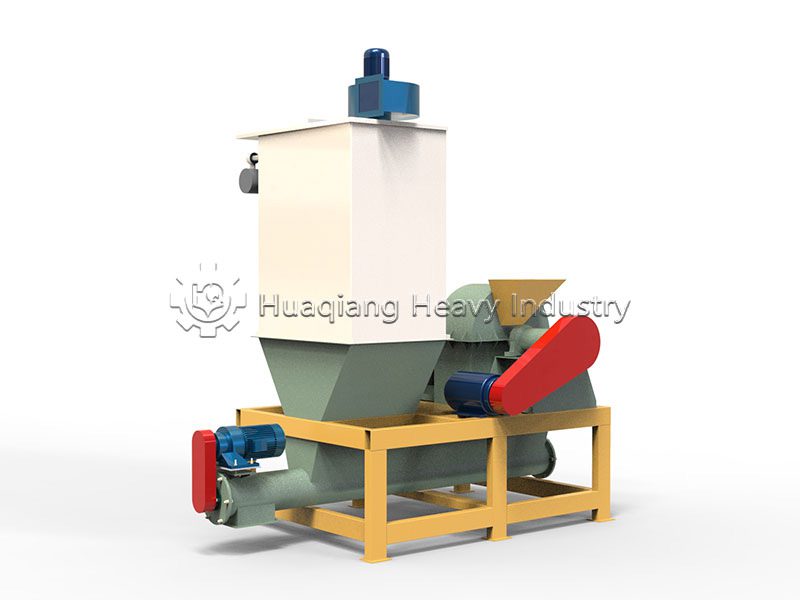
Step 1: The Chain Crusher as the “Coarse Crushing Pioneer”
The chain crusher is renowned for its powerful impact force, making it ideal for processing fermented materials containing hard lumps. It uses a high-speed rotating chain to violently strike the material, crushing large hard objects into coarse powder of approximately 40 mesh. The choice of this fineness is crucial: it cannot be too coarse (otherwise hard lumps will remain), nor too fine (otherwise it will increase energy consumption and affect subsequent processes). The Huaqiang chain crusher is equipped with a fineness adjustment scale; simply changing the screen with the appropriate aperture allows for precise control of the output particle size.
Key Operational Points: Feeding must be continuous and uniform to avoid overloading due to sudden large amounts of material. The coarsely crushed material is directly fed into the feed hopper of the semi-wet material crusher via a belt conveyor, eliminating the need for intermediate handling and reducing manual transfer.
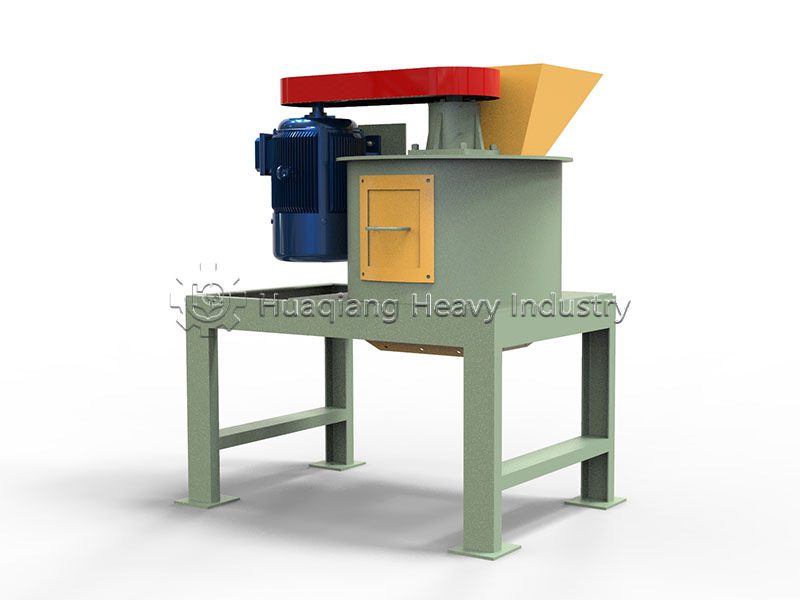
Step Two: The Semi-Wet Material Crusher Performs “Fine Crushing and Adjustment”
The semi-wet material crusher specializes in high-moisture raw materials, performing secondary processing on the coarsely crushed material. It further grinds the material to an ideal fineness of 20-30 mesh—the “golden range” for granulators. The equipment adopts a dual-stage rotor structure and a screenless design, handling materials with a moisture content of 25%-50% without any problems or clogging.
Key Operating Points: The feed speed must be synchronized with the discharge speed of the chain crusher. Huaqiang equipment is equipped with a variable frequency speed control device, which can automatically adjust the speed according to the upstream material flow, avoiding accumulation or material interruption in the feed hopper. The discharge port can be directly connected to the granulator elevator to achieve seamless “crushing-granulation” connection.
Step Three: Speed Synchronization to Avoid “Intestinal Obstruction”
What is the biggest fear when two machines are linked? Speed mismatch. If the chain crusher discharges material too quickly, the semi-wet material crusher cannot process it in time, leading to accumulation on the intermediate conveyor belt; conversely, if the discharge is too slow, the semi-wet material crusher is “waiting for the rice to be cooked,” reducing efficiency.
Huaqiang Heavy Industry equips its integrated production lines with a synchronous control system, using frequency converters to adjust the feeding speed and spindle speed of both machines in real time. After the operator sets the target capacity on the main control screen, the system automatically calculates and matches the operating parameters of the two machines, ensuring that the entire line operates in unison. For small and medium-sized production lines, balance can also be achieved by manually fine-tuning the opening of the feed gate by observing the material layer thickness on the conveyor belt.
III. Parameter Matching: Precise Selection Based on Capacity
Different scale production lines require matching equipment combinations of appropriate specifications. Huaqiang Heavy Industry provides precise parameter matching solutions:
5-ton/hour production line (suitable for small organic fertilizer plants)
Chain crusher: Model WLF-600, power 22 kW, output 3-8 tons/hour
Semi-wet material crusher: Model WSF-600, power 30 kW, output 3-5 tons/hour
Connection method: 5-meter belt conveyor + simple synchronous control
Land area: Approximately 20 square meters
10-ton/hour production line (medium-sized professional fertilizer plants)
Chain crusher: Model WLF-800, power 45 kW, output 8-15 tons/hour
Semi-wet material crusher: Model WSF-800, power 55 kW, output 8-12 tons/hour Tons
Connection Method: 8-meter belt conveyor + frequency conversion synchronous control system
Land Area: Approximately 30 square meters
20-ton/hour production line (large-scale production base)
Chain crusher: Model WLF-1000, power 75 kW, output 15-25 tons/hour
Semi-wet material crusher: Model WSF-1000, power 90 kW, output 15-20 tons/hour
Connection Method: 10-meter belt conveyor + fully automatic linkage control system + buffer silo
Land Area: Approximately 45 square meters
Practical Case: A Leap from 60% to 90%
A professional granular organic fertilizer manufacturer had long been plagued by a low granulation rate. Their raw material was well-rotted chicken manure, which severely caking after fermentation. Even after processing it directly with a semi-wet material crusher, the material still contained many coarse and hard particles, causing the disc granulator’s granulation rate to hover around 60%. A large number of substandard granules needed to be reworked, wasting both energy and time.
After introducing Huaqiang Heavy Industry’s “chain crusher + semi-wet material crusher” secondary crushing linkage solution, the factory upgraded its production line: the chain crusher, as the first stage, thoroughly crushes hard lumps in the composted material; the semi-wet material crusher, as the second stage, uniformly grinds the material to 20-30 mesh. The upgrade yielded immediate results:
The granulation rate jumped from 60% to 90%, reaching the best level since the factory’s establishment.
The granule appearance significantly improved, becoming round and smooth, leading to a 10% increase in market price.
Screening return material was reduced by two-thirds, increasing the actual production line capacity by nearly 50%.
Customer complaints decreased, and product reputation continued to improve.
Process Insights: Secondary Crushing, One-Time Investment
From single-machine operation to dual-machine linkage, from primary crushing to secondary fine grinding—this is not merely an addition of equipment, but an upgrade in process thinking. For manufacturers pursuing high-quality granular organic fertilizer, the combination of a semi-wet material crusher and a chain crusher is a wise choice for a one-time investment with long-term benefits.
The detailed two-stage crushing solution is a critical downstream process, but its success hinges on the quality of the upstream fermentation. The raw material, with its problematic hard lumps and uneven particle size, is a direct result of the composting process. This is where mastering fermentation composting turning technology becomes essential. The choice of composting equipment—whether a large wheel compost turner for vast windrows, a robust chain compost turner for intensive trough systems, or a flexible windrow composting machine—directly impacts the consistency of the fermented output. For operations requiring maximum process control and odor containment, trough-type aerobic fermentation composting technology with a dedicated trough-type compost turner is often preferred. These machines are key equipments required for biofertilizer production. A well-managed fermentation process, guided by proper turning techniques, produces a more uniform compost, reducing the severity of caking and making the subsequent job of the half-wet material crusher machine and chain crusher much more effective. The seamless integration of optimized fermentation composting turning technology with a precisely matched two-stage crushing system is the hallmark of a truly efficient and high-quality biofertilizer production line, transforming variable raw waste into a consistent, premium feedstock for granulation.
Huaqiang Heavy Industry not only provides high-performance individual machines, but also excels at designing optimal integrated solutions based on your raw material characteristics, production capacity targets, and site conditions. When your production line operates stably with a molding rate of over 90%, and when your granular products win market favor due to their uniformity and roundness, you will understand that secondary crushing technology is worth every penny invested in.