
In NPK compound fertilizer production, after granulation, drying, and cooling, there is an often overlooked but crucial process—screening. The role of the screening machine is to separate qualified granules from fine powder and oversized particles, ensuring that the final product has uniform particle size and a neat appearance. If screening is inaccurate, the mixed particle sizes will not only affect the accuracy of fertilization but also reduce the product’s market competitiveness. Among many screening devices, the rotary drum screener, with its stability, durability, and strong adaptability, has become the quality “gatekeeper” of the NPK production line.
The core role of screening in the NPK production line: After granulation and drying, the material typically consists of three parts: qualified granules (2-4mm or 3-6mm), fine powder (ungranulated powder), and oversized particles (material clumped together). If these unqualified components enter the packaging stage, it will not only lead to inconsistent product appearance but also affect the uniformity of mechanized fertilization. The task of a screening machine is to precisely separate qualified particles from unqualified products. Fine powder and oversized particles are returned to the granulator for reprocessing via a return system, achieving a zero-waste closed-loop production.
Working Principle: How a Rotary Drum Screen Classifies Particles
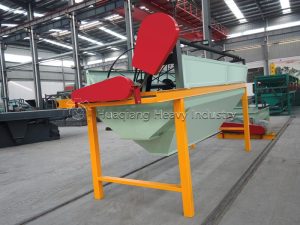
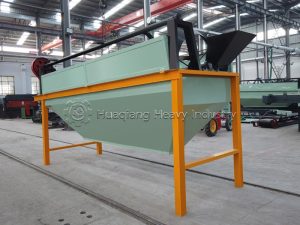
The main body of a drum screen is an inclined rotating drum covered with multiple layers of screens. During operation, material enters the drum from the feed end and rolls forward axially as the drum rotates. Qualified particles smaller than the screen openings pass through the screens and fall into the hopper below, while oversized particles larger than the screen openings are discharged from the discharge end. Fine powder is separated through a layer of screens with even smaller openings. The drum’s inclination angle and rotation speed are adjustable to adapt to the screening needs of different materials. The core design lies in anti-clogging technology—self-cleaning rubber balls or brushes are installed inside the screens, continuously striking the screens as the drum rotates, effectively preventing wet, sticky materials from clogging the mesh.
Comparative Advantages: Why is a Drum Screen Superior to a Vibrating Screen?
Compared to common vibrating screens, drum screens exhibit unique advantages in NPK production lines. Firstly, it operates more smoothly—the drum rotates at a low speed (15-25 r/min), without severe vibration, requiring less stringent foundation conditions and significantly reducing dust generation. Secondly, it is better suited for wet and sticky materials—if the granules are not completely dried after granulation, the surface still retains a certain stickiness, making the screen of a vibrating screen prone to clogging, while the self-cleaning design of the drum screen effectively addresses this. Thirdly, it has a low failure rate and is easy to maintain—its simple structure consists only of a motor, reducer, and drum body, without complex vibration mechanisms, resulting in higher long-term operational reliability.
Key Parameters and Selection Considerations When selecting a drum screen, four main parameters need to be considered: drum diameter and length (determines processing capacity, commonly φ1.2m×4m to φ2m×8m), screen aperture (selected according to product specifications, multiple layers with different apertures can be set), rotation speed (generally 15-25 r/min, reduce speed and extend residence time when materials are wet and sticky), and processing capacity (matching the production line capacity, slightly larger than the granulator output). The recommended material for the screen is 304 stainless steel, which is wear-resistant and corrosion-resistant. The bearing housing must be sealed and dustproof to extend its service life.
Matching with upstream and downstream equipment: The drum screen’s position in the NPK production line is fixed: upstream it connects to the cooler outlet, and downstream it connects to the automatic packaging scale. After cooling, the material’s temperature drops to ambient temperature before entering the screen. Qualified particles after screening fall directly into the packaging scale hopper, while fine powder and oversized particles are returned to the mixing system before the granulator via a return screw. To ensure continuous operation, a buffer silo can be installed before the screen to buffer fluctuations in upstream capacity.
Maintenance points: Simple but crucial: Maintenance of the drum screen focuses on three points: regularly cleaning the screen, especially after processing highly viscous materials, using a high-pressure air gun or water gun to rinse the mesh; checking the bearings and seals, adding grease every 200 hours, and observing for dust leakage at the seals; monitoring screen wear, and when the proportion of fine powder in the output increases abnormally, it indicates potential screen damage and requires immediate replacement.
From granulation to packaging, the drum screen, while not the most expensive piece of equipment, is a crucial link in ensuring granule quality. Choosing the right model and maintaining it correctly will ensure stable performance and safeguard the final quality checkpoint for your NPK products.
While the screening process is critical for NPK product quality, it is only one stage in a larger manufacturing ecosystem. The journey begins upstream with the agriculture waste compost fermentation machine. This includes various equipments required for biofertilizer production, such as a large wheel compost turner (or large wheel compost turning machine) for large-scale windrows, a chain compost turner (also a chain compost turning machine) for trough systems, a trough-type compost turner for enclosed, controlled environments, or a flexible windrow composting machine. These machines are all implementations of fermentation composting turning technology, designed to transform raw organic waste into a stable, mature compost. The quality of this upstream compost directly impacts the downstream granulation and, consequently, the screening process. A well-fermented, uniform compost leads to better granulation and a higher proportion of on-size product, reducing the load on the screening machine. The rotary drum screener in the NPK line, with its robust design and self-cleaning features, is built to handle the output of a high-capacity granulator, efficiently separating the desired product from recycle material. The synergy between effective fermentation composting turning technology and precise downstream screening ensures a high-quality, consistent final product.