
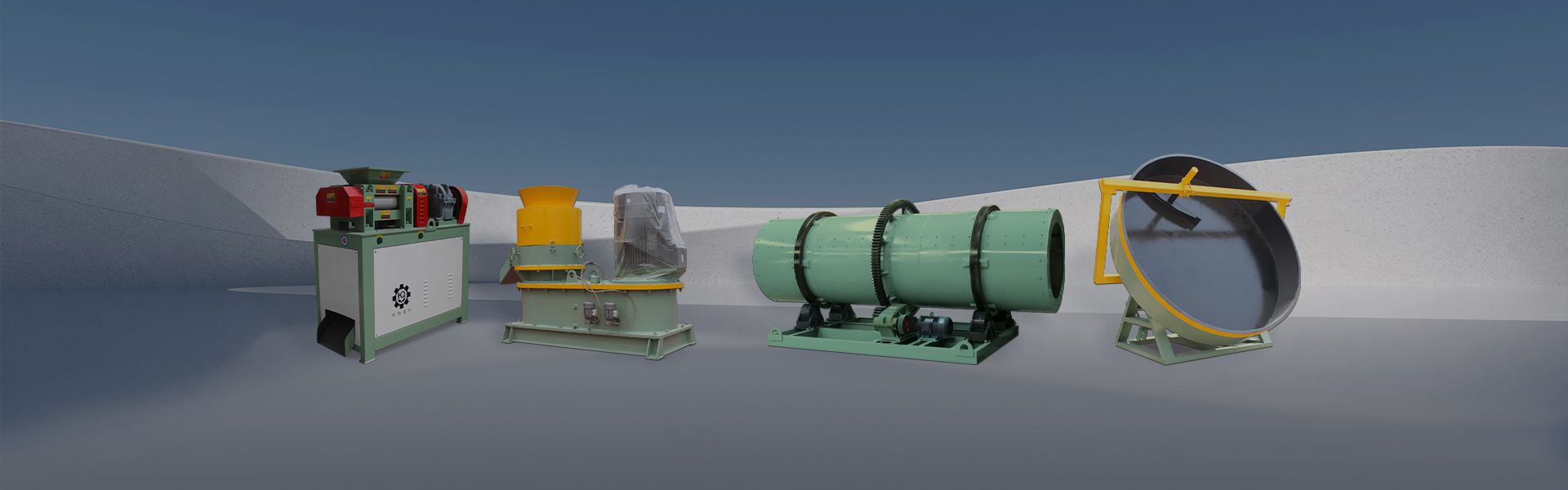
As a standard piece of equipment in large-scale organic fertilizer production lines, the rotary drum granulator‘s greatest advantages are its exceptional material adaptability, massive production capacity, and stable operation. It is compatible with various mixed raw materials of high and low organic matter, such as livestock and poultry manure, straw, mushroom residue, sludge, furfural residue, and humic acid. It has high tolerance for material fineness and moisture content, allowing for normal granulation without fine pretreatment.
The rotary drum granulator adopts a horizontal, long cylindrical structure, internally divided into a mixing and granulation zone and a polishing and granulation zone. Through drum rotation, lifting by lifting plates, and micro-spraying to agglomerate the particles, natural tumbling and grinding result in round and compact granules. The hourly production capacity can reach 5-15 tons, meeting the needs of production volumes exceeding 10,000 tons. When selecting and configuring the granulator, it is necessary to equip it with a screening machine, a return material system, a dryer, and a cooler to re-crush and re-form 40%-60% of the unformed particles, improving the overall yield.
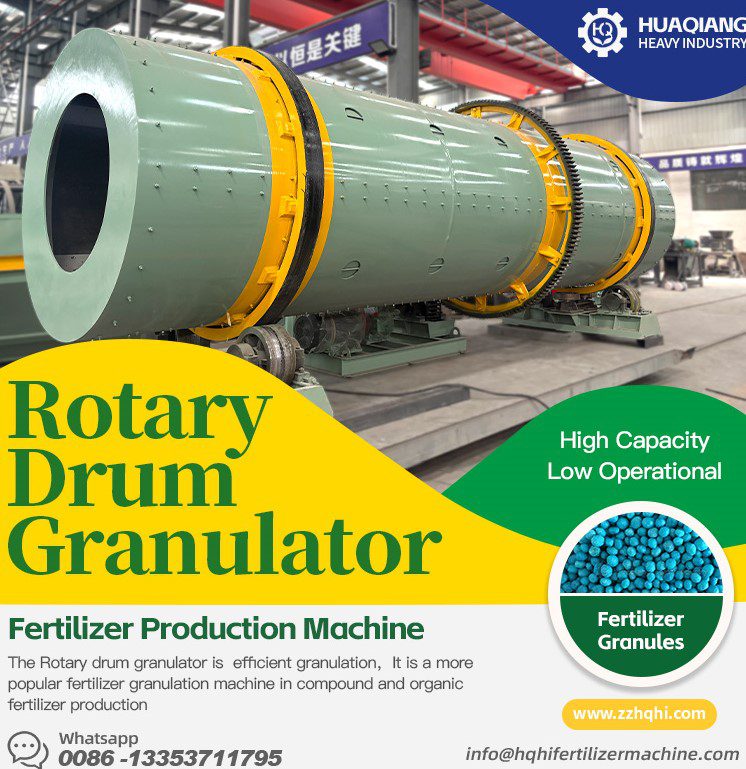
The production line layout should follow a streamlined approach, with raw material crushing, mixing, granulation, drying, screening, and packaging arranged sequentially to shorten conveying distances and reduce energy consumption. A variable frequency speed control system is also required to flexibly adjust the speed based on material moisture content and output. The rotary drum granulator requires minimal manual intervention, is easy to maintain, and has few easily damaged parts, making it suitable for large-scale, low-cost mass production. It is the preferred main equipment for large-scale livestock farms and organic fertilizer industrial parks.