
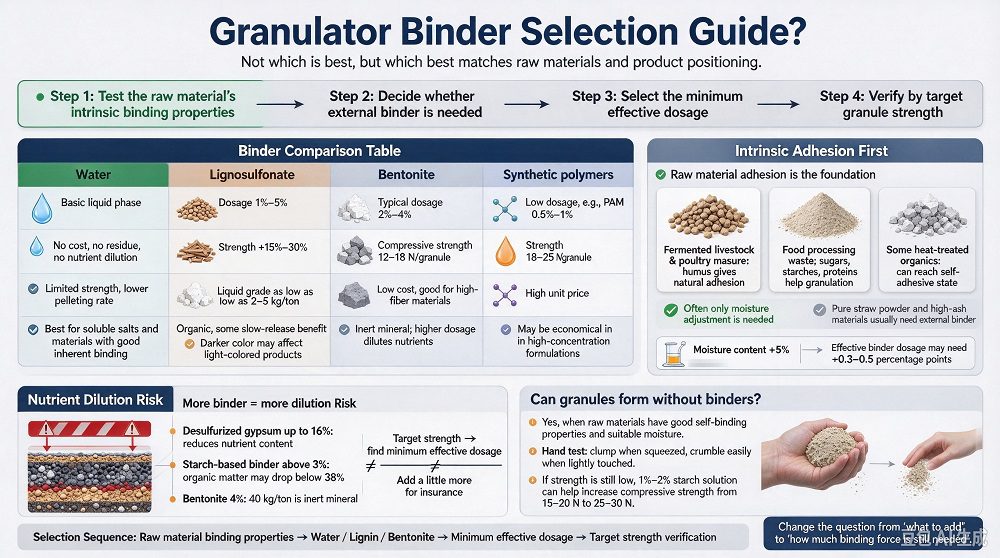
The key to choosing a granulator binder isn’t “which is best,” but rather “which best matches your raw materials and product positioning.” Water is suitable for soluble materials; lignin sulfonates and starch provide green strength; bentonite is low-cost but adds inert matter; synthetic polymers have low dosage but high unit price. A more crucial logic is: first test the binding properties of the raw material itself, then decide whether to add an external binder, rather than assuming “it must be added.”
I. Trade-offs Between Binder Type, Dosage, Strength, and Cost
Water is the most basic binding phase, suitable for soluble salts and organic materials with good inherent binding properties. Water’s advantages are zero cost, no residue, and no nutrient dilution. However, when granulating with water alone, the pellet strength is limited, the pelleting rate is low, and the pellets are relatively uniform but not dense. For fermented and decomposed livestock and poultry manure, the humus itself already possesses natural binding properties; often, only water spraying to adjust the moisture content is needed for pelleting, without the need for additional binders.
Lignosulfonates are organic binders, with a recommended dosage of 1%–5%, which can increase particle strength by 15%–30%. When used as a granulating agent in compound fertilizers, the dosage in liquid, fully water-soluble formulations can be as low as 2–5 kg per ton of fertilizer without affecting the total nutrient content, making it suitable for producing high-concentration compound fertilizers. Another advantage of lignin sulfonates is their slow-release function; their natural lignin structure has a certain regulatory effect on nutrient release. The disadvantages are that their unit price is higher than bentonite, and their darker color may affect the appearance of light-colored products.
Bentonite is the lowest-cost inorganic binder. A typical addition amount of 2%–4% can achieve a particle compressive strength of 12–18 N per pellet, with a cost of approximately 80–120 yuan per ton and an organic matter loss rate of only 0–2%. Bentonite is particularly suitable for high-fiber materials such as livestock and poultry manure and straw powder, exhibiting good water absorption and a high pelletizing rate. However, it is essentially an inert mineral; the higher the addition amount, the more significantly the proportion of effective nutrients in the product is diluted, and it also increases the ineffective weight during transportation.
II. The Synergistic Effect of the Raw Material’s Intrinsic Adhesion
The binder does not establish adhesion “from scratch,” but rather it is superimposed on the adhesive properties of the raw material itself. Fermented and decomposed livestock and poultry manure contains humus, possessing good natural adhesive properties; the sugars, starches, and proteins in food processing waste also act as binders during granulation; some organic raw materials, after heat treatment or chemical conversion, can even achieve a “self-adhesive” state, granulating without the need for external binders.
This means that the amount of external binder used should be calculated based on the raw material’s “basic adhesive strength.” For raw materials with strong intrinsic adhesion, the amount of bentonite added can be reduced from 4% to 2%, or even omitted entirely; for raw materials with weak intrinsic adhesion (such as pure straw powder and high-ash materials), lignin sulfonate or bentonite is needed to supplement it. In practice, for every 5% increase in the moisture content of the raw material, the effective dosage of binder needs to be increased by 0.3–0.5 percentage points. Pre-analyzing the raw material before determining the binder dosage is a prerequisite for avoiding “too much waste and too little failure to granulate.”
III. Dilution of Nutrient Content by Excessive Binders
The cost of excessive binders is primarily reflected in nutrient dilution. Taking desulfurized gypsum as an example, as a granulating agent, it needs to be added at up to 16% to form granules, directly leading to reduced nutrient content and increased production costs in granular fertilizers. When the addition of starch-based binders exceeds 3%, the organic matter content may drop from 45% to below 38%, losing its eligibility for the high-end market. Although bentonite is low in cost, a 4% addition means that 40 kg of each ton of finished product is inert mineral; for high-concentration compound fertilizers, this weight encroaches on the space for effective nutrients.
Therefore, the selection logic for binders should be “minimum effective dosage”: finding the lower limit of dosage based on the target particle strength, rather than “adding a little more for insurance.” While synthetic polymers with good water solubility and low dosage (such as PAM, which can achieve a strength of 18–25 N at 0.5%–1%) have a higher unit price, they may be more economical in high-concentration formulations due to less dilution.
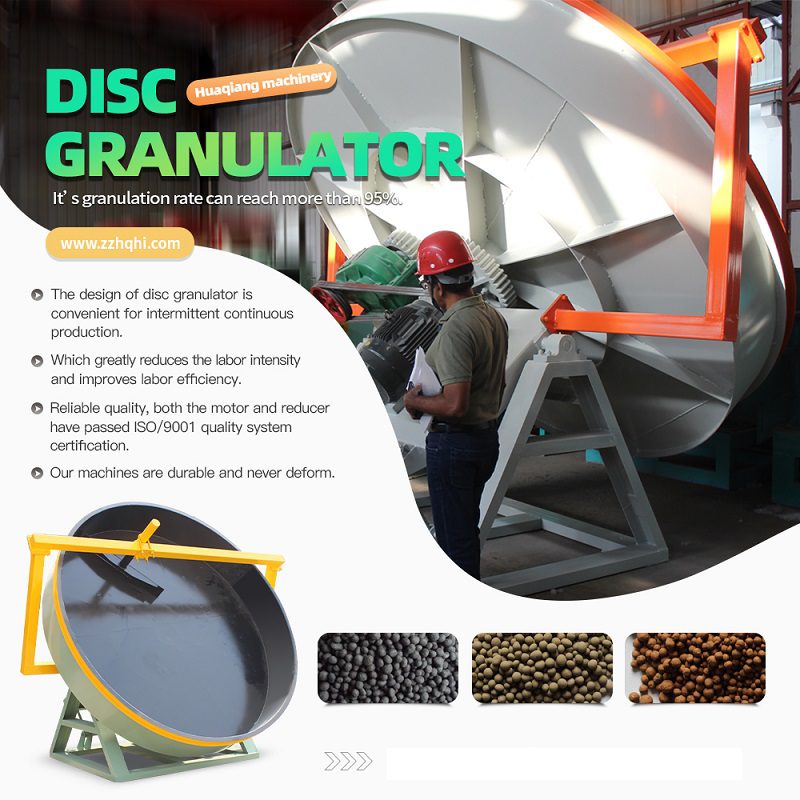
Proper pre-treatment equipment directly shapes the inherent binding performance of your raw materials before granulation. Equipment for fermenting and composting livestock and poultry manure stabilizes fresh manure into humus-rich compost; among these units, the large wheel compost turner is widely adopted for large-scale windrow composting, delivering uniform aeration and thorough decomposition to develop natural adhesion in chicken manure. Well-rotted compost becomes the core feedstock for a chicken manure fertilizer machine, and the disc granulator machine stands out as the preferred granulation unit for this material. The quality of compost produced by Equipment for fermenting and composting livestock and poultry manure determines whether you can reduce or skip extra binders in the disc granulator machine. If the large wheel compost turner runs with insufficient turning frequency, incomplete decomposition leaves raw manure with unstable viscosity, forcing higher binder dosage and lowering finished pellet quality. When designing a chicken manure fertilizer machine line, matching fermentation capacity from the composting equipment with the throughput of the disc granulator machine is essential to keep binder consumption at the minimum effective level.
IV. FAQ: Can Granules Be Formed Without Binders?
Q: Can organic fertilizer granulation form pellets without any binders?
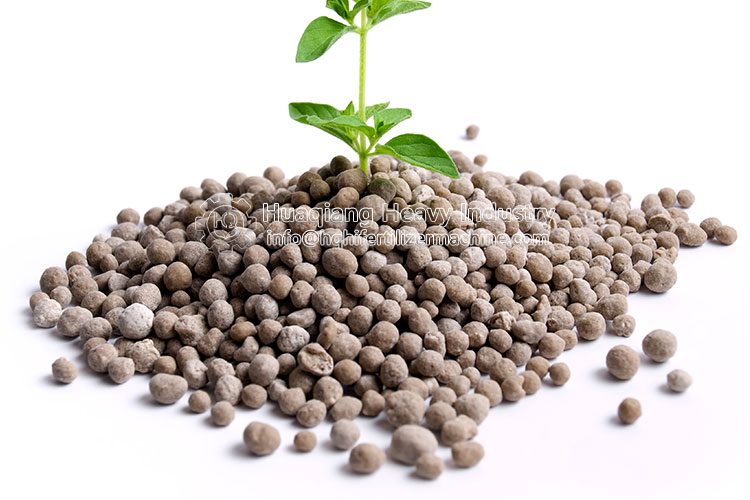
Yes, but under certain conditions. Materials with good self-binding properties — such as fermented and decomposed livestock and poultry manure, food processing waste containing sugar or starch, and some heat-treated organic raw materials — can form pellets based on their own binding properties under the combined effect of moisture and mechanical force. Disc granulation can form pellets without binders for raw materials such as chicken manure, sludge, and peat moss under suitable moisture conditions. If it is necessary to increase the hardness of the pellets for mechanized fertilization, adding 1%–2% starch solution can increase the compressive strength from 15–20 N per pellet to 25–30 N per pellet.
Granulation of fibrous raw materials such as straw powder is more difficult on its own and usually requires mixing with livestock and poultry manure in a certain proportion, or using processes specifically designed for high-fiber materials, such as flat die extrusion. The judgment standard is simple: first, take a small sample of the raw material, adjust the moisture content to “form a clump when squeezed in the hand, but crumble easily when lightly touched,” and observe the pelleting rate and pellet strength; if the standard can be met without adding binders, there is no need to increase costs and dilution risks.