
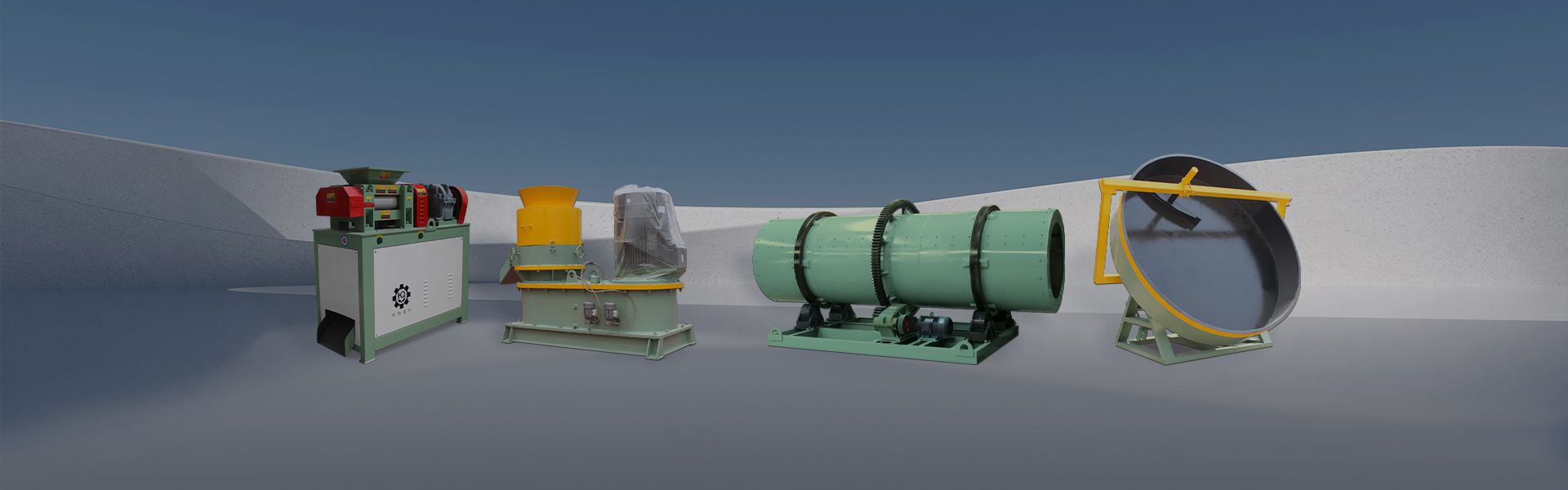
Have you ever seen a crusher that uses steel chains as its “teeth”? On a fertilizer production line, that tough guy exists the chain fertilizer crusher. It has no blades, no hammers. Instead, a set of high speed rotating steel chains whips caked urea, ammonium phosphate, or fermented organic material into flying powder. Today, let’s walk into its installation site and see how this “chain warrior” teams up with its partners to prepare the finest “meal” for the disc granulator.
On site, the first thing you see is the vertical or slightly tilted housing, inside which several sets of heavy chains are suspended. Workers are carefully installing the main shaft and chain discs. The length and weight of every chain must be identical otherwise, at high speed, violent vibration will occur and even break the pins. An old hand squats beside the coupling, feeler gauge in hand, muttering, “The level of this shaft can’t be off by more than a hair. The chains spin at over a thousand rpm. A tiny misalignment and the whole thing is scrap.” A younger worker climbs onto a scaffold and tightens the bolts on the chain disc one by one with a torque wrench each click sounds like fastening armor onto the warrior.

The inner wall of the housing is lined with wear resistant steel plates, and some areas even get rubber or polyurethane to reduce rebound noise and abrasion. While installing these liners, workers have to bend and work in cramped spaces drilling holes, fastening bolts, applying sealant making sure every plate fits tightly, otherwise powder will seep into gaps and slowly wear through the outer shell.
The chain crusher never works alone. Upstream, a belt conveyor or bucket elevator feeds large chunks into the crusher’s inlet. Downstream, a horizontal or vertical mixer blends the fine powder with other ingredients. Some lines also install a cyclone and a baghouse dust collector at the crusher outlet – recovering flying powder, which is both eco friendly and economical. Also on site: an electrical control panel, where a VFD adjusts the main motor speed slower for hard materials, faster for soft ones based on hands on experience.
On trial run day, workers put on hard hats and safety glasses. The motor starts, and the chains accelerate from a low hum to a sharp whoosh, and finally a crackling symphony as chains whip against the housing and the material. A few fist sized hard lumps fall into the inlet. Less than three seconds later, flour fine powder drifts out of the discharge, puffing up a small dust cloud. The old hand reaches out, picks up some powder, rubs it between his fingers, and smiles: “Good fine enough! The granulator will love this.”
That’s the chain crusher – a hot tempered warrior. It doesn’t cut gently or grind politely. It uses the most direct way: whip every hard lump into pieces. Without it, the granulator would have to swallow lumps of all sizes, producing pellets with cores or cracks. With it, the powder becomes as fine as flour, as uniform as snow, and the resulting pellets are perfectly round. Isn’t that chain even more powerful than a blade?