
What is Large-Scale Farm Composting Equipment?
Large-scale farm composting equipment refers to mechanized aerobic fermentation systems configured for livestock or agricultural settings processing over 10 tons of organic waste per day (equivalent to the excrement of 500 dairy cows or 3000 pigs). Its core function is to rapidly decompose livestock manure, straw, and vegetable waste under controlled conditions, transforming them into stable organic fertilizer.
TroughCompost Turner: The Benchmark for Cost-Effectiveness in Large Farms
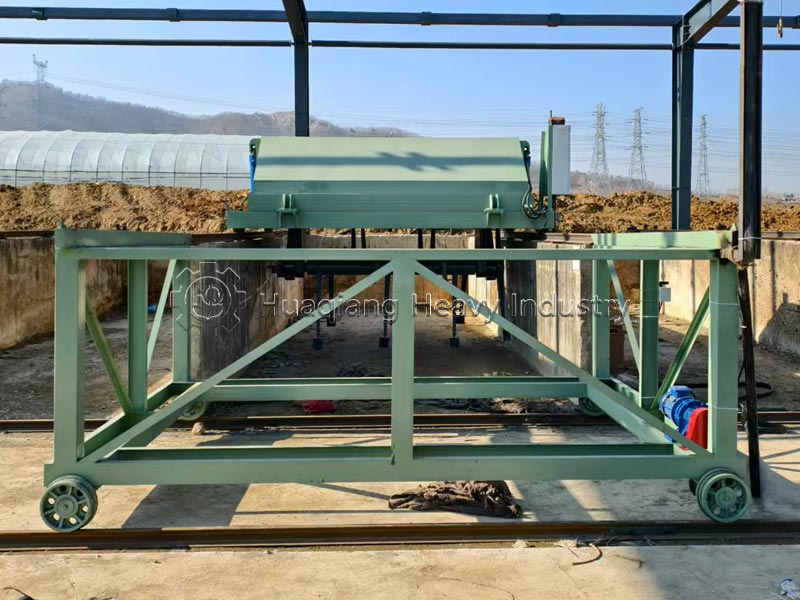
The trough compost turner is currently the most widely used composting solution in large farms worldwide. Its system consists of: a concrete or brick fermentation trough (typically 3 to 6 meters wide, 1.2 to 1.8 meters high, and the length can be extended to 30 to 80 meters depending on the daily processing capacity), a track-mounted compost turner, and a forced ventilation duct at the bottom. The turner travels back and forth along the track, using rollers to break up, displace, and convey the material backward. According to process data, the fermentation cycle of a trough system is approximately 15 to 25 days, with energy consumption of only 0.8 to 1.2 kWh per ton of raw material processed. Equipment investment is at a moderate level among the three mainstream options—a configuration with a daily output of 20 tons requires approximately $30,000 to $60,000. Its biggest advantage lies in its mature technology and simple operation; one worker can manage multiple fermentation tanks.
Rotary Drum Fermentation Reactor: The Fastest Solution with the Smallest Footprint When farms face land scarcity or strict environmental odor controls, the rotary drum fermentation reactor becomes an alternative. This equipment is a closed, horizontal rotating cylinder. Material enters from one end and is propelled forward by the slow rotation of the cylinder and the action of internal baffles, compressing the fermentation cycle to 7 to 10 days. The closed structure, combined with a biological filter deodorization system, can reduce ammonia emissions by more than 85%. However, the cost is a higher unit investment—for the same processing capacity, the equipment cost of a rotary drum reactor is approximately 2 to 3 times that of a trough system, and the maximum processing capacity of a single unit is typically around 20 tons per day; very large farms may require multiple units in parallel. Suitable for large-scale farms with high land prices, proximity to residential areas, or strict environmental rating requirements.
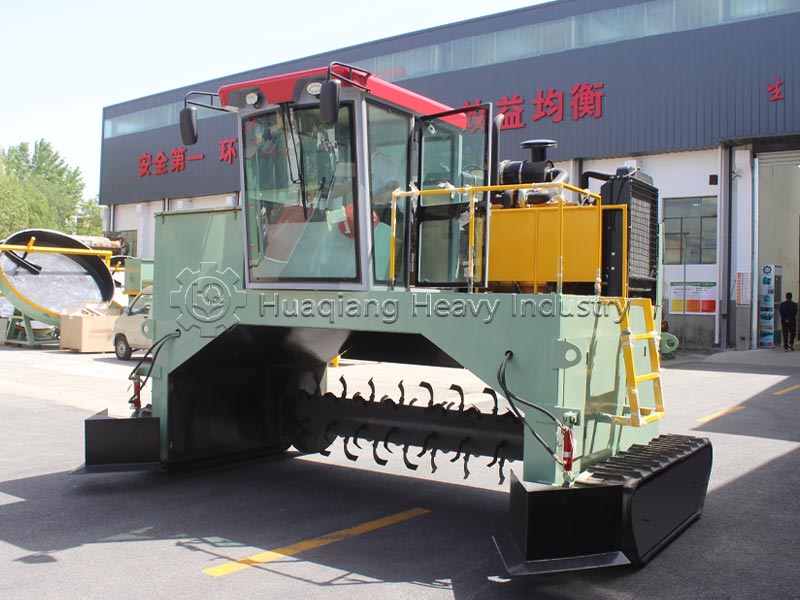
III. Windrow compost Turner: The Most Flexible and Lowest Threshold Option Windrow composting is the simplest form: materials are piled into long, strip-shaped heaps (trapezoidal cross-section, 3-5 meters wide at the base and 1.2-1.5 meters high), and periodically turned by a towed or self-propelled turner. Compared to trough systems, windrow composting requires no civil engineering investment, only a hardened ground surface, reducing equipment purchase costs by 40-60%. However, the trade-off is a longer fermentation cycle of 40-60 days, more than double the required floor space, and a slower turner speed—processing the same 100-meter-long heap takes approximately three times longer with a trough turner. Furthermore, controlling moisture content is difficult during open-air operation in the rainy season, making windrow composting more suitable for arid climates or farms with ample land.
The Importance of Auxiliary Equipment
Regardless of the main unit chosen, the following three auxiliary systems directly determine compost quality: Forced ventilation system – perforated ducts buried at the bottom of the fermentation tank, with a recommended ventilation rate of 30 to 60 cubic meters per square meter per hour, precisely controlling the oxygen concentration in the compost pile between 8% and 15%; Deodorization system – for facilities near sensitive areas, investment in biological filters or chemical scrubbing towers requires an additional 15% to 25%; and screening and crushing equipment – after fermentation, the coarse compost needs to be screened (usually using 8 to 12 mm screens) and crushed before it can be sold as commercial organic fertilizer or further granulated.
Optimal Matching Recommendations for Different Scales
Based on the typical capacity requirements of large-scale farms, the recommended solutions are as follows: For daily processing of 10 to 30 tons of organic waste, a trough-type compost turner offers the best overall cost-effectiveness, with controllable total investment in civil engineering and equipment, and the lowest operating and maintenance costs. For daily processing of 30 to 60 tons, a configuration of dual parallel troughs or a single wide trough with a large compost turner can be used, with unit processing costs decreasing as the scale increases. For daily processing capacities exceeding 60 tons or requiring an AAA environmental rating, a combination of rotary drum fermentation reactors and trough systems should be considered. The rotary drum handles the rapid degradation during the primary fermentation stage, while the trough system handles the stabilization during the post-fermentation stage. The overall investment payback period is typically controlled within two to three years.
Selecting the optimal composting system for large-scale livestock operations demands a rigorous trade-off analysis among fermentation speed, capital intensity, land availability, and environmental compliance. At the foundation of every successful deployment lies advanced fermentation composting turning technology calibrated to the specific waste stream—whether processing nitrogen-rich poultry litter through a dedicated chicken manure fertilizer machine workflow, or managing bulky fiber-laden dairy waste via a cow manure fertilizer machine configuration. For operations processing 10–30 tons daily with moderate budgets and ample space, a trough-type compost turner anchored in concrete fermentation lanes delivers the benchmark cost-effectiveness, compressing the composting process for animal manure to 15–25 days with energy consumption below 1.2 kWh per ton. When land scarcity or stringent odor regulations dominate decision-making, the large wheel compost turning machine or closed rotary drum reactor—though commanding 2–3× the unit capital—achieves 7–10 day cycles and >85% ammonia reduction, justifying the premium in high-density agricultural zones. Conversely, for arid-region farms with surplus land and minimal environmental pressure, a flexible windrow composting machine or towed animal manure compost turner eliminates civil engineering entirely, reducing upfront investment by 40–60% while extending the cycle to 40–60 days. Regardless of the primary compost turner machine selected, integrating forced ventilation, deodorization, and post-fermentation screening transforms raw waste stabilization into a commercially viable organic fertilizer production platform—delivering pathogen-free, humus-rich outputs that close the nutrient loop between livestock operations and crop production.
We offer a full range of composting systems, from trough turners to deodorizing and screening auxiliary equipment. We can also provide customized optimal configuration solutions and return on investment calculations free of charge based on your daily processing capacity, environmental rating, and land conditions, helping you efficiently complete the resource conversion of organic waste.