
In 2026, the global organic fertilizer industry is poised for a boom driven by both policy incentives and technological innovation. According to the latest market research report, the global organic fertilizer market size is projected to grow from US$11.99 billion in 2026 to US$18.46 billion in 2031, representing a CAGR of 9.03%. In this wave of growth, fermentation turning equipment, as the core equipment for organic fertilizer production, is undergoing a profound transformation from “functional machines” to “intelligent machines.” Meanwhile, the urgent need for resource utilization of agricultural waste is opening up broader application scenarios for turning equipment.
Currently, the development of the global organic fertilizer industry is driven by three main engines. First, there is the strong constraint of environmental policies—the EU’s “Farm to Fork” strategy clearly sets a target of 25% organic farmland coverage by 2030; the US Department of Agriculture will inject US$116 million in subsidies into 76 facilities for capacity expansion in 2025; and China’s “Comprehensive Solid Waste Management Action Plan” focuses on the resource utilization of agricultural waste. Secondly, there’s increased policy support for the resource utilization of agricultural waste. The Ministry of Agriculture and Rural Affairs has explicitly stated its intention to overcome key technological bottlenecks in areas such as straw return to the field and the resource utilization of livestock and poultry manure. Thirdly, the widespread adoption of precision fermentation technology, with the integration of sensors, the Internet of Things (IoT), and intelligent control systems, has shifted the fermentation process from “experience-driven” to “data-driven.”
In line with industry trends, compost turning equipment is rapidly evolving along four main directions: intelligence, automation, mobility, and low energy consumption. Intelligence has become standard – self-propelled compost turning machines with IoT capabilities now account for 67% of newly launched products, automatically adjusting the turning frequency and depth by monitoring the pile temperature and oxygen content in real time. In terms of automation, high-efficiency trough-type compost turning machines, combined with PLC programming control, allow one machine to manage 5-8 fermentation troughs, achieving unattended continuous operation. With the trend towards mobility, self-propelled compost turning machines, with their four-wheel drive and hydraulic turning design, have become the preferred choice for large-scale open-air composting projects. Breakthroughs in low-energy consumption technology are equally significant; hydraulic disc compost turning machines utilize energy-saving transmission mechanisms, reducing energy consumption by 70% compared to traditional equipment for the same workload.
The demand for compost turning equipment varies across different regions. Southeast Asia, as the world’s largest untapped market, is transitioning from a fertilizer importer to an exporter. Thailand will have completed an integrated fertilizer industrial park by the end of 2024, while Indonesia and Vietnam are experiencing a surge in demand for compost turning equipment for processing empty palm fruit bunches and livestock manure. The African market, supported by the EU, is accelerating the development of its standards system. Gambia recently launched a solar composting project, creating a strong demand for small, flexible, self-propelled compost turning equipment. The South American market, led by Brazil and Argentina, is experiencing a compound annual growth rate of 8.2% in its bio-organic fertilizer market, with continuously increasing demand for large-scale compost turning equipment for processing sugarcane bagasse and soybean straw.
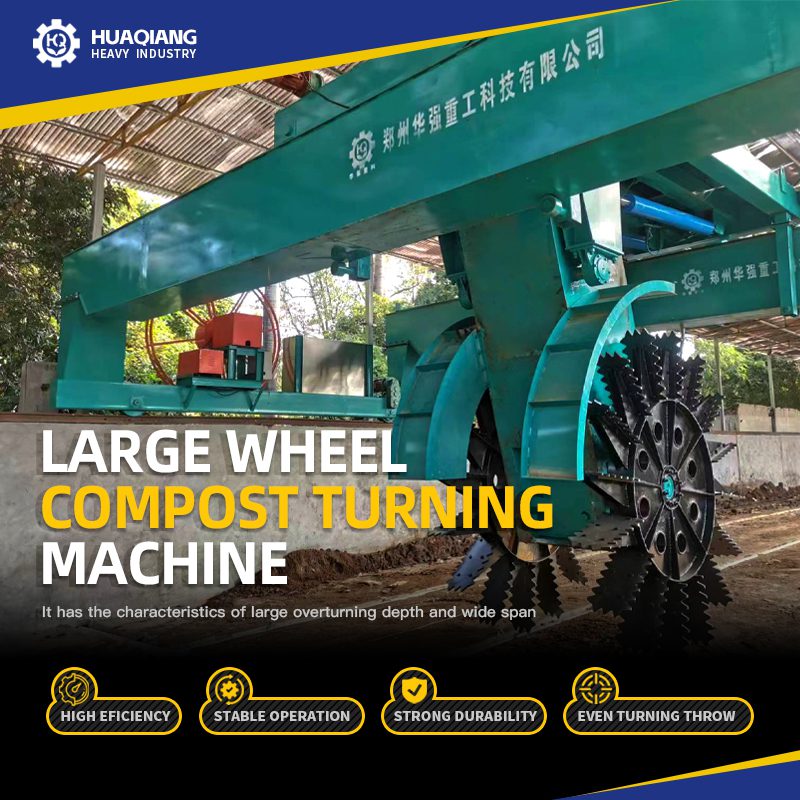
Faced with diverse global market demands, our compost turning equipment has been designed with an international perspective from the outset. All products comply with EU environmental standards and can be equipped with exhaust gas collection systems to meet the market access requirements of Europe and the United States. To accommodate different regional power grid characteristics, the equipment supports multiple voltage configurations, including 380V/50Hz and 460V/60Hz, eliminating the need for customers to add transformers. In terms of raw material adaptability, large wheeled compost turners feature optimized blade designs for high-fiber straw, while trough-type compost turners are equipped with leachate collection systems as standard for high-moisture livestock and poultry manure, ensuring efficient fermentation of agricultural waste worldwide.
The market analysis and regional trends underscore the critical and evolving role of fermentation composting technology for organic fertilizer worldwide. The shift from functional to intelligent machines is revolutionizing fermentation composting turning technology across all equipment types. In Southeast Asia, the demand for processing empty palm fruit bunches drives the need for robust large wheel compost turners capable of handling high-fiber materials. For controlled, continuous operations in European or North American facilities, trough-type compost turners (or trough type composting turners) with integrated exhaust systems are essential for meeting stringent environmental standards. The African market’s need for small, flexible solutions creates a strong demand for windrow composting machines and versatile chain-plate compost turners. Each of these applications represents a specific implementation of fermentation composting technology, adapted to local raw materials, scale, and regulations. The global trend towards intelligence, with IoT-enabled machines that self-optimize turning frequency and depth based on real-time data, applies to all—from a massive large wheel compost turner in a Brazilian sugarcane facility to a compact chain-plate compost turner on an African farm. This technological evolution ensures that fermentation composting technology for organic fertilizer continues to be a powerful and adaptable tool for transforming agricultural waste into a valuable resource, contributing to global food security and environmental sustainability.
From intelligent trough-type to self-propelled mobile systems, from energy conservation and consumption reduction to global adaptability, the compost turning equipment market in 2026 is responding to the challenges of the times with technological innovation. Our company will continue to delve into fermentation and composting technology, providing Chinese solutions for the resource utilization of agricultural waste globally.