
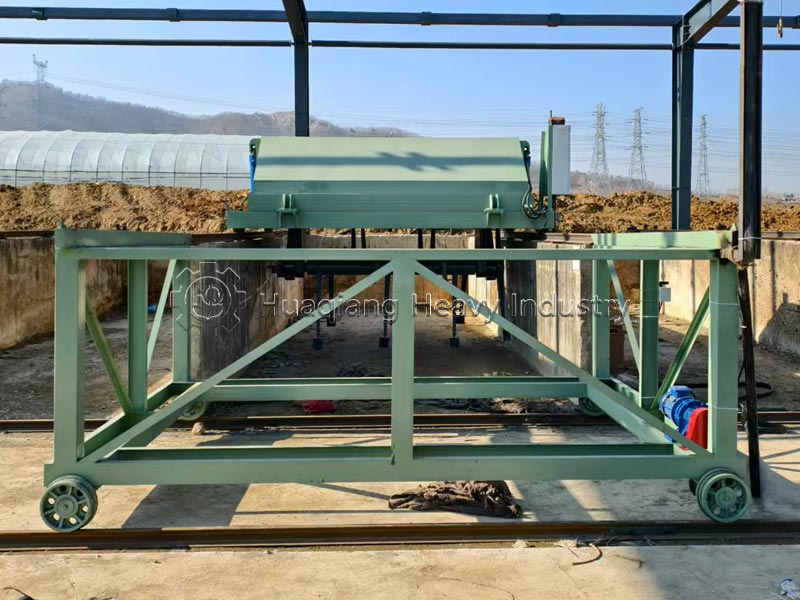
In organic fertilizer production, high-moisture raw materials such as chicken manure and cow manure are the most common fermentation materials, but also the most difficult to process—they have high moisture content, are prone to caking, and have poor air permeability. Ordinary compost turners experience enormous resistance during operation, resulting in uneven turning or even machine jamming and damage. It adopts hydraulic lifting and hydraulic drive technology, offering powerful performance and flexible adjustment, making it a truly “exclusive tool” for fermenting high-moisture raw materials. This article will explain the unique advantages and practical application techniques of this equipment.
Core Advantages: Three Major Breakthroughs Brought by the Hydraulic System
Hydraulic Lifting, Flexible Adaptation to Different Material Pile
Ordinary compost turners have a fixed turning blade height. When encountering material piles with uneven moisture content, the blades either penetrate too deeply, causing excessive resistance, or float on the surface and fail to turn the material to the bottom. The hydraulic compost turner is equipped with a hydraulic lifting system, allowing the operator to adjust the height of the turning blades in real time from the cab. The blades can penetrate 80-100 cm into the material, or be raised to the surface. This means that regardless of the height or moisture content of the material pile, the turning depth can be precisely controlled, ensuring that the bottom layer of material is thoroughly turned over.
Hydraulic Drive, Powerful and Smooth Operation
High-moisture raw materials are sticky and have strong resistance, often rendering mechanically driven compost turners inadequate. The hydraulic compost turner uses a fully hydraulic drive; the turning blades are powered by a high-torque hydraulic motor, with an output torque more than 30% higher than motors of the same power. Even with hardened material piles with a moisture content of over 70%, it can easily chop and turn them over without jamming. One user described it as: “Like a hot knife cutting butter, even the stickiest material is sliced through in one go.”
Turning Blades with Crushing Function, Crushing While Turning
Ordinary compost turners only “turn” the material, unable to handle hardened lumps. The hydraulic compost turner uses specially designed pulverizing blades. While turning the material, the high-speed rotating blades chop and break up clumps, turning fist-sized hard lumps into loose, bean-sized pieces after a single turn. This function greatly improves the aeration of the compost pile, creating an ideal environment for microbial activity.
Practical Application Techniques: Making High-Moisture Raw Materials “Compliant”
Tip 1: Depth Priority, Slow Operation
When processing high-moisture raw materials with a moisture content of over 60%, it is recommended to adjust the turning blades to the maximum depth (80-100 cm) to ensure that the bottom material is thoroughly turned over. Control the travel speed at a slow setting of 1-2 meters per minute to give the turning blades sufficient time to chop up clumps. After the first turn, observe the state of the pile. If large pieces remain, appropriately reduce the speed or increase the number of turns.
Tip 2: Combined Auxiliary Materials for Better Results
Although the hydraulic compost turner is powerful, scientifically combining auxiliary materials can improve the fermentation effect. For extremely moist raw materials such as pure chicken manure, it is recommended to mix it with crushed straw, rice husks, or mushroom residue in a ratio of 3:1 to 4:1. These additives not only adjust the carbon-to-nitrogen ratio to the ideal range but also significantly increase the permeability of the compost pile, reducing the load on the compost turner. The hydraulic compost turners achieve more uniform turning and faster fermentation when processing mixed materials.
Tip 3: Moisture Sensing and Speed Matching
The higher the moisture content of the raw material, the greater the turning resistance, and the slower the required travel speed. Huaqiang equipment is equipped with a variable frequency speed control system, allowing operators to flexibly adjust the speed according to the site moisture. A rule of thumb: for moisture content below 60%, use a medium speed of 3 m/min; for moisture content between 60% and 70%, reduce to a slow speed of 2 m/min; for moisture content above 70%, use an extremely slow speed of 1 m/min. Proper speed matching ensures both effective turning and equipment protection.
III. Case Study: Chicken Manure with 70% Moisture Content Decomposes in 15 Days
A large-scale farm produces a large amount of fresh chicken manure daily, with a moisture content exceeding 70%. Previously, it required 3-5 days of sun-drying before fermentation, which was both time-consuming and generated unpleasant odors. After introducing a Huaqiang hydraulic compost turner, the farm experimented with “direct fermentation”—mixing fresh chicken manure with 20% straw powder and piling it directly, then immediately using the hydraulic compost turner for the first turning.
The results are encouraging:
No pre-dehydration is needed; high-moisture raw materials can be directly piled up, saving drying space and time.
Completion of composting is achieved in 15 days, more than 10 days shorter than traditional processes.
No caking, no odor; the pile after turning is loose and uniform, with a significantly reduced smell.
Product composting meets standards, and seed germination index fully complies with organic fertilizer standards.
The farm manager remarked, “We used to think high-moisture chicken manure was a ‘hot potato,’ but now with the hydraulic compost turner, it’s become an advantage for rapid fermentation.”
Parameter Adjustment: Precise Control of Each Batch
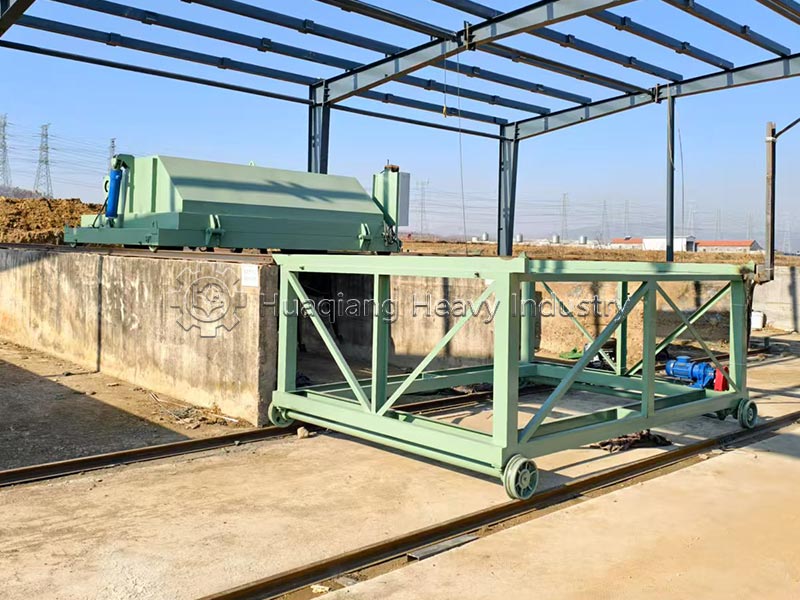
The hydraulic compost turner’s control system integrates multiple adjustable parameters:
Turning depth adjustment: Controlled by a hydraulic lifting cylinder, adjustment range 0-100 cm, with scale indication, high repeatability.
Travel speed adjustment: Variable frequency control, stepless speed adjustment from 0-5 m/min, real-time speed display.
Turning blade speed: Driven by a hydraulic motor, speed adjustable; low speed for high-moisture materials (increased torque), high speed for dry materials (improved efficiency).
Material pile width adaptability: The turning width is adjustable from 2.5 to 3.5 meters to accommodate different material pile specifications.
Daily Maintenance: Ensuring the longevity of the hydraulic system
The hydraulic system is the “heart” of the hydraulic compost turner; proper maintenance can extend its lifespan by many years.
Daily Inspection: Check the hydraulic oil level before operation and replenish it promptly if necessary; check all oil pipe joints for leaks and address any leaks immediately.
Weekly Maintenance: Clean the hydraulic oil radiator to prevent overheating due to poor heat dissipation; check the hydraulic oil filter and replace it promptly if clogged.
Monthly Maintenance: Take an oil sample for observation. If the oil emulsifies or turns black, it indicates deterioration and requires replacement. Huaqiang Equipment recommends using No. 46 anti-wear hydraulic oil, with a replacement cycle of 1000-1500 working hours.
Seasonal Maintenance: Replace with low-pour-point hydraulic oil before winter to prevent difficulty starting in low temperatures; check electrical components for waterproofing during the rainy season to prevent moisture damage to the controller.
From the flexible adaptability of hydraulic lifting to the powerful hydraulic drive, and the integrated design of the crushing blades—every detail of the hydraulic compost turner responds to the special needs of fermenting high-moisture raw materials. When your material pile completes its decomposition within 15 days, and when the previously difficult-to-handle caking disappears, you will understand: for high-moisture raw materials, choosing the right equipment is choosing the right “shortcut” to fermentation.
The hydraulic compost turner represents a specialized advancement within the broader field of fermentation composting turning technology. Its powerful hydraulic drive and adjustable depth make it uniquely suited for the most challenging, high-moisture raw materials. This contrasts with other, more general-purpose equipment. For large-scale, open-air windrows of drier materials, a large wheel compost turner (a type of windrow composting machine) provides efficient, flexible aeration. For more controlled, intensive systems, trough-type aerobic fermentation composting technology is employed, utilizing a trough-type compost turner or a robust chain compost turner that moves along concrete channels. Each of these technologies—from the flexible windrow machine to the powerful hydraulic turner—plays a vital role in the ecosystem of fermentation composting turning technology, allowing producers to select the optimal tool based on their specific raw material characteristics, climate, and operational scale. The hydraulic compost turner simply occupies the crucial niche of making rapid, efficient composting possible for the most difficult, high-moisture feedstocks.