
The fermentation stage is not merely “piling up and waiting,” but rather the absolute bottleneck determining the entire organic fertilizer production line‘s capacity ceiling, compost uniformity, and harmlessness compliance rate. The core value of the Trough-type compost turner fermentation system lies in the complete mechanization and standardization of “oxygen supply timing” and “turning depth.” Compared to the windrow system, which relies on site relocation, the Trough-type compost turner travels along guide rails on the top of a concrete trough, achieving repeatable turning cycles through a fixed stroke. The standard fermentation composting turning technology’s turning rhythm is: 1-2 times/day in the first week (heating period), decreasing to 3-5 times/day after the high-temperature period; material moisture must be locked at 50%-65%, and the turning depth gradually increases from 0.8 m to 1.5 m with each stage. Excessive moisture or incorrect frequency are the primary culprits leading to anaerobic odor and production collapse.
I. System Composition and Hardware Requirements
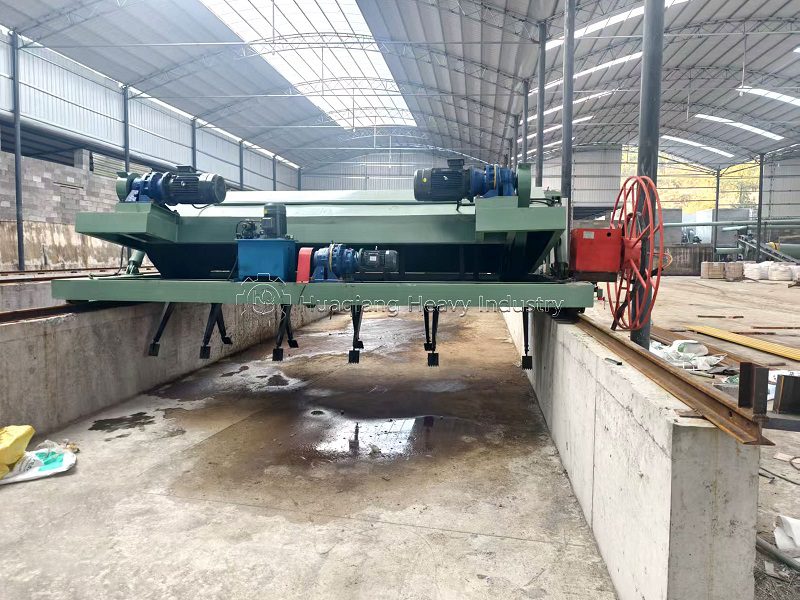
The trough-type compost turner system consists of a fermentation trough (typically 3-6 m wide and 1.2-1.8 m deep), a track-mounted turning and composting unit, and an aeration or drainage network at the bottom of the trough. The trough length is customized according to the site (commonly 30-100 m), and it is recommended to configure 2-3 parallel troughs to maintain a continuous flow of “feed-fermentation-discharge”.
A critical maintenance requirement: The gap between the turning blades and the bottom of the trough should be maintained at 3-5 mm. If the gap is too large, the bottom material will not be turned, creating an anaerobic dead zone; if the gap is too small, scraping and jamming may occur.
II. Turning Frequency: Driven by “Temperature,” Not “Calendar”
In the operating logic of the trough-type compost turner, turning is not a timed clock-in, but a temperature control method.
First Week (Heating Phase): 1-2 times/day. At this time, high-frequency turning is needed to introduce oxygen and drive the compost pile to quickly exceed 55°C. Turning depth can be shallower (0.8-1.2 m) to avoid excessive heat loss.
High-temperature period (after stabilization at 55-65℃): 2-3 days/time. Reduce frequency to maintain core temperature, while breaking up the compacted bottom layer through deeper turning (1.0-1.5 m). If the core temperature exceeds 65℃, turning must be done immediately to dissipate heat and protect beneficial bacteria.
Cooling and maturation period (after approximately 16 days): 3-5 days/time. Switch to shallow turning to retain residual heat for stabilization. Remember, “1-2 times/day” is only a tactic during the warming period and should not be used throughout the entire cycle.
III. Depth and Moisture: The Inextricable Link Between Viscosity and Resistance
The fermentation moisture window is strictly locked at 50%-65% (the critical point where it clumps when squeezed but crumbles upon impact). This is not a suggestion, but a red line. When the moisture content exceeds 65%, the material viscosity increases sharply, forming a “mud cake” between the blades, causing a 30%-40% surge in motor load at standard speeds. The matching rule for turning depth: Shallow turning (0.8-1.2 m) during the warming period to prevent overcooling; deep turning (1.0-1.5 m) during the high-temperature period to break up dead zones. If turning is only done on the surface for a long time, the bottom material will be compacted and enter an anaerobic state.
IV. Ventilation and Temperature Closed-Loop
A bottom aeration system should be installed at the bottom of the tank, combined with mechanical turning, to form a three-dimensional oxygen supply network of “bottom micro-oxygen + surface turning”. During the active fermentation period, the oxygen concentration in the pile needs to be maintained above 10%. Operators only need to monitor one indicator: monitor the core temperature in the tank at multiple points every day. If the temperature does not rise after turning, it indicates oxygen deficiency or carbon-nitrogen imbalance; if the temperature remains high, it indicates insufficient turning depth or too low frequency.
V. Failure Cause Troubleshooting Table
| Fault Phenomenon | Possible Causes | Corrective Measures |
|---|---|---|
| Motor overload or frequent tripping | Moisture >65% causing material winding, fast feeding; blocked cooling holes | Reduce moisture to 50%—60%; Clean residual material at the front of the drum before restarting; Clean cooling fan and air ducts |
| Uneven turning / Material left at the bottom of the trough | Gap between blades and trough bottom >5 mm or blade wear; Track deviation | Readjust gap to 3—5 mm; Replace blades with wear exceeding 1/3; Clean track and calibrate wheelbase |
| Slow temperature rise in the first week | Insufficient turning frequency; C/N ratio imbalance; Moisture deviates from optimal range | Increase to 1—2 times/day; Check C/N ratio (25:1—30:1); Adjust moisture to 55%—65% |
| Pile temperature exceeds 65℃ | Turning frequency too low or insufficient depth | Turn immediately; Deepen turning depth to 1.0—1.5 m; Turn on bottom aeration to assist heat dissipation |
CTA: If your fermentation section is dragging down the overall production line capacity or causing inconsistent product decomposition, do not simply copy the generic dimensions from the product catalog. We need to calculate the tank width, guide rail specifications, and control logic for the turning and composting unit based on your daily fresh manure production, initial moisture content, and carbon-to-nitrogen ratio.