
Basic Principles of Aerobic Fermentation: The essence of composting fermentation is the decomposition of organic matter in organic materials by microorganisms under aerobic conditions. During decomposition, microorganisms release heat, gradually raising the pile temperature to 55-70℃. This temperature range effectively kills pathogens and weed seeds while accelerating the maturation of organic matter.
The key to aerobic fermentation is “oxygen supply.” Microbial activity requires sufficient oxygen. If there is insufficient oxygen in the pile, fermentation will shift to an anaerobic state, producing malodorous gases such as hydrogen sulfide and ammonia, while significantly reducing the fermentation rate. The core function of turning is to mechanically turn the outer layer of material into the interior and the inner layer to the surface, ensuring uniform contact of the entire pile with fresh air and maintaining an aerobic environment.
Operational Points for Turning: Turning is not necessarily better the more frequent it is; the frequency needs to be adjusted according to the fermentation stage and the state of the material. In the early stages of fermentation (the first 3-5 days), microorganisms are rapidly multiplying, and the pile temperature rises quickly. It is recommended to turn the pile every 24-48 hours to ensure oxygen supply. Once the high-temperature stage begins (pile temperature reaches above 60℃), the turning frequency can be reduced to once every 2-3 days to prevent excessive heat loss. Once the maturation stage begins (pile temperature gradually drops below 40℃), turning the pile 1-2 times per week is sufficient.
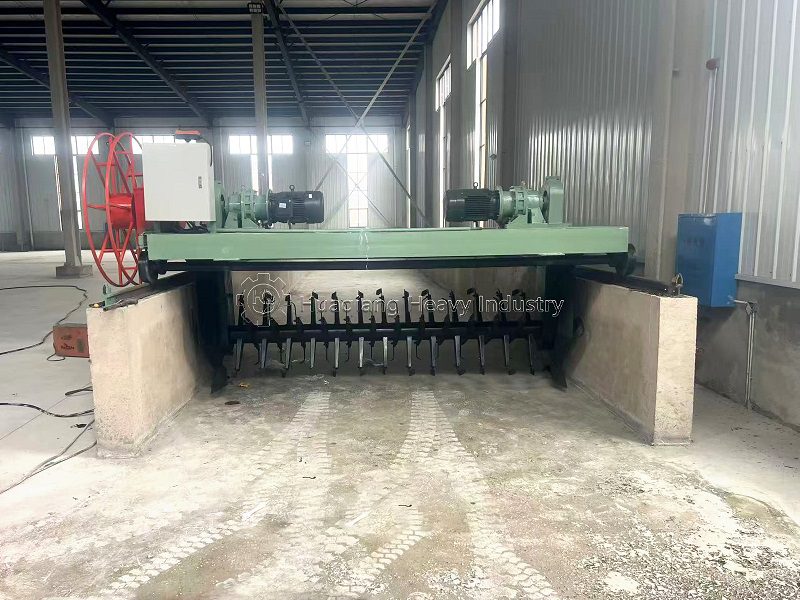
The depth of turning is also important. For windrow composting, the turning machine should thoroughly mix the top 10-15 cm and the bottom 5-10 cm of material to ensure uniform fermentation throughout the pile. The equipment speed should not be too fast during turning, typically controlled at 5-10 meters per minute, to ensure the material is fully dispersed and aerated.
Temperature and Moisture Control
Temperature is the most direct indicator of fermentation progress. It is recommended to insert thermometers at different locations within the pile (30-50 cm below the surface) and record the readings daily. When the pile temperature exceeds 70℃, it indicates excessive microbial activity, requiring immediate turning and cooling; otherwise, beneficial microorganisms will be killed. When the pile temperature remains below 45℃ for an extended period, it indicates insufficient oxygen supply or excessive moisture, necessitating increased turning frequency.
The moisture content of the material directly affects fermentation efficiency. The ideal initial moisture content is 55%-65%, forming a clump when squeezed but crumbling easily upon impact. Excessive moisture will clog material gaps, hindering oxygen diffusion; insufficient moisture will inhibit microbial activity. Turning itself has a natural drying effect, reducing moisture content by 2%-5% with each turn. If the material is too dry, a small amount of water can be sprayed during turning; if too wet, the turning frequency and aeration time need to be increased.
The successful implementation of fermentation composting turning technology relies on proper turning frequency and depth. The choice of turning equipment—a large wheel compost turner (or large wheel compost turning machine) for open-air windrows, a windrow composting machine for flexible operation, or a trough-type compost turner for controlled environments—directly impacts oxygen supply and temperature regulation. A trough-type aerobic fermentation composting technology system with a dedicated turner is ideal for controlled, continuous production. The agriculture waste compost fermentation machine is the core of this process. Turning strategy: early fermentation (days 1-5, turn every 24-48 hours, temperature rises quickly), high-temperature stage (pile >60°C, turn every 2-3 days to prevent excessive heat loss), maturation stage (<40°C, turn 1-2 times/week). Turning depth should mix the top 10-15 cm and bottom 5-10 cm, with equipment speed controlled at 5-10 m/min. Temperature control: insert thermometers 30-50 cm below the surface; turn immediately if >70°C; if persistently <45°C, increase turning frequency. Moisture control: ideal initial moisture 55%-65% (“clump formed when squeezed, crumbles upon impact”); turning reduces moisture by 2%-5% per turn; spray small amounts of water if too dry, increase turning frequency if too wet. After successful composting, the mature material is ready for a disc granulation production line. Mastering the art of fermentation composting turning technology—maintaining “full oxygen level, moderate temperature, and suitable moisture content”—is essential for producing fully decomposed organic fertilizer feedstock.
In actual production, appropriate turning equipment can be selected for fermentation sites of different sizes. Large-scale trough fermentation can use trough turners or double-helix turners; windrow composting is suitable for large wheeled turners; and small and medium-sized farms can choose compact mobile turners. Regardless of the type of equipment used, the core objective is to maintain the compost pile at a “full oxygen level, moderate temperature, and suitable moisture content” in order to obtain fully decomposed organic fertilizer raw materials.