
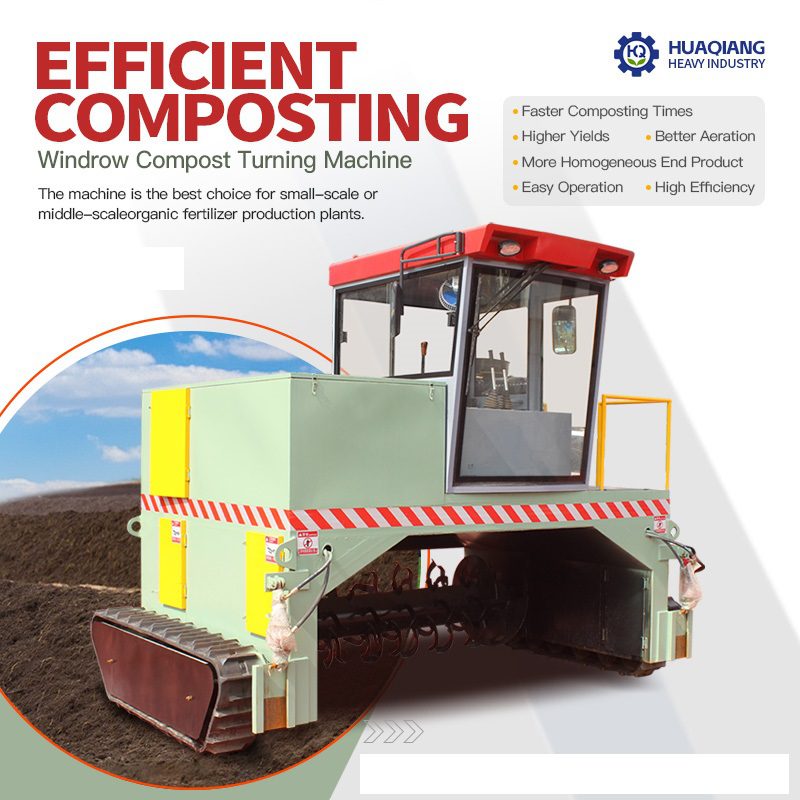
In organic fertilizer production, open-air windlass fermentation is the most common and economical method, and the windlass turner is the “main equipment” in this process. Its function is not only to supplement the material with oxygen, but also to evenly mix the inner and outer layers of material through turning, ensuring that each part undergoes a complete high-temperature composting process. Huaqiang Heavy Industry’s windlass turner features a mobile design, allowing for flexible turning and adaptability to various open-air sites, making it the first choice for many farms and organic fertilizer plants. This article will provide a complete breakdown of how to effectively use this equipment and maximize the efficiency of open-air fermentation, covering topics from stockpile planning, equipment operation, operating frequency to daily maintenance.
Stockpile Planning: Good Turning Starts with the “Pile”
The effectiveness of a windlass turner depends half on the rationality of the stockpile planning. Many users pile materials haphazardly, resulting in the equipment being unable to reach deep enough or missing areas, significantly reducing the fermentation effect.
The size of the material pile is crucial: According to the design parameters of the Huaqiang bar stack turning machine, a pile width of 2-4 meters is most suitable, and a height of 1-1.5 meters. This size ensures that the turning blades can effectively penetrate to the bottom while maintaining good heat and water retention properties of the pile. If the pile is too wide, the middle area cannot be turned; if the pile is too high, the pressure on the bottom material is too high, resulting in poor air permeability.
Sufficient “turning space” is essential: A 0.8-1 meter passage should be left between adjacent piles to facilitate equipment movement and turning. At least 3 meters of open space should be left at the ends for easy equipment turning. A passage that is too narrow puts too much pressure on the operator and is prone to collisions with the pile; a passage that is too wide wastes space.
Adjustable width for flexible adaptation: The turning width of the Huaqiang bar stack turning machine can be adjusted according to the actual size of the pile. No parts replacement is required, and one person can operate multiple sizes of piles with just one machine.
Key Points for Equipment Operation: Uniform Speed, Straight Line, and Thorough Depth
Correct operating habits are the guarantee of efficient equipment operation and the key to ensuring uniform fermentation.
Two Pre-Start Checks: Before starting, check if the tire pressure is sufficient. Insufficient tire pressure will cause the machine to veer off course. Check the turning blades for looseness or wear. Severely worn blades should be replaced promptly, otherwise the turning effect will be greatly reduced.
Uniform Speed and Straight Line Movement: During operation, maintain a uniform speed and straight line movement, ideally controlled at 2-4 meters per minute. Inconsistent speed will lead to unstable turning depth and missed areas. During movement, the operator should look ahead and maintain a parallel distance from the edge of the material pile to avoid “edge-biting” or “veering off course.”
Precise Control of Turning Depth: The turning blades should penetrate 30-50 centimeters into the material pile to ensure that the bottom material is thoroughly turned. If the depth is too shallow, the bottom material will remain in an oxygen-deficient state for a long time, resulting in incomplete fermentation; if the depth is too deep, it may touch the ground and damage the blades. Huaqiang equipment is equipped with a hydraulic lifting device, allowing operators to adjust the turning depth in real time from the cab for precise control.
III. Scientific Operating Frequency: Temperature as a Guide
Turning the pile is neither too frequent nor too infrequent; the scientific basis lies in the changes in the pile temperature.
Early Fermentation Stage (Days 1-7): Microorganisms are just starting to activate, requiring a large amount of oxygen. It is recommended to turn the pile every 2 days. After each turning, the pile temperature will briefly drop, but will quickly rise back above 60℃ due to increased microbial activity.
Middle Fermentation Stage (Days 8-15): The pile temperature remains at a high temperature of 55-65℃, and organic matter decomposes rapidly. Turning can be adjusted to once every 3 days to maintain oxygen supply while preventing excessive heat loss.
Late Fermentation Stage (Day 16 and beyond): The temperature gradually decreases, and the material tends to stabilize. Turning once every 5 days is sufficient until decomposition is complete.
Key Principle: Regardless of the stage, once the internal temperature of the pile exceeds 65℃, it should be turned immediately to cool it down. Excessive temperatures can kill beneficial microorganisms and even pose a risk of spontaneous combustion.
Practical Case Study: Fermentation Completed in 15 Days
An organic fertilizer plant used a 3:1 mixture of chicken manure and straw for fermentation on a 2000 square meter site, employing a Huaqiang Heavy Industry windrow turner. Following the aforementioned techniques, the material piles were planned (3 meters wide, 1.2 meters high, 1 meter spacing), and a strict turning frequency of “once every 2 days in the initial stage, once every 3 days in the middle stage, and once every 5 days in the later stage” was implemented. The results were surprising:
The fermentation cycle was shortened from the conventional 25 days to 15 days, increasing efficiency by 40%.
The maturity test reached over 95%, and the seed germination index fully met the standards.
The production cost per ton of product was reduced by approximately 20%, mainly due to the shortened fermentation time and reduced labor.
Routine Maintenance: Extending the Equipment’s Lifespan
Walking System: Clean the mud and grime from the tracks (or tires) after each shift to prevent hardening and impede movement. Check the chain tension weekly and adjust as needed.
Turning Blade Assembly: Check blade wear every 50 hours of operation. Replace blades when they wear down to half their original thickness. Huaqiang turning machine blades are made of wear-resistant alloy and are reversible, extending their lifespan.
Lubrication and Maintenance: Before each day’s operation, apply grease to all lubrication points, especially the turning shaft bearings and the moving transmission parts. Remember: equipment requires 30% use and 70% maintenance.
From stockpile planning to operation frequency, from operational points to daily maintenance—every detail affects the final result of open-air fermentation. Huaqiang Heavy Industry’s windrow turning machine, with its stable performance and user-friendly design, helps you upgrade the fermentation process from “by feel” to “controllable.” When your stockpile is evenly decomposed within 15 days, and when the turned material is fine, loose, and fragrant, you will understand: the right equipment combined with scientific operation is the true secret to efficient fermentation.
The detailed operational guide for the windrow turner embodies the practical application of fermentation composting turning technology. The windrow turner itself is a classic example of a windrow composting machine, serving as an efficient agriculture waste compost fermentation machine. Its success hinges on understanding that it is not just a piece of equipment, but a system integrated with proper windrow design. The pile dimensions (width, height, and spacing) are not arbitrary; they are calculated to match the turning machine’s reach and ensure complete, uniform aeration across the entire pile cross-section. The turning frequency, guided by pile temperature monitoring, is a critical application of fermentation composting turning technology, balancing oxygen supply with heat retention to optimize microbial activity. By mastering these principles—correct windrow geometry, precise equipment operation, and temperature-guided scheduling—the windrow composting machine becomes a powerful tool, transforming raw agricultural waste into stable, mature compost efficiently and cost-effectively.