

In modern agricultural production, NPK compound fertilizers are hailed as the “golden formula for crop nutrition,” and the core technology realizing this precise formulation is the NPK fertilizer production line. This highly automated production system can precisely combine the three major nutrient elements—nitrogen (N), phosphorus (P), and potassium (K)—in scientific proportions, providing customized nutritional solutions for different crops at various growth stages, completely transforming traditional agricultural fertilization methods.
Nitrogen (N)
Promotes plant stem and leaf growth, enhances chlorophyll synthesis, serving as the “power source” for plant growth. In NPK fertilizers, nitrogen content typically ranges from 15-30%.
Phosphorus (P)
Promotes root development and flower/fruit formation, improves crop stress resistance, acting as the “catalyst” for plant flowering and fruiting. Phosphorus content usually ranges from 5-20%.
Potassium (K)
Enhances crop disease and stress resistance, improves fruit quality and storability, serving as the “guardian” of crop health. Potassium content generally ranges from 10-30%.
NPK Fertilizer Production Line: Industrial Realization of Scientific Formulations
The core task of the NPK fertilizer production line is to achieve precise proportioning and uniform mixing of the three major nutrient elements. Unlike traditional single-nutrient fertilizers, NPK compound fertilizers require uniform distribution of different raw materials at the microscopic level, ensuring each fertilizer granule contains the same nutrient ratio. Modern production lines transform this scientific ideal into industrial reality through precise metering systems, efficient mixing equipment, and advanced granulation technology.
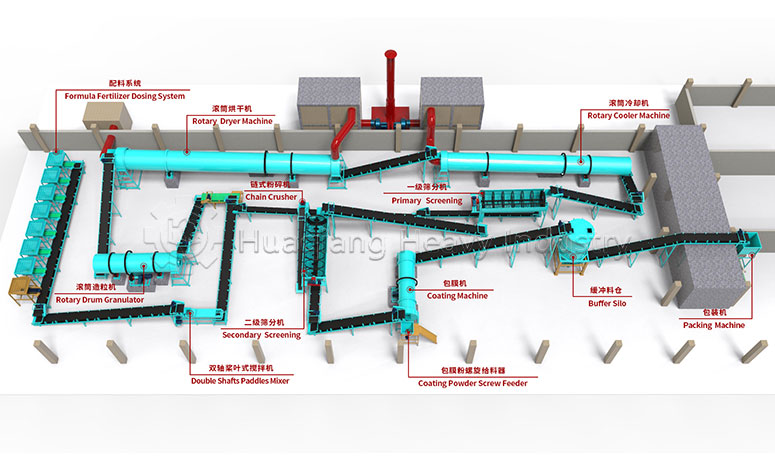
An advanced NPK fertilizer production line is not merely a collection of equipment but a perfect integration of chemistry, mechanical engineering, automation, and agricultural science. It can quickly adjust formulations based on market demands, producing various compound fertilizers from general-purpose to specialized types, meeting diverse needs from field crops to cash crops.
Core Production Process Flow
Raw Material Reception and Pretreatment
Nitrogen sources (urea, ammonium sulfate, etc.), phosphorus sources (monoammonium phosphate, diammonium phosphate, etc.), potassium sources (potassium chloride, potassium sulfate, etc.), and medium/trace elements are stored separately in dedicated silos. Raw materials undergo crushing and screening to remove impurities, ensuring uniform particle size.
Precise Metering and Batching
The computer control system precisely measures various raw materials using loss-in-weight feeders or belt scales according to preset formulations. Accuracy can reach ±0.5%, ensuring absolute formulation accuracy. This is a critical step in producing high-quality NPK fertilizers.
Efficient Mixing and Homogenization
Metered raw materials enter twin-shaft or vertical high-efficiency mixers, achieving over 98% mixing uniformity within 3-8 minutes. Necessary binders, anti-caking agents, and other auxiliary materials are added simultaneously in preparation for granulation.
Granulation and Forming
Uniformly mixed materials form granules through rotary drum granulators, disc granulators, or double roller press granulators. Steam or water can be added during granulation to promote agglomeration while controlling granule size and strength.
Drying and Cooling
Moist granules enter drum fertilizer dryer to remove excess moisture, then enter coolers to reduce temperature. This process not only improves granule strength but also prevents caking during storage.
Screening and Coating
Dried and cooled granules are graded through multi-layer vibration screener machine. Qualified products enter coating machines to add anti-caking agents, while non-conforming granules return to crushing or granulation processes, forming a closed-loop circulation.
General-Purpose Formulations
15-15-15: Balanced formulation suitable for most field crops
20-20-20: High-concentration general-purpose fertilizer suitable for cash crops
17-17-17: Good water solubility suitable for drip irrigation fertilization
Specialized Formulations
Corn-specific fertilizer: 28-6-6, high nitrogen for growth promotion
Fruit tree-specific fertilizer: 12-12-17, high potassium for quality improvement
Vegetable-specific fertilizer: 20-10-20, balanced for yield promotion
Special Functional Formulations
Slow-release fertilizers: Added controlled-release agents to extend fertilizer efficiency
Water-soluble fertilizers: High purity, fully water-soluble, suitable for facility agriculture
Biostimulant fertilizers: Added functional substances like seaweed extracts, amino acids
Comparison of Different Production Processes
| Process Type | Rotary Drum Granulation | Disc Granulation | Double Roller Press Granulation |
| Suitable Raw Materials | Powdered, slurry materials | Powdered materials with some viscosity | Dry powdered materials |
| Granule Shape | Spherical, smooth surface | Spherical, relatively smooth surface | Cylindrical, with edges |
| Granule Strength | 15-25N | 10-20N | 20-35N |
| Capacity Range | 10-50 tons/hour | 5-20 tons/hour | 3-15 tons/hour |
| Energy Consumption Level | Medium | Lower | Low |
| Investment Cost | Medium | Lower | Low |
Core Advantages of NPK Production Lines
Modern NPK fertilizer production lines have significant advantages over traditional fertilizer production:
Precise Nutrient Control: Computer control systems ensure accurate proportioning of various nutrient elements with errors less than 1%, meeting specific needs of different crops.
Efficient Resource Utilization: Closed-loop circulation design achieves over 99% raw material utilization, reducing waste. Energy consumption is 30-40% lower than traditional processes.
Flexible Production Capacity: Quick changeover systems can complete formulation switching within 30 minutes, adapting to multi-variety, small-batch market demands.
Excellent Product Quality: High granule uniformity, moderate strength, controllable dissolution characteristics ensure uniform nutrient release in soil.