
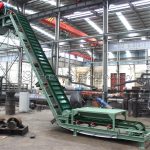
In the complex layout of fertilizer production, the tug-of-war between space and efficiency is ever-present. When traditional horizontal belt conveyors “devour” floor space with their length, and vertical bucket elevators face challenges like material fallback and maintenance, an innovative solution emerges—the large angle belt conveyor. Like a masterful space magician, it can transport materials smoothly and efficiently up steep inclines of 30° to 90°,completely revolutionizing the concept of vertical logistics in plants.
Core Advantages: Unifying Steepness, Stability & High Capacity
The core marvel of the large angle belt conveyor lies in its breaking through the incline limits of ordinary belt conveyors, achieving a perfect balance between conveying capacity and space savings.
Revolutionary Space-Saving Capability
This is its most immediate advantage. It can perform vertical or near-vertical lifting at steep angles of 60° to 90°, with an extremely concise conveying path. Compared to ordinary belt conveyors requiring long sloping runs or complex multi-stage transfer systems, it can shorten horizontal conveying distances by over 70%, freeing up valuable production and storage floor space for plant planning. It is particularly suitable for upgrades of older plants or new projects with space constraints.
Unique Anti-Spill & Stable Conveying Design
Its secret lies in the special belt design: the belt features raised edges (sidewalls) on both sides and is equipped with regularly spaced cleats or buckets across its width. This combination forms a series of enclosed “pockets” that securely “hold” the material. Even at extreme angles, powdered, granular, or small lump fertilizers can be transported safely and without leakage, with minimal product degradation, ensuring material integrity.
Powerful Conveying Capacity & Operational Economy
Despite the steep incline, its volumetric capacity per unit time can match or even exceed that of a standard belt conveyor of equivalent width. A single unit can handle high-volume, high-lift tasks, reducing the number of devices and transfer points, thereby lowering the system’s overall power consumption, potential failure points, and maintenance costs. Its operation is smooth and quiet, making it an ideal backbone conveying equipment for continuous, automated production.
Synergistic Production: The “Vertical Highway” Connecting Process Stages
In modern fertilizer production lines, the large angle belt conveyor acts as a “vertical highway” connecting process stages at different elevations.
Connecting “Pre-processing” with the “Main Line”: Lifts raw materials from loader feeding hoppers or pits via the most direct route to the intake points of elevated equipment like rotary screener machine, crushers, or mixers.
Serving “Drying & Cooling” Processes: Quickly elevates fertilizer (still warm) from the discharge end of dryers or coolers to subsequent screening or packaging floors, enabling efficient transfer of hot materials.
Executing the Final Lift for “Finished Product Storage”: Vertically conveys bagged or bulk finished products to the stacking area of high-bay warehouses, maximizing the use of three-dimensional storage space.
As a Powerful Alternative to “Bucket Elevators”: In scenarios with high handling capacity, sticky materials, or a need for gentler handling, the large angle belt conveyor offers superior anti-clogging and easier cleaning options, with more convenient maintenance.
Evolution & Outlook: Smarter, More Reliable Vertical Logistics
With technological progress, the large angle belt conveyor is evolving towards greater intelligence and durability:
Core Component Enhancement: Use of highly wear-resistant, anti-tear belt materials and sturdy steel cleats greatly extends service life. New “tubular” or “deep-troughed” large angle designs achieve fully enclosed conveying, taking environmental performance to the next level
Integrated Intelligent Monitoring: Equipped with belt misalignment detection, slip monitoring, automatic tension adjustment, and run-off alarms. IoT integration uploads operational data to the central control room, enabling predictive maintenance and energy efficiency management.
Modularity & Customization: Offers more flexible drive, tensioning, and intermediate frame configurations, allowing for customized non-standard designs based on site space and process requirements, enhancing adaptability.
Conclusion
In summary, with its ground-breaking space utilization, outstanding conveying reliability, and significant economic benefits, the large angle belt conveyor has become a strategic choice for vertical logistics in modern fertilizer plants. It does more than just save a few meters of floor space; by optimizing the entire plant’s material flow, it provides solid skeletal support for compact, continuous, and intelligent production processes. In an era of rising land costs and the relentless pursuit of production efficiency, this highly effective “space magician” continues to empower fertilizer manufacturers to create boundless production possibilities within finite physical space.