
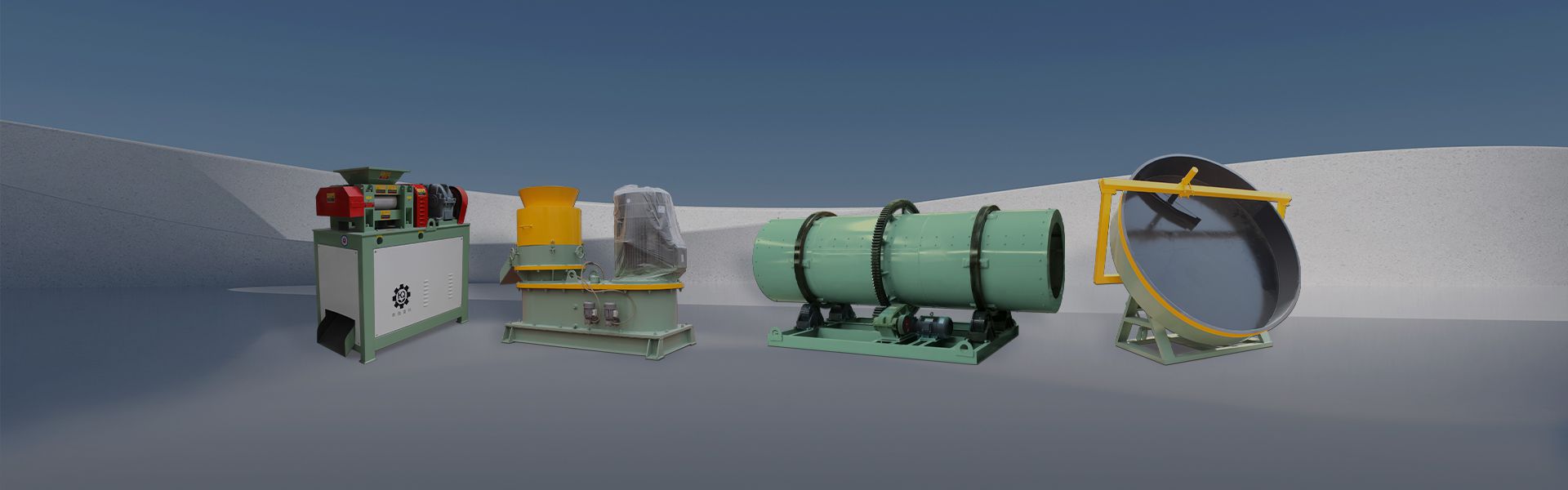
The difference in choosing between trench-type and tracked compost turners isn’t about “which is better,” but rather the site shape and required turning depth. For standardized fermentation troughs, trough widths of 3-6 m, and a focus on uniform turning and automated operation, choose a trench-type compost turner”(trough-type compost turner). Typical turning depths are 0.8-1.8 m, with deep-trough models reaching 2.5 m. For sites without fixed troughs, irregular terrain, or where windrows need to be moved, choose a tracked compost turner. Typical turning depths are 0.6-1.8 m, with a working width of 1.5-3 m. There is some overlap in the 1.5-1.8 m depth range between the two. The final decision should come down to two key constraints: “whether there is a trough” and “whether turning needs to cover the entire width of the trough.”
I.Consider a key constraint: Does your site have a “trough”?
Trough-type compost turners rely on fermentation troughs for operation, moving above the trough via guide rails or tracks. The turning device spans the width of the trough. Fermentation trough widths are typically 3-6 m, with some large models exceeding 12 m. Turning depths are generally 0.8-1.8 m, with deeper trough chain plate or wheel models reaching 2.0-2.5 m. Its operating boundaries are locked by the trough, and the uniformity of turning depends on the precision of the guide rails and the alignment of the turning device with the trough width.
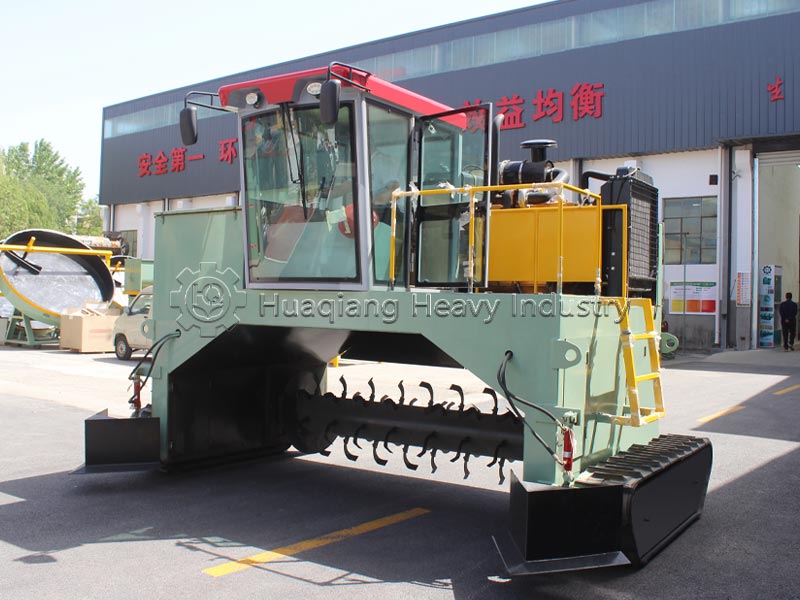
Tracked compost turners(windrow composting machine) do not require troughs. Materials are directly piled into trapezoidal windrows on a flat site. The equipment straddles the windrows or moves along their sides, turning as it goes. Windrow base widths are typically 2-4 m, heights 1-1.5 m, and turning widths 2.5-4 m. Its advantage lies in its flexibility in relocation; the same equipment can move between different windrows, making it suitable for irregular sites or scenarios requiring rotating fermentation zones.
Conditional Conclusion: Sites with existing concrete fermentation tanks or planned for construction → trough-type route; sites with open-air flat ground, flat ground inside greenhouses, or requiring frequent relocation → tracked route. This judgment has higher priority than all other parameter comparisons.
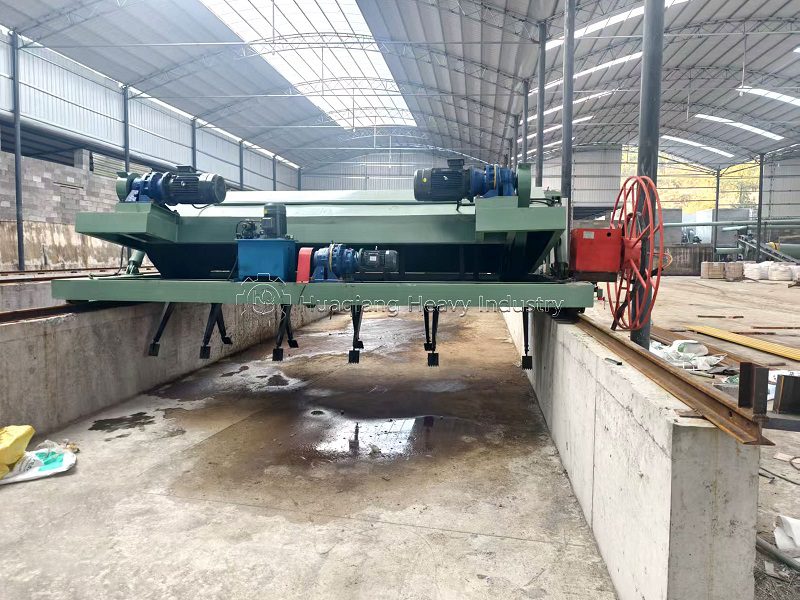
II. Turning Depth: Overlapping Area and Boundary Point of Two Routes
Turning depth is the most easily generalized parameter in turning machine selection. Comparing the depths of the two routes in the same table reveals the true decision boundary.
| Comparison Item | Trough Type Compost Turner | Crawler Type Compost Turner |
|---|---|---|
| Standard Turning Depth | 0.8—1.8 m | 0.6—1.8 m |
| Depth of Deep Trough / Large Models | Up to 2.0—2.5 m | Usually not exceeding 1.8 m |
| Working Width | 3—6 m (Customized according to trough width) | 1.5—3 m (Graded according to width) |
| Trough / Windrow Constraints | Must have a fermentation trough | No trough required; windrow bottom width 2—4 m |
| Typical Applicable Scale | Daily processing capacity of 5—20 tons and above | Starting from 1—5 tons per day, scalable |
Data Definition: The depth ranges mentioned above are cross-checked from publicly available parameters from multiple equipment manufacturers. For trough-type machines, 0.8–1.8 m is the standard range; for tracked-type machines, 0.6–1.8 m covers small to medium-sized models. The overlap zone is 1.5–1.8 m: If your target turning depth falls within this range, both routes can achieve it. At this point, the availability of a trough and the required turning uniformity become the decisive variables.
When the target depth exceeds 1.8 m, tracked routes typically lose competitiveness, and deep-trough trough machines or chain-plate machines become the only option. Conversely, if the site cannot be troughed and the depth requirement is below 1.2 m, the tracked route’s site adaptability and relocation capability constitute a structural advantage.
III. Turning Uniformity and Operational Stability:
The core benefit of the trough route comes from “constraints.” The turning uniformity advantage of the trough turner essentially comes from the constraint of the fermentation trough on the material boundaries. The turning device operates within a fixed span, preventing material from spilling to the sides, and the turning teeth or auger can cover the entire cross-section of the trough. Under conditions of matching trough width and material moisture content of 55%–65%, the temperature of the compost pile after turning can be stabilized within the harmless range of 55–65℃, and the fermentation cycle can be controlled within 15–25 days.
The uniformity of a tracked compost turner depends on the matching of the windrow parameters with the equipment width. The windrow width typically needs to be 0.3–0.5 m smaller than the turning width to allow space for the track to move; if the windrow is too wide, material on both sides will be missed, increasing the risk of localized anaerobic digestion. In other words, the tracked route transfers the “constraints of the trough” to the operator—the width and height of the windrows need to be stacked neatly for each batch.
Implications for selection: If you prioritize “turning quality that doesn’t depend on operator experience after equipment installation,” a trough route is more suitable; if you accept that “the quality of the windrow stack directly affects the turning effect” and prioritize flexibility, a tracked route is a reasonable choice.
IV. FAQ: Frequently Asked Questions Regarding Trench vs. Tracked Compost Turner Selection
Q1: Should I choose a trough or tracked compost turner for a turning depth of 1.8 m?
Both routes can reach 1.8 m, but 1.8 m is the upper limit for tracked compost turners in their standard range, requiring higher equipment power and greater windrow uniformity. Trench turners operate more stably at a depth of 1.8 m and can be extended to deeper trenches of 2.0-2.5 m. If there is a future need for deeper trenches, prioritize trough turners.
Q2: Can I use a trough turner if there is no fermentation tank?
No. Trench turners rely on fermentation tanks or guide rails for both movement and turning; without a tank, a stable operating baseline cannot be established. When space is limited, tracked or wheeled turners are alternatives.
Q3: At what daily processing capacity will a tracked turner be insufficient?
The bottleneck for tracked turners is not the turning capacity of a single machine, but the number of windrows and the time spent moving between locations. When the daily processing volume increases to the point where multiple long stacks need to be run in parallel and the frequency of turning and turning is required to be high, the multi-stack trough type or the multi-stack shared chain plate type solution has more advantages in terms of labor and consistency. The specific threshold depends on the length of the stack and the frequency of turning and turning, and it is recommended to work backward from “the number of stack turning and turning that can be completed in a single shift”.