
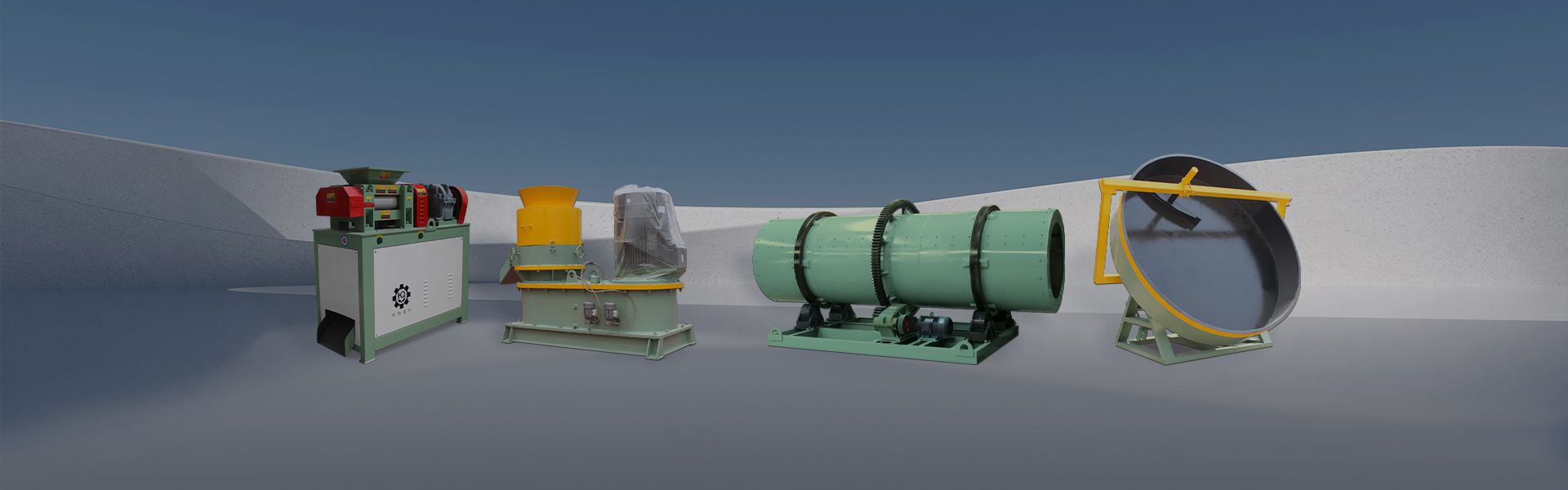
Watch a disc granulator from a distance, and it looks like a flying saucer tilted toward the sky. Step closer, and you realize it is something far more down to earth a spinning steel pan that turns dusty fertilizer powder into round, rolling pellets. No extreme pressure, no heat, no chemical binder. Just a slow dance of powder, water, and gravity.
The disc granulator usually sits in the middle of a fertilizer production line. Upstream, a mixer blends raw materials into a uniform powder perhaps ammonium sulfate, phosphate rock, or fermented organic waste. A belt conveyor feeds this powder into a small hopper above the disc. Downstream, a rotary dryer waits to remove moisture, followed by a rotary screener machine and a packing scale. But the granulator steals the show.

The disc itself is a shallow steel pan, three to five meters in diameter, mounted on a central shaft that tilts at an angle of 40 to 55 degrees. A variable speed motor spins the disc slowly typically 5 to 15 revolutions per minute. The powder feeds onto the disc near the center, close to the bottom of the pan. At the same time, fine water sprays from nozzles mounted above, wetting the particles just enough to make them sticky. As the disc rotates, the powder rolls against the wet bottom surface. Small nuclei form, then grow like snowballs, layer by layer.
An old operator once described it while scraping a stuck lump off the pan edge. “It is like making meatballs, but the bowl spins. Too much water, and you get mud. Too little, and you get dust. The right amount, and the granules roll out perfect round, hard, uniform.” He held up a handful of finished pellets each one 2 to 5 millimeters, dark grey, and almost identical. “That is three minutes of rolling.”
Installation day is all about finding the right tilt and speed. The disc’s support frame must be bolted to a concrete foundation that isolates vibration. A digital inclinometer measures the angle while workers add or remove shims under the pivot. The technician at the control panel adjusts the motor frequency. “Sixty five percent speed,” he calls out. The disc spins slowly. Powder dribbles onto it, rolls for a moment, then slides off unformed. “Too slow,” the operator says. “Seventy five percent.” The disc speeds up. Now the powder clings, rolls, and launches itself over the rim in a steady stream of green pellets. Perfect.
The disc granulator works best with a scraper a fixed blade that rubs against the pan surface, preventing material from building up into thick, hard layers. Without that scraper, the disc would become a heavy, unbalanced mess within an hour. During installation, the fitter adjusts the scraper gap to exactly three millimeters. Too close, and it grinds into the steel. Too far, and sticky powder cakes on. He uses a feeler gauge, sliding it between the blade and the pan surface at four different points. Each reading matches. He tightens the locking nuts and moves to the next scraper.
Downstream, a bucket elevator lifts the fresh, wet granules to a drum fertilizer dryer. The dryer roars, tumbling the pellets in hot air until they become hard and free flowing. A vibrating screen then separates oversize and undersize. The oversize goes to a crusher and back to the disc. The undersize fine powder and small fragments returns directly to the feed hopper for another rolling session. Only the perfect granules proceed to the cooler and packing scale. The disc granulator never wastes anything.