
In large-scale livestock farms, centralized straw processing areas, or municipal sludge composting sites, composting operations are often conducted in open, unpaved outdoor environments. In these situations, crawler type compost turners, with their excellent terrain adaptability, high processing efficiency, and economical fuel economy, become the ideal choice for windlass composting. This article analyzes their advantages from three dimensions: walking mechanism, processing capacity, and fuel efficiency.
Walking Mechanism Design: All-Terrain Compass Capability
Complex ground conditions in large outdoor sites—loose soil, mud after rain, straw residue, undulating slopes, etc.—place stringent requirements on the equipment’s walking system.
Tracked Walking Device: Utilizing wide rubber or steel tracks (typically 400-600mm wide), the ground pressure is as low as 0.3-0.5 kg/cm², only 1/3-1/2 that of wheeled equipment. Even when operating around fermentation tanks with high moisture content or during the rainy season, it will not sink into the mud.
Self-cleaning track patterns: The track plates feature V-shaped or herringbone anti-slip patterns, automatically removing adhering mud and manure to prevent slippage. Some models are also equipped with hydraulic tensioning devices that automatically adjust track tension according to ground softness, reducing the risk of derailment.
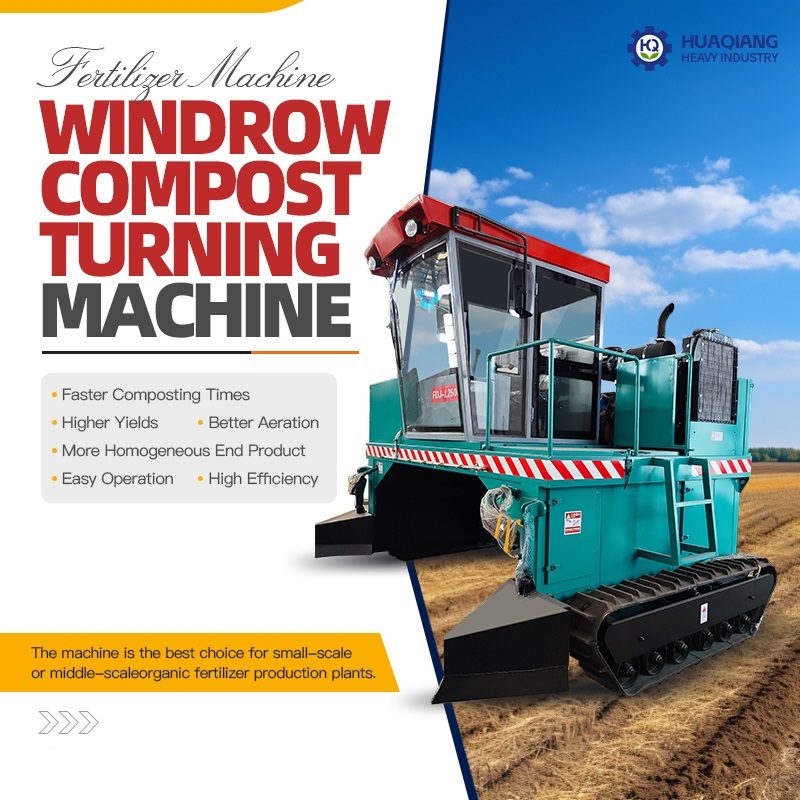
Flexible steering: Achieves 360° turning on the spot through differential speed of the left and right tracks, with a near-zero turning radius. Compared to wheeled compost turners requiring a 10-15 meter turning radius, tracked turners can more efficiently complete the reversal of windrow ends, making them particularly suitable for irregular plots.
Processing capacity: Wide width and high output. Large-scale field composting requires equipment to complete large-area turning tasks within a limited time.
Turning width: The working width of crawler type compost turners is generally between 2.5-4 meters, covering the entire windrow surface in one operation. With roller-type or cutter-type turning devices, the maximum turning depth can reach 1.2-1.8 meters, fully replacing the inner and outer layers of material in a single pass.
Hourly Processing Capacity: Taking a common 280-horsepower model as an example, the hourly capacity for processing cow manure and straw mixtures can reach 400-600 cubic meters. This means that a 10,000 cubic meter fermentation site can have all materials initially turned within 20-25 hours using a single tracked compost turner.
Continuous Operation Capacity: The tracked structure distributes stress evenly, allowing for long-term continuous operation. The fuel tank capacity is generally 200-400 liters, and a single fill can meet 8-12 hours of operation, reducing refueling stops.
III. Fuel Efficiency: Superior Unit Cost to Wheeled Machines
Although tracked equipment is heavier, its actual unit fuel consumption is not higher than that of wheeled machines, and may even be more economical under certain conditions.
Low Rolling Resistance: The track has a large contact area with the ground, resulting in approximately 30% less compaction resistance on soft surfaces compared to tires. Experimental data shows that at the same turning depth and speed, the fuel consumption per ton-kilometer for a tracked compost turner is approximately 0.25-0.30 liters, while that for a wheeled machine is 0.35-0.45 liters. Hydraulic Load Sensing System: Modern crawler type compost turners employ variable displacement pumps and load-sensitive valves. When turning resistance is high, the hydraulic pressure automatically increases; when resistance is low, the flow rate decreases, avoiding energy waste. Compared to a fixed displacement pump system, this can save 15%-20% on fuel.
Economy Speed Operation: In field operations, composting is typically done at a low speed of 1.5-3 km/h. At this speed, the engine is in its economical RPM range (1400-1800 rpm), ensuring more complete fuel combustion. The operator can switch between two speed settings at any time based on the material density.
Typical Application Scenarios and Selection Recommendations: crawler type compost turnersare particularly suitable for:
Large dairy/pig farms: Mixed manure and bedding in windrows, with unhardened ground;
Municipal sludge treatment: Sites often have leachate, and the ground is slippery;
Straw collection and storage centers: Direct composting in fields with undulating terrain.
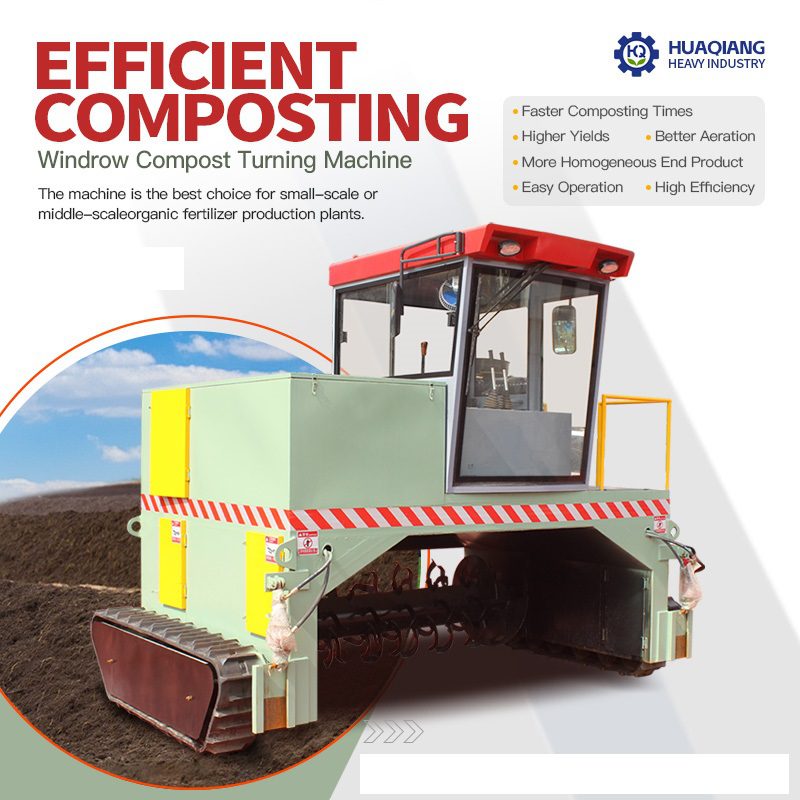
When selecting a model, please note: Rubber tracks are suitable for cement or compacted surfaces, while steel tracks are more wear-resistant but can damage road surfaces. An engine power of ≥150 horsepower is recommended; otherwise, the turning depth will be insufficient. Routine maintenance includes cleaning mud from the inside of the tracks daily and checking the wear of the track rollers and drive teeth every 200 hours.
The crawler type compost turner is more than just a piece of machinery—it is the heart of modern fermentation composting turning technology for large‑scale outdoor operations. As a robust windrow composting machine (crawler type compost turner), it excels in handling the challenging composting process for animal manure on unpaved, muddy, or uneven terrain, ensuring thorough aeration, temperature control, and moisture regulation. For dedicated manure treatment, when paired with a chicken manure fertilizer machine or other animal manure compost turner, it transforms raw, high‑moisture waste into stable, odor‑free organic material within weeks. This turning stage is a critical step in the broader fertilizer manufacturing process, bridging raw composting with downstream granulation, drying, and packaging. Moreover, integrating the crawler turner with advanced bio-organic fertilizer production technology allows for the uniform incorporation of microbial inoculants during turning, enhancing biological activity and accelerating humification. In short, the crawler type compost turner offers an all‑terrain, high‑capacity, and fuel‑efficient solution that significantly reduces labor and time costs, making it indispensable for any large‑scale composting site. By choosing the right track configuration, engine power, and turning depth, operators can achieve consistent, high‑quality compost that meets the strictest standards—turning organic waste into a valuable resource for sustainable agriculture.
In summary, crawler type compost turners, with their all-terrain capability, wide-area high-yield operation, and excellent fuel economy, have become the irreplaceable mainstay for large-scale field composting. We specialize in the research and development and manufacturing of crawler type compost turners, offering a full range of models from 150-280 horsepower and matching turning devices—whether in muddy wetlands or soft field ridges, their all-terrain capability, wide-area high yield, and economical fuel consumption make your field composting operations twice as efficient.