
The fermentation stage is the bottleneck of the entire organic fertilizer production line. The trough-type compost turner fermentation system determines whether harmless treatment is thorough and composting is uniform. Improper coordination of the three parameters—turning frequency, turning depth, and material moisture content—will lead to a chain reaction of “no temperature rise, anaerobic digestion, and strong odor.”
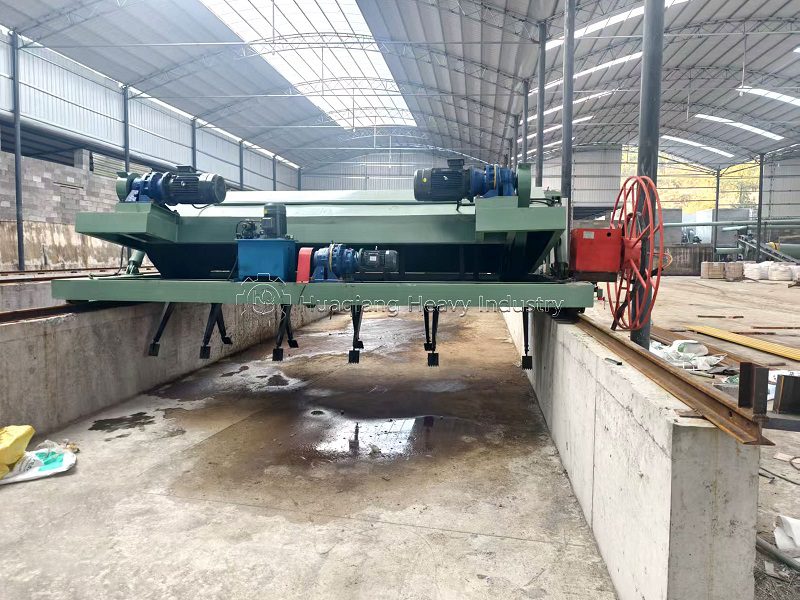
Trough-type fermentation system composition
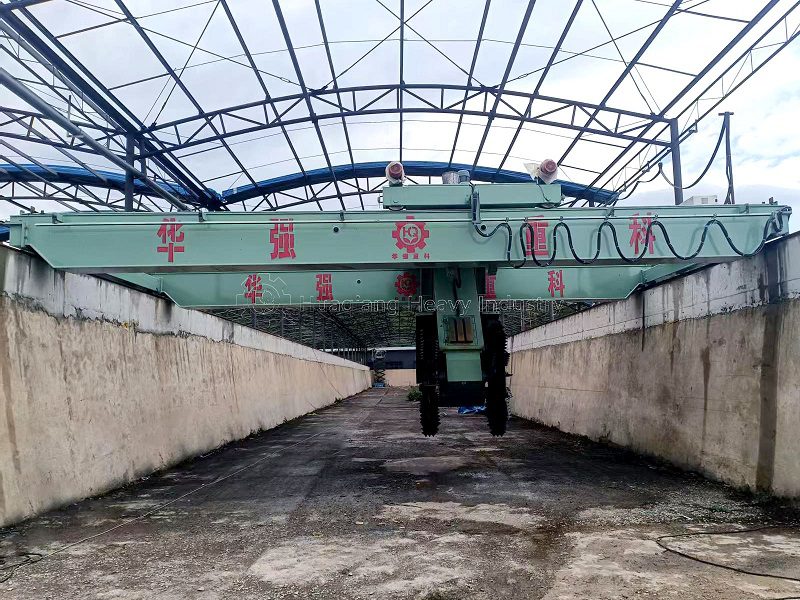
The system consists of a fermentation trough, a traveling track, the trough-type compost turner main unit, a moving trolley, and a ventilation and aeration device. The turner operates along the track, with the cutter rollers throwing, breaking up, and propelling the material forward, simultaneously supplying oxygen and mixing it. The trough dimensions (width, length, and depth) directly determine the turning depth and single-batch processing capacity; therefore, the trough size should be determined first, followed by matching the compost turner model.
Turning Frequency: High in the first week, decreasing later
The first week is the aerobic, high-temperature period. Turn the material 1-2 times daily to maintain a temperature of 55-65℃ and supplement oxygen. From the second week onwards, reduce the frequency to once every 3-5 days to prevent excessive heat loss. The frequency is not fixed and should be based on the temperature curve: if the material temperature exceeds 65℃, increase the frequency of turning to dissipate heat; if it is below 50℃, check oxygen supply and moisture content.
Turning Depth and Material Moisture
The turning depth should cover the entire cross-section of the material layer. Common trench depths are 0.8-1.8 m. Insufficient depth will cause anaerobic conditions at the bottom. Material moisture content should be controlled between 50% and 65%: below 50%, fermentation is slow; above 65%, pores are filled with water, preventing oxygen from entering, easily leading to anaerobic conditions and producing odors. For high-moisture chicken manure, it is recommended to perform solid-liquid separation or premix with auxiliary materials to adjust moisture content.
Ventilation and Temperature
Oxygen for aerobic fermentation is supplied by both turning and bottom aeration. Aeration rate should be dynamically adjusted according to the frequency of turning and composing, aiming to maintain the material temperature between 55-65℃. Excessive temperature will kill beneficial bacteria and cause nitrogen loss. The temperature should rise within 2-4 hours after turning and composing; failure to do so indicates an imbalance in moisture or carbon-to-nitrogen ratio.
Common Failures and Troubleshooting
| Phenomenon | Common Causes | Countermeasures |
|---|---|---|
| Temperature does not rise | Excessive moisture, imbalanced C/N ratio, insufficient oxygen supply | Adjust moisture to 50%-65%, add bulking agents, increase turning frequency |
| Anaerobic odor | Insufficient turning depth, material layer too thick | Deepen turning, reduce material layer thickness, increase aeration |
| Moisture too high | Raw material not dewatered, rainwater ingress | Solid-liquid separation, cover to prevent rain, mix with dry auxiliary materials |
| Uneven decomposition | Low turning frequency, insufficient mixing | Increase turning frequency, check the knife roller |
The configuration of a trough-type compost turner can be matched based on three key factors: raw materials, daily processing capacity, and trough dimensions. More equipment parameters can be found on the trough-type compost turner product page, and process details can be found on the fermentation technology page.