
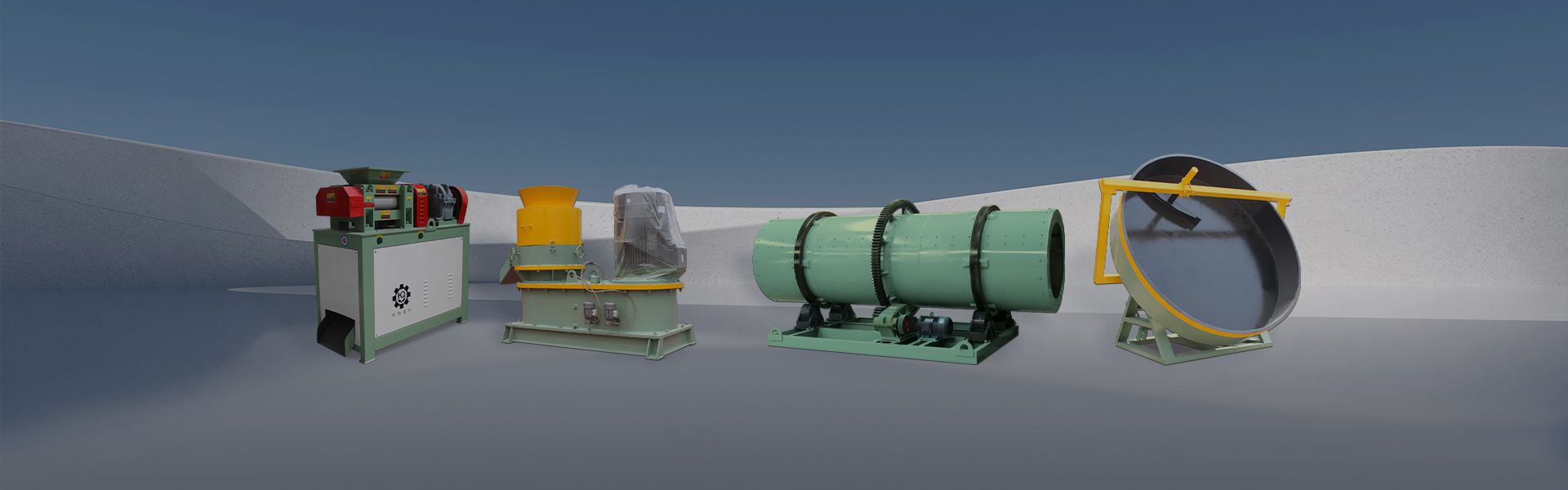
The double roller extrusion granulator is the most mature and stable model in dry granulation technology, widely used in the production of organic fertilizers, organic-inorganic compound fertilizers, and compound fertilizers. Its biggest technological highlight is room temperature forming, no need for water addition, no need for drying, and one-time granulation, making it particularly suitable for the production of temperature-sensitive bio-organic fertilizers containing functional live bacteria.
The core structure of the double roller extrusion granulator consists of a main frame, hydraulic system, double roller molds, feeding mechanism, speed-regulating motor, and transmission system. The most critical component is a pair of custom-made pressure rollers rotating in opposite directions. The roller surfaces are precision-machined into uniform hemispherical grooves, and the two rollers, when joined, form a complete spherical mold cavity. The hydraulic system can provide continuously adjustable pressure from 3 to 20 tons. The pressure directly determines the particle density and hardness, and users can freely set it according to product requirements.
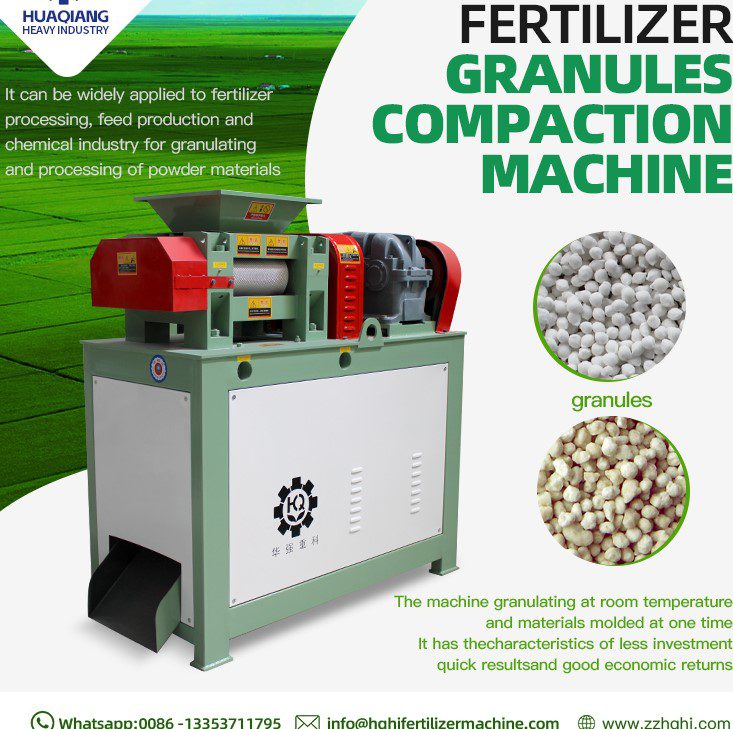
In terms of production details, the double roller extrusion granulator employs forced horizontal feeding. Material is evenly fed into the extrusion zone under the propulsion of a screw, where it is forcefully compacted by the pressure rollers, preventing problems such as hollowness, looseness, and material shortage. The resulting granules have high density, high strength, a smooth surface, are non-hygroscopic, do not soften, and are not easily broken upon landing, fully meeting the requirements for bagged storage and long-distance transportation. Its production process is dust-free, wastewater-free, and environmentally friendly.
The die life is a core advantage of this machine: the pressure rollers are made of manganese steel alloy with quenching treatment, making them wear-resistant and impact-resistant. Their normal service life can reach 800-1200 hours. Furthermore, the dies can be reused on both sides, partially repaired, and reused after wear, significantly reducing consumable costs. Common aperture specifications are 3.0mm, 3.5mm, 4.0mm, and 5.0mm, which can be quickly changed to meet different market demands.
In terms of application scenarios, the double-roller extrusion granulator is particularly suitable for compound fertilizers with high nitrogen, phosphorus, and potassium content and easy moisture absorption, as well as pure organic fertilizers, oilseed cakes, and humic acid fertilizers. The disadvantage is that the finished granules are flat and round, which is not as aesthetically pleasing as round spheres. However, its advantages lie in stable production capacity, extremely low failure rate, and the ability to operate continuously for 24 hours, making it the preferred model for production lines that pursue large-scale, low-cost, and highly stable operations.