
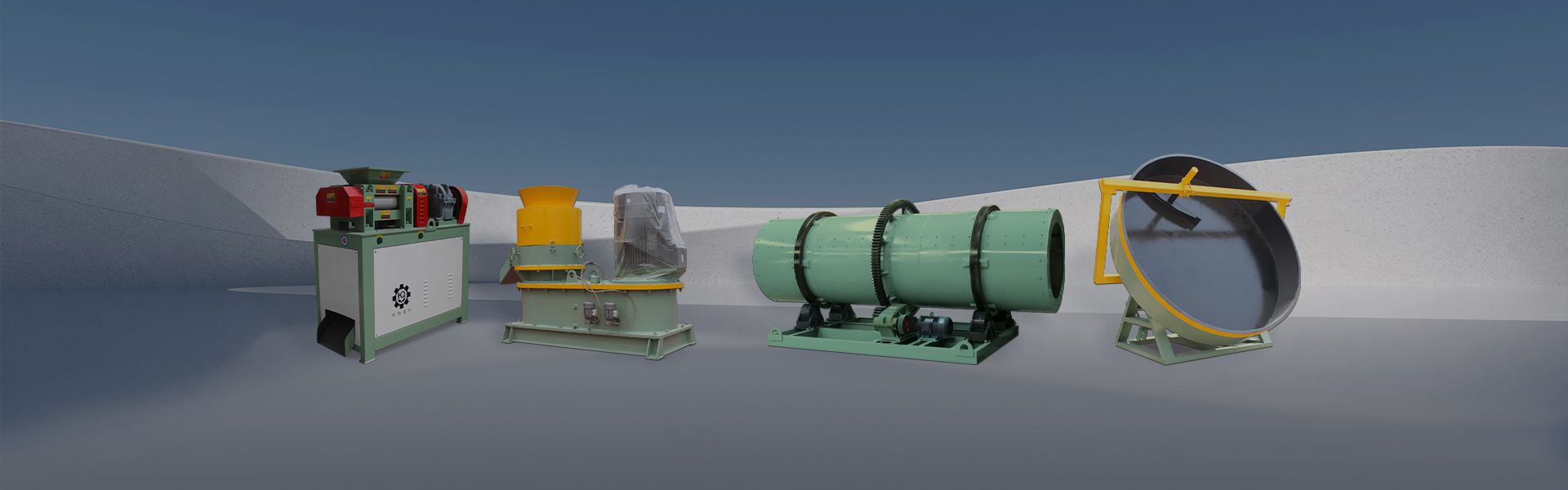
Have you ever witnessed the scene: on one side, mountains of chicken manure, straw, and distiller’s grains emitting pungent odors; on the other, neatly stacked organic fertilizer pellets—plump, round, and carrying the earthy scent of quality compost. The magical journey from waste to wealth is paved by the disc granulation production line, with the ever-tilting, ever-spinning disc granulator at its heart.
The story begins in the raw material yard. Livestock manure, crop straw, mushroom residue, tobacco dust, herbal waste—what others see as garbage becomes precious “feedstock” here. They first enter the crusher. Too wet? Use a semi-wet material crusher. Containing hard impurities? Opt for a chain crusher. The crusher’s sole mission is to reduce everything into uniform fine powder, laying the foundation for subsequent mixing and granulation.
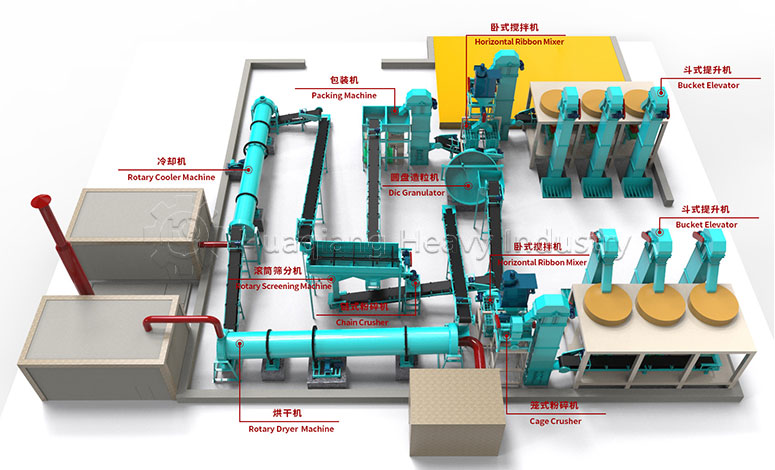
From the crusher, the powder flows into the batching system and mixer. This is the “sauce mixing” stage—based on crop requirements, add nitrogen, phosphorus, potassium, probiotics, humic acid, or blend different batches in precise ratios. The double shaft mixer, with its counter-rotating shafts, repeatedly folds, kneads, and tosses the materials until they achieve perfect uniformity—each particle intimately mingling with the others. This step directly determines whether the final pellets will have balanced nutrition.
Now the main event. The uniformly mixed material enters the inclined disc granulator. As the disc rotates slowly, centrifugal force and friction carry the material upward until it cascades back down. Amid this continuous tumbling, fine water mist sprays from nozzles—and magic happens: tiny powder particles begin adhering to each other, growing like snowballs, rounder and larger. The operator can adjust the disc’s inclination, rotation speed, and spray rate to control pellet size. Want 3 mm small pellets? Increase speed. Need 8 mm large ones? Slow down and steepen the angle. The disc granulator’s greatest charm is its “visible” controllability—every pellet in the disc grows right before your eyes until it reaches the ideal size and automatically spills over the rim.
But freshly discharged pellets are still tender, with high moisture content and prone to deformation. They need a “sauna” and a “cold bath.” First, they enter the rotary dryer, where hot air removes excess moisture, hardening the pellets. Then they rush into the cooler, rapidly dropping temperature to prevent reabsorption and caking. The temperature and duration of drying and cooling must be precisely controlled—too dry loses nutrients, too damp invites mold.
Cooled pellets finally face their “audition.” A vibrating screener sorts them into grades: qualified product pellets happily flow onward; fines and broken pieces return to the production line for another round; oversized pellets are collected separately—they can be crushed and reused or sold as another specification. For higher-quality lines, a coating step follows: wrapping each pellet in a thin layer of biochar, humic acid, or functional microbes, granting them superpowers like slow release, disease resistance, or growth promotion.
Last but not least, the automatic packing scale takes over. Finished pellets are weighed, filled into bags, and sealed—row after tidy row, ready for shipment. From raw material to finished product takes just hours; the entire line from crushing to packaging requires only two or three operators.
This is the disc granulation production line—it transforms pungent waste into round wealth, turning pollution sources into crop nutrients. And at its core is that ever-rotating disc, performing its endless “snowball dance.” Next time you see thriving crops in the field, perhaps you’ll imagine: what nourishes them might just be those round golden nuggets that rolled off some production line.