
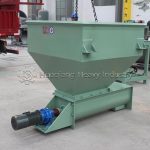
In the grand symphony of fertilizer manufacturing, dramatic equipment like granulators and dryers often take center stage. Yet, the silent maestro ensuring every note is played on time and in perfect measure is the uniform feeder. This unassuming device is the indispensable rhythm keeper of the entire production line, transforming chaotic, bulk material flow into a steady, precise, and controllable stream—the fundamental prerequisite for quality, efficiency, and consistency.
Core Strengths: Precision, Adaptability, and Control
The uniform feeder’s paramount value lies in its mastery over the very heartbeat of the process: material flow.
Unwavering Precision and Flow Stability
Engineered for minimal flow deviation, high-end uniform feeders (like loss-in-weight or precision belt feeders) achieve astonishing accuracy, often with tolerances below ±0.5% to ±1%. This granular control is non-negotiable for processes where exact ratios define the product. It is the guardian of formulation integrity in double shaft mixers for premium blends and the guarantor of consistent layer thickness in dryers for optimal thermal efficiency.
Seamless Intelligence and Process Integration
Modern uniform feeder are intelligent process nodes. Integrated with PLC/SCADA systems, they move beyond simple setpoints. They can dynamically adjust their rate based on real-time feedback from downstream—such as the motor load of a chain crusher or the pressure drop across a rotary drum granulator—enabling true adaptive, closed-loop process control. This prevents downstream equipment starvation or overload, optimizing energy use and throughput.
Synergistic Role: The Critical Bridge in Process Flow
Acting as the crucial interface between storage and processing, the uniform feeder’s performance ripples through every subsequent stage.
Empowering Pre-processing: Positioned beneath a raw material hopper, it provides a consistent, controllable feed to a straw crusher or chain crusher, preventing jamming and ensuring stable operation, which is vital for handling variable biomass.
Enabling Precision Mixing: As the verified source for continuous blending lines or batch ribbon mixers, its accuracy is the first and most critical step in guaranteeing the final product’s nutrient specification. Inconsistency here cannot be corrected later.
Optimizing Granulation & Drying: A stable feed rate to a drum granulator is essential for achieving uniform granule size distribution. Similarly, a consistent material bed fed to a rotary dryer by a uniform feeder maximizes heat transfer and prevents hot spots.
Ensuring Packaging Precision: In final packaging, ultra-precise feeders are the core of high-speed weighing and bagging systems, directly impacting filling speed, weight accuracy, and operational cost.
Evolution & Future Vision: The Rise of the Smart Feeder
The future of the uniform feeder is one of greater autonomy and connectivity, evolving into a predictive process optimizer.
Self-Diagnosis & Predictive Health: Equipped with advanced sensors for vibration analysis, bearing temperature, and internal wear monitoring, the feeder will predict maintenance needs and signal potential failures before they cause downtime.
AI-Powered Flow Optimization: Integrating machine learning algorithms, feeders will not only respond to changes but also learn from process patterns, proactively adjusting to material property variations (e.g., moisture content) to maintain target flow without operator intervention.
Plug-and-Play Modularity: Standardized communication protocols (like OPC UA) and mechanical interfaces will allow for rapid feeder swaps or reconfiguration, supporting flexible, multi-product production lines with minimal changeover time.
Conclusion
In essence, the uniform feeder is the unsung hero of modern fertilizer production. Its contribution—absolute control over material flow—is the silent foundation upon which product quality, production efficiency, and operational profitability are built. As fertilizer manufacturing advances towards fully integrated, lights-out operations, the intelligent, self-regulating uniform feeder will undoubtedly play an even more pivotal role, precisely conducting the material flow that powers the industry’s progress.