
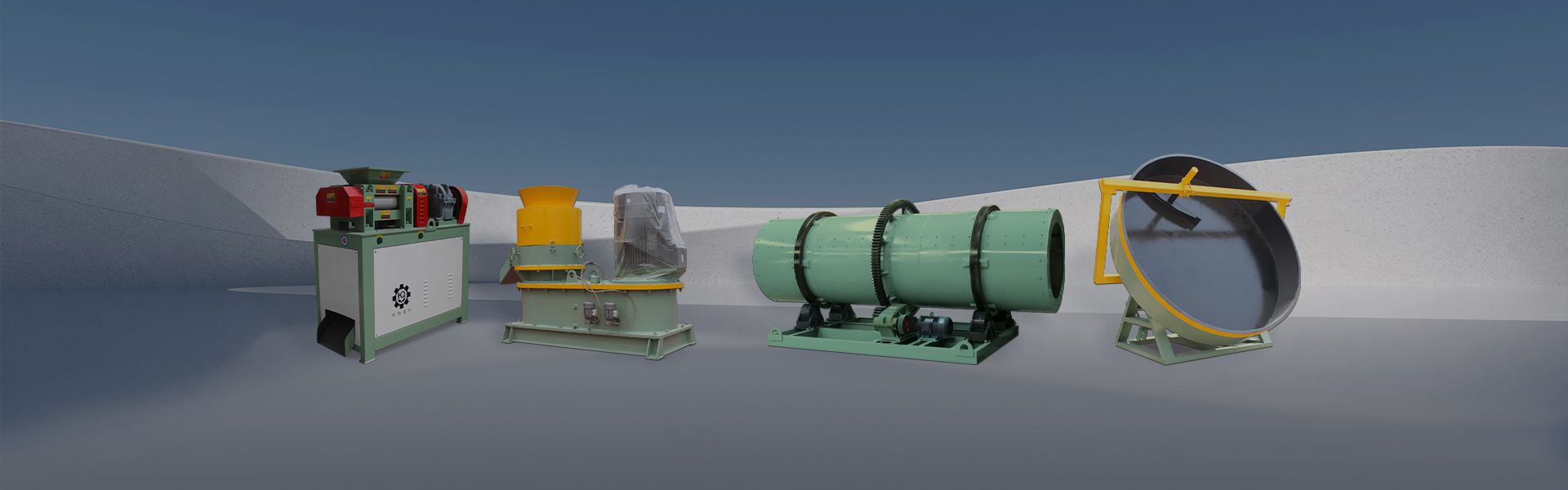
Have you ever seen a giant steel drum, tilted and turning slowly, with dust and steam swirling inside like storm clouds, yet out comes handful after handful of round, solid pellets? That’s the “big eater” on organic and compound fertilizer production lines the rotary drum granulator. Today, let’s step inside its installation site and see how this rolling giant works, and meet the teammates that clear the path ahead and tidy up behind.
The rotary drum granulator looks honest and bulky a steel drum two meters in diameter and seven or eight meters long, mounted on a base at a tilt of 3° to 6°. Inside, there are no complicated knives just a rubber or steel liner. Material enters at the high end. As the drum rotates, centrifugal force and friction lift the material to a certain height before it falls back. Meanwhile, steam or water is sprayed through internal pipes. The powder sticks layer by layer, compacts, and rounds just like a snowball growing. Simple as the principle sounds, the pellets that come out are surprisingly uniform and dense.

At the installation site, workers are busy aligning the drum’s tilt and the reducer’s coaxiality with a laser alignment tool. “Half a degree off, and the material moves too fast or too slow inside the pellets won’t be round,” explains an old hand, lying under the drum with a spirit level, eyes squinting. A few younger workers, with the help of an overhead crane, slowly lower the ten ton drum onto the support rollers, then use a feeler gauge to check that the four rollers are evenly spaced. Grease pumps and a pile of heavy duty wrenches lie on the floor, and the air smells of rust and lubricating oil.
The rotary drum granulator never fights alone. Upstream, a half wet material crusher and a horizontal mixer first grind fermented organic material into fine powder, then blend it with NPK inorganic fertilizers according to the formula. A belt conveyor connects the mixer’s outlet to the drum, feeding the blend continuously. Inside the drum, steam pipes inject high temperature steam to boost the material’s moisture and stickiness. Downstream, a dryer and a cooler wait freshly formed pellets still carry residual heat above 50°C and must be cooled quickly to set their shape. Further down come a rotary screener machine and an automatic packaging scale, removing oversize and undersize pellets before the perfect ones are bagged and palletized.
On test day, a worker starts the motor. The drum begins rolling slowly, with a low, deep hum. Mixed material and steam enter together, and mist billows inside the drum. Within minutes, the discharge chute starts raining deep brown pellets, clattering onto the belt conveyor like a pellet shower. The workshop supervisor grabs a handful and rubs them in his palm – round, firm, not sticky. He gives a thumbs up to the control room. A young worker leans in and says, “This drum looks clumsy, but it sure gets the job done.” The old hand pats the drum’s shell and smiles: “A big belly big enough to hold what’s hard to hold. Three rolls, and it turns waste into golden pellets all over the ground.”
So don’t think a rotary drum granulator is just a big spinning barrel. Its rough outside hides a craft of granulation using the simplest rolling motion to achieve the most complex shaping. Without it, powders would stay scattered like loose sand. With it, waste rolls its way into a perfectly round, promising future.