
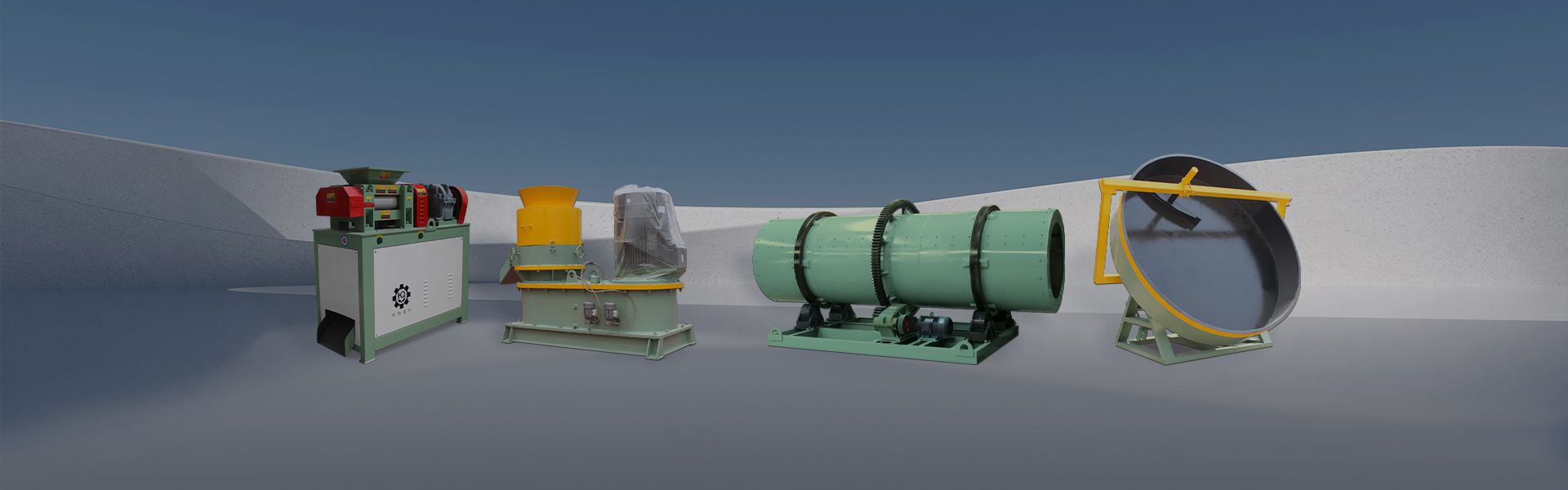
In organic fertilizer production, the quality of pre-treatment for high-moisture manure directly determines the upper limit of the granulation yield. While many manufacturers focus heavily on the granulation stage, they often overlook the preceding crushing and homogenization processes; in reality, the fineness, uniformity, and moisture distribution of the raw materials set the stage for the final granulation yield long before the material enters the granulator. After fermentation, high-moisture manures (such as chicken or pig manure) typically retain moisture levels of 40% to 60% and contain significant amounts of clumps, aggregates, and coarse fiber residues. If pre-treatment is inadequate, these large chunks enter the granulator and—under the action of stirring pins or rotating drums—form hollow granules or loose, fragmented particles, thereby directly reducing the yield. Therefore, the essence of pre-treatment is not merely to “break up” the material, but to create the optimal material state for the granulation equipment: uniform particle size, consistent texture, and appropriate moisture content.
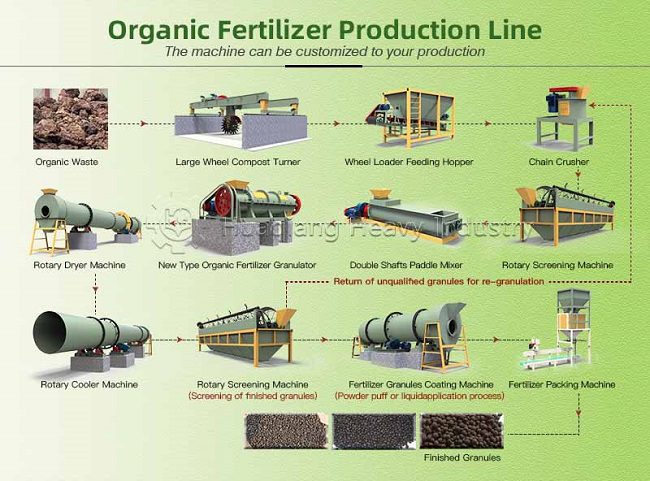
Fertilizer crushing equipment represents the first critical step in pre-treatment, and its performance has the most significant impact on granulation yield. Standard crushers often struggle with high-moisture, sticky manure, frequently suffering from wall adhesion, clogging, and incomplete crushing; the resulting large particles and coarse fibers can severely compromise the stability of the granulation process. To address this challenge, cage crushers utilize a high-speed, counter-rotating dual-cage structure without screens, fundamentally solving the problems of screen blinding and clogging associated with high-moisture materials; the output is fine and uniform, free from large particle impurities. Meanwhile, vertical crushers—featuring a vertical feed and multi-stage impact design—can directly process composted manure with moisture content ranging from 15% to 48%, achieving ultra-fine crushing without the need for air-drying or thermal drying. The core value of this specialized equipment lies in its ability to transform high-moisture, viscous, and clumped manure waste into a fluffy, fine powder. This ensures that the subsequent granulator operates on a uniform feedstock, enabling effective agglomeration or extrusion molding and stabilizing the forming rate at over 85%–90%.
Material homogenization is the second key task of pretreatment, directly influencing the density and strength of the granules produced. Fermented manure often suffers from uneven moisture content and an inconsistent carbon-to-nitrogen ratio; some areas may be excessively wet and sticky, while others are too dry and loose. Without thorough mixing, wet zones tend to adhere to the granulator’s inner walls—causing blockages—while dry zones fail to agglomerate effectively, resulting in loose granules and high material recycle rates. Pretreatment equipment, such as horizontal ribbon mixers, utilizes vigorous agitation to blend material batches thoroughly, unifying moisture content and texture to ensure a stable, consistent feed for the granulation stage. Certain granulators that integrate a pre-mixing structure perform material breakdown and homogenization right at the inlet, significantly boosting the forming rate. This integrated “pretreatment-plus-granulation” design approach represents a key trend in modern organic fertilizer equipment innovation.
Looking at the process as a whole, the forming rate for high-moisture manure is not determined solely by the granulator’s performance but is the inevitable result of the entire pretreatment system’s combined effect. From the screenless fine-crushing of cage mills and the dual-purpose (wet/dry) crushing of vertical mills to the intensive homogenization provided by mixers, every piece of pretreatment equipment contributes a critical variable to the final forming rate. Only when the material enters the granulator in a uniform, fine state can the processes of agglomeration, spheronization, and densification proceed smoothly, naturally driving up the forming rate.