
In large-scale organic fertilizer production, the choice of composting equipment directly affects fermentation efficiency and operating costs. As the core equipment for open-style windrow fermentation, the self-propelled compost turner, with its unique advantages of flexible movement, efficient turning, and independent operation, is becoming the preferred choice for large-scale composting projects worldwide. This article will delve into the core technology design and application advantages of the self-propelled compost turner.
Core Technology Design: Synergy of Four-Wheel Drive and Hydraulic Turning
The core structure of the self-propelled compost turner consists of three major systems: a walking drive system, a turning operation system, and an intelligent control system. The walking system adopts a four-wheel or tracked independent drive design, allowing it to move freely in muddy and uneven fermentation sites. Tracked models have low ground pressure, enabling stable operation even in slippery areas during the rainy season, with adaptability far exceeding that of wheeled equipment.
The core of the turning operation system is a large-diameter drum rotor with a surface densely covered with highly wear-resistant blades or rake teeth. During operation, the rotor rotates at high speed, grabbing material from the bottom and throwing it backward, forming a “left-side in, right-side out” cross-flow. This design not only achieves uniform mixing of materials but also allows oxygen to fully penetrate into the core of the pile, effectively preventing the formation of anaerobic zones. The hydraulic lifting device can dynamically adjust the turning depth (0.8-1.8 meters) to adapt to changes in material thickness at different fermentation stages.
Technical Differences Between Self-Propelled and Fixed Turning Equipment: The core difference between self-propelled turning machines and trough-type track turning machines lies in their “flexibility.” Trough-type turning machines need to move along tracks within a fixed fermentation tank. While offering good controllability and easy waste gas collection, their capacity expansion is limited by the tank structure, requiring the construction of additional fermentation tanks. Self-propelled turning machines, on the other hand, require no track foundation and can move between windrows in open areas, with a single machine covering hundreds of acres of fermentation area. In terms of equipment investment, self-propelled models can be purchased as small to medium-sized units for 80,000-250,000 RMB, without the need for civil engineering investment, resulting in a significantly lower overall cost compared to trough-type solutions.
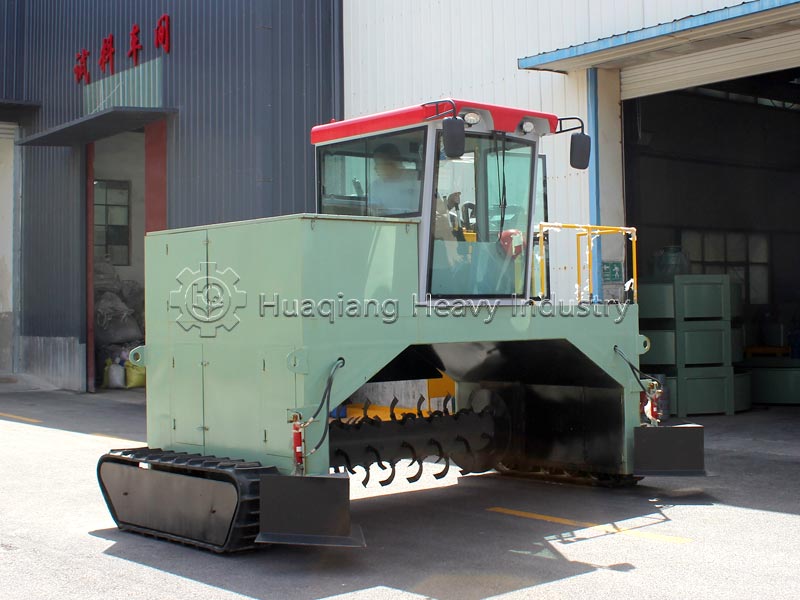
Fermentation Process Adaptability of Self-Propelled Equipment: Self-propelled turning machines are particularly suitable for large-area open-air windrow fermentation processes. With a working width of 3-12 meters and a daily processing capacity ranging from 500 to 800 tons, it can flexibly adapt to the needs of farms and organic fertilizer plants of different sizes. For scenarios involving complex raw materials—such as the mixed fermentation of livestock manure and straw—the self-propelled equipment can achieve uniform mixing and crushing of fibrous materials by adjusting the turning frequency (once every two days during high-temperature periods) and rotor speed.
Technological Upgrades: Remote Monitoring and One-Button Operation
Modern self-propelled compost turners have integrated multiple intelligent technologies. The automatic driving function allows the equipment to operate autonomously along a preset trajectory; operators only need to set parameters via a tablet. Intelligent sensors monitor the pile temperature and oxygen content in real time, uploading data to a cloud server to provide decision-making basis for process optimization. Some high-end models are equipped with a fully enclosed air-conditioned cab, enabling comfortable operation in complex environments.
In the arid inland and temperate coastal regions of Australia, self-propelled compost turners have demonstrated excellent environmental adaptability, helping local farms convert livestock manure and green waste into high-value organic fertilizer. The equipment features a large trapezoidal channel design, ensuring high efficiency even when handling heavy materials. Furthermore, optimized turning and turning operations effectively reduce methane emissions, offering environmental benefits.
From the agile mobility of four-wheel drive to the precise operation of intelligent navigation, the self-propelled compost turner, with its independent, efficient, and highly adaptable technical characteristics, is becoming a core piece of equipment for the global resource utilization of organic waste. Please provide your raw material type and daily processing requirements to receive a customized equipment selection solution.
The self-propelled compost turner represents a pinnacle of flexibility within the broader field of fermentation composting technology. Its mobile, independent operation makes it an ideal agriculture waste compost fermentation machine, particularly suited for large-scale, open-air windrow composting. This type of windrow composting machine is often a self propelled compost production machine, capable of navigating between piles without fixed infrastructure. This contrasts with the more constrained but highly controlled trough type composting turner, which operates within engineered channels. While a large wheel compost turner is also used for windrows, its design emphasizes immense scale and span. The self propelled compost production machine prioritizes maneuverability and operational independence, allowing a single unit to service a vast composting area. Each of these technologies—the flexible self-propelled machine, the massive large wheel compost turner, and the precise trough type—is a distinct implementation of fermentation composting turning technology. The choice between them is a strategic decision based on scale, site constraints, and the level of process control required, ensuring that the chosen agriculture waste compost fermentation machine optimally transforms organic waste into a valuable resource.