
In the global wave of green transformation in animal husbandry, the resource utilization of livestock manure has become a core issue that farms must confront. Whether it’s the environmental pressure on European dairy farms or the odor complaints from Southeast Asian pig farms, efficient manure fermentation systems are key to solving these problems. The selection of turning equipment directly determines fermentation efficiency, environmental benefits, and operating costs.
Large-scale farms face three major challenges in manure treatment: rapid processing of large volumes of manure—a 10,000-head pig farm generates over 100 tons of manure daily, requiring daily production and disposal within limited space; odorless fermentation—farming areas are often near villages or ecologically sensitive areas, making odor control a survival priority; and localized production—the ideal model is “manure not leaving the farm,” directly converting it into organic fertilizer within the farm to reduce transportation costs.
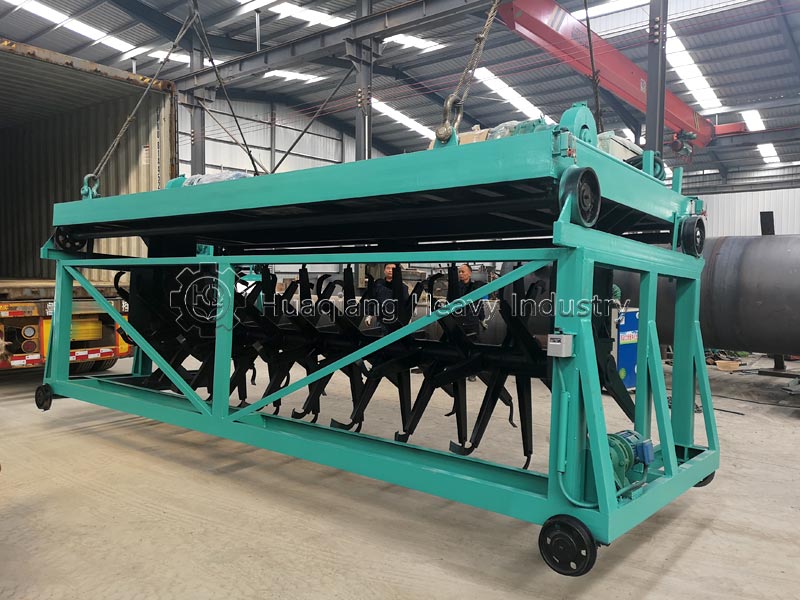
For the specific needs of farms, the trough-type manure turner is the optimal solution. Its core advantages are reflected in three aspects: closed fermentation, controlling odor at the source. The trough-type compost turner operates within a fixed fermentation tank and can be equipped with a roof and exhaust gas collection system to collect and treat odorous gases such as ammonia and hydrogen sulfide before release. Compared to open windrow fermentation, the trough process can reduce odor emissions by more than 80%, completely resolving environmental complaints from livestock farms.
Highly efficient treatment, daily production and disposal. The practice in a concentrated beef cattle breeding area in Bozhou, China, is typical: the village has 10,000 head of beef cattle, producing an average of 130 tons of manure daily. Previously, using traditional windrow fermentation, the daily processing capacity was only 50-60 tons, resulting in severe manure accumulation. After introducing the trough-type compost turner, the daily processing capacity jumped to 150-200 tons, achieving daily production and disposal of manure in the area, and closed-loop treatment. This case fully demonstrates that the trough-type compost turner can be precisely matched with livestock production capacity, alleviating environmental pressure at the source.
Controllable process, stable quality. The “fixed tank + mechanical turning” mode of trough fermentation ensures consistent material pile size and turning parameters, stabilizing the fermentation cycle to 15-20 days. Combined with a bottom aeration system, oxygen content and temperature can be precisely controlled, ensuring complete decomposition of manure and producing high-quality organic fertilizer.
A manure fermentation production line serving a livestock farm typically includes: a trough turner (single or multiple troughs depending on daily processing capacity), a semi-wet material crusher (for fresh manure), and a horizontal mixer (for mixing straw and microbial agents in a specific ratio). The process follows a “pretreatment—mixing—trough fermentation—screening” flow: fresh manure is mixed with straw, mushroom residue, and other auxiliary materials at a carbon-to-nitrogen ratio of 25-30:1, and a specialized microbial agent is added. The mixture is then turned regularly within the trough, completing decomposition in 20-25 days.
In European dairy farms, stringent environmental regulations on ammonia emissions have spurred the widespread application of trough fermentation. The EU’s revised nitrate directive of 2026 allows member states to use processed manure products, further driving the adoption of efficient manure treatment systems in livestock farms. Using trough-type compost turners in conjunction with exhaust gas collection devices, dairy farms can convert manure into compliant organic fertilizer while significantly reducing ammonia emissions.
In Southeast Asian pig farms, the hot and humid climate makes manure prone to decay and odor. A 10,000-head pig farm in Indonesia adopted our trough-type compost turner system, combined with a rainproof roof and leachate collection design, shortening the fermentation cycle to 18 days, reducing odor complaints from the surrounding area by 90%, and resulting in high demand for our product in local plantations.
Our company offers the F-series trough-type compost turner for livestock farms, standardly equipped with a hydraulic lifting device (adjustable turning depth 0.8-1.8 meters), a variable frequency speed control system, and an exhaust gas collection interface. The equipment is made of corrosion-resistant steel, adaptable to high-humidity environments; an optional remote monitoring module allows real-time monitoring of the operating status via mobile phone. The supporting raw material processing equipment includes a semi-wet material crusher (for processing fresh manure with a moisture content ≤30%) and a horizontal mixer, achieving a “one-stop” conversion from manure to organic fertilizer.
The detailed case study of the trough-type turner for livestock farms illustrates a critical application of fermentation composting technology. For large-scale farms needing to process hundreds of tons of manure daily while controlling odors, the trough-type compost turner (a specialized agriculture waste compost fermentation machine) is the optimal solution. This equipment is the heart of trough-type aerobic fermentation composting technology, designed for closed, controlled operation. It contrasts with other technologies: a large wheel compost turner or windrow composting machine might be suitable for open-field processing of straw or manure on large land parcels, but they cannot contain odors. A chain compost turner is a versatile tool, but for the specific needs of a livestock farm—daily throughput, odor control, and consistent quality—the engineered trough-type compost turner is the benchmark. This system, combined with other equipments required for biofertilizer production like a semi-wet crusher and mixer, forms a complete solution. Whether for a European dairy farm facing strict ammonia regulations or a Southeast Asian pig farm in a humid climate, this targeted application of fermentation composting turning technology enables “manure not leaving the farm,” transforming a waste problem into a valuable resource.
From European dairy farms to Southeast Asian pig farms, trough-type compost turners, with their unique advantages of being closed, highly efficient, environmentally friendly, and controllable, are becoming core equipment for the resource utilization of manure in global livestock farms. Please provide your farm scale and processing needs to obtain a customized solution.