
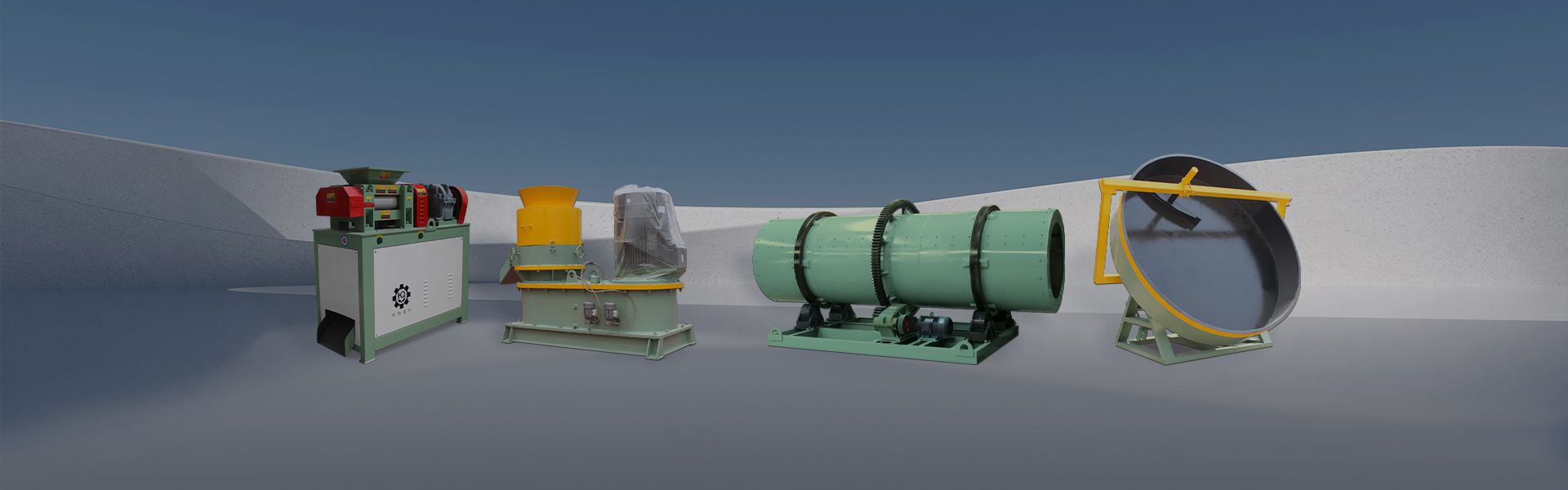
Ever pictured how mountains of wet chicken litter or fermented compost transform into thousands of sleek fertilizer pellets in just a few hours? If you guessed something like a “giant tumble dryer,” you’re not far off. The real star here is the rotary drum granulator—the true rolling giant of organic fertilizer lines. With its massive throughput and robust design, it anchors large-scale organic fertilizer plants and compound fertilizer operations worldwide.
The process begins with the gentle crunch of a crusher, reducing straw, manure, distiller’s grains, and other raw materials into a consistent, fine powder. Next, a horizontal mixer or double-shaft blender adds binders, probiotics, or recycled fines, kneading the blend into a “pre-pellet” state with just the right moisture content—typically 20%–30%. This homogeneous mixture is the foundation for uniform granulation.
Now the prepared material enters a slightly inclined rotary drum granulator, typically 1–4 meters in diameter and 3–12 meters long. As the drum rotates slowly (at 10–30 rpm), specially designed internal lifter flights scoop and cascade the material, creating a continuous “material curtain.” Simultaneously, steam or water spray is injected through nozzles; the tumbling particles collide, stick together, and grow through coalescence and layering—much like snowballs rolling downhill or pebbles smoothing in a river. This gentle yet powerful mechanism excels at producing high-density, high-strength granules (typically 3–8 mm in diameter, or even larger on demand), with a on-size yield often exceeding 70%. By adjusting rotational speed, drum inclination, and steam input, operators can fine-tune particle size and hardness to meet specific crop or soil needs.
But the drum never works alone. Freshly formed pellets, still warm and moist (around 10%–15% moisture), travel via belt conveyor to a rotary dryer, where they are dried in a hot air stream to reduce moisture to below 10%—critical for storage and anti-caking. They then pass through a rotary cooler, which rapidly brings down the temperature and further hardens the granules. After cooling, a vibration screener machine rigorously sorts them: on-size pellets proceed to the next stage, while fines and overs are automatically returned to the granulator (often blended with fresh feed) for another round. For clients requiring slow-release or anti-caking properties, a coating drum wraps each pellet in a thin layer of oil or powder. Finally, an automatic packing scale fills bags with precision—typically 20–50 kg bags, ready for shipping. An integrated control system monitors and adjusts the entire line, ensuring 24/7 continuous operation with minimal manual intervention.
Compared to disc granulators, rotary drum models offer significantly higher capacity (from 5 up to 30 tons per hour), produce denser and more uniform granules, and handle a wider range of formulas—pure organic, mixed NPK, bio-organic, and more. Their rugged construction means lower maintenance and longer service life, making them a favorite among large-scale farmers and fertilizer enterprises in North America, Europe, and beyond. Moreover, the enclosed design reduces dust and odor, aligning with modern environmental standards.
Crushing, mixing, granulating, drying, cooling, screening, coating, packing—this chain of machines works like a well-coached basketball team, passing and scoring in perfect sync. What was once messy, bulky waste transforms into valuable “golden pellets” that crops love. The rotary drum granulator doesn’t just roll; it revolutionizes organic waste management.
Next time you see mountains of organic granules, picture the endless snowball dance inside that massive drum—a waltz of mechanics and nature. Ready to let this rolling miracle roll onto your land?