
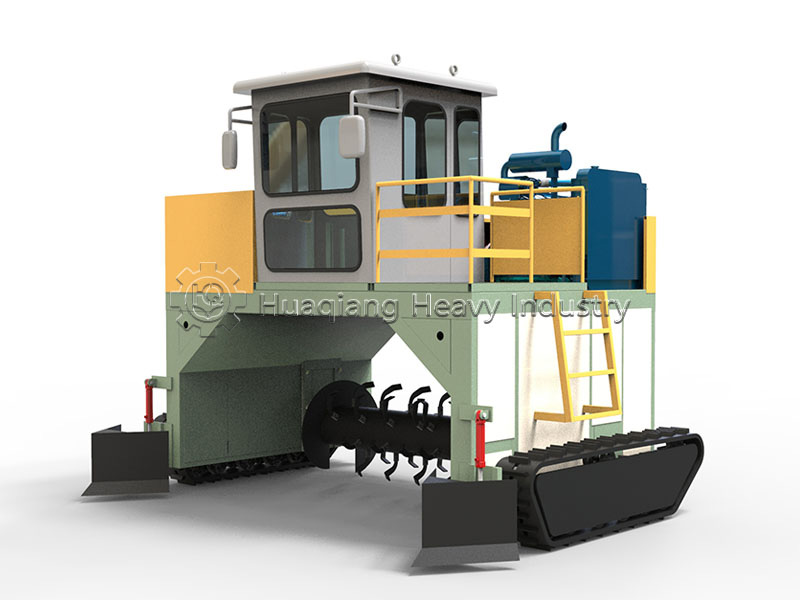
In the fields of organic fertilizer production and organic waste resource utilization, the windrow compost turner is a crucial piece of equipment. It employs a tracked walking mechanism specifically designed to turn and mix organic materials, creating optimal fermentation conditions for microbial activity. With its strong terrain adaptability and efficient operation, this equipment has become an indispensable component of large-scale organic fertilizer plants, farms, and municipal waste treatment plants.
The windrow compost turner boasts a compact and robust structure. Its frame is constructed from high-strength welded steel, providing reliable load-bearing capacity. The tracked walking mechanism is equipped with wear-resistant and non-slip track plates, minimizing ground pressure (0.05-0.1 MPa), allowing for smooth movement on muddy or uneven ground. The core turning mechanism of this compost turner consists of a hydraulic arm and alloy steel tipping teeth, capable of flexibly handling compost piles with heights of 1-2.5 meters and widths of 2-6 meters. A powerful power system (propulsion power 15-45kW, turning power 22-75kW) and an advanced hydraulic system (working pressure 16-25MPa) ensure stable and efficient operation of the equipment. An electronic control system equipped with an LCD screen and multiple sensors monitors operating parameters in real time and provides automatic fault protection.
This multi-functional equipment can process various organic raw materials. It efficiently processes livestock and poultry manure (chicken, pig, cow manure), breaking up soil compaction, killing pathogens, and reducing odor. Coarse fibrous materials such as corn stalks and wheat straw are shredded and mixed with other materials to accelerate degradation. Industrial organic waste, such as distiller’s grains and traditional Chinese medicine residues, as well as municipal organic waste and sludge (after heavy metal testing), can all be harmlessly treated through the turning process of this equipment, transforming them into high-quality organic fertilizer raw materials.
The fermentation process of the windrow turning machine follows scientific steps. After pretreatment (sorting, crushing, adjusting the carbon-to-nitrogen ratio to 25-30:1, and controlling the moisture content to 55%-60%), the raw materials are piled into trapezoidal windrows. The machine turns the compost pile at different stages: initial fermentation period (1-3 days), with the temperature reaching 50-60℃; high-temperature period (4-10 days), turning every 1-2 days, maintaining the temperature at 60-70℃; cooling period (11-20 days), turning every 2-3 days. The 15-25 day fermentation cycle ultimately forms mature compost, which is dark brown in color, loose in texture, and has a fresh earthy aroma.
Compared to other compost turning equipment, this equipment has significant advantages. Its tracked design ensures strong terrain adaptability, suitable for sites with slopes ≤15°, and can improve site utilization by more than 30%. Turning efficiency reaches 50-150 tons per hour, with a material turning rate exceeding 95%, ensuring uniform fermentation. The equipment is flexible to operate and can be adjusted on-site to adapt to various raw materials without replacing core components.
In fertilizer production lines, this equipment connects pretreatment and deep treatment stages, achieving large-scale continuous fermentation through multi-zone turning. Regular maintenance, including daily inspections of the tracks, turning teeth, and hydraulic lines, ensures the long-term stable operation of the equipment. As a key driver of organic waste recycling, windrow compost turners play a vital role in promoting green agriculture and sustainable development.
Integrating Turning Technology into Complete Production Systems
In summary, the windrow compost turner is a cornerstone of efficient organic waste recycling. Its robust design and powerful turning capability embody a mature fermentation composting turning technology essential for accelerating the aerobic decomposition of organic matter. As a highly effective windrow compost turning machine or windrow compost production machine, it completes the critical middle stage of the transformation from waste to resource.
This equipment is part of a diverse family of solutions within the broader trough-type aerobic fermentation composting technology. Depending on the scale and site layout, producers may also choose a trough-type compost turner for more controlled environments, a large wheel compost turner for wide windrows, or a chain compost turner for deep piles. Each serves the same vital function. The mature compost produced is a primary raw material for the equipments required for biofertilizer production. The finished compost can be directly applied or further processed into uniform granules using a disc granulation production line, creating a market-ready organic fertilizer product.
Thus, from initial pre-composting processing equipment to final granulation, each piece of technology, including the versatile crawler type compost fermentation machine, plays a specific role in building a complete, sustainable organic fertilizer manufacturing system.