
The large wheel compost turning machine is a mobile composting device specifically designed for windrow composting. Its main structure consists of a heavy-duty self-propelled chassis and a large turning wheel mounted at the rear. The turning wheel can reach a diameter of 1.5 to 2.5 meters, with multiple rows of throwing blades or rake teeth evenly distributed on its rim.
During operation, the turning wheel rotates at a low speed driven by a hydraulic motor, while the entire machine moves along the direction of the material pile. The rotating blades cut into the bottom of the pile, throwing the material upwards and backwards, forming a continuous turning process. The material, while being thrown into the air, makes full contact with fresh air and, upon landing, re-accumulates into loose windrows. A single turning operation can complete multiple actions of “material collection-scattering-aeration-stacking,” with efficiency far exceeding that of manual turning or small equipment.
The operation method is typically a tracked self-propelled system, equipped with a diesel engine or electric motor. The operator sits in the cab, controlling the travel speed and the rotation speed of the turning wheel via a joystick; a single person can complete the operation.
Large Span and High Efficiency: The core advantage of large wheeled compost turners lies in their working width and depth. The width of the turning wheel determines the span of the material pile turned in a single pass; mainstream models have a working width of 3 to 6 meters, and some customized models even exceed 8 meters. This means the equipment can handle the entire width of the windrow in one pass, eliminating the need for repeated back-and-forth operations. The turning depth is typically 1.2 to 2.0 meters, thoroughly turning the bottom of the pile to prevent oxygen deficiency in the lower layers.

In terms of processing capacity, a single large wheeled compost turner can process 200 to 500 cubic meters per hour, equivalent to turning hundreds of tons of fermented material per day. For an annual production scale of 10,000 tons of organic fertilizer, one machine can meet all the turning needs. Compared to trough-type compost turners, which require the construction of fixed fermentation troughs, wheeled compost turners require no civil engineering and can operate directly on hardened ground, resulting in lower investment costs and more flexible layout.
The equipment typically travels at a speed of 5 to 15 meters per minute, with the turning wheel rotating at 200 to 400 revolutions per minute. The lower speed reduces material breakage and dust generation, while also lowering energy consumption. The steering mechanism is designed for in-situ rotation, allowing for easy turning at both ends of the material pile and maximizing site utilization.
Suitable for Large-Scale Organic Fertilizer Plants
large wheel compost turning machines are particularly suitable for large-scale organic fertilizer plants with an annual output exceeding 5,000 tons. They are especially applicable in the following scenarios:
Large-scale livestock farm manure treatment: Large-scale cattle farms, pig farms, and chicken farms generate large amounts of manure daily, requiring rapid fermentation. Wheeled compost turners can handle windrows up to 50 to 100 meters long, completing the turning of the entire windrow in a single operation.
Specialized Organic Fertilizer Production Bases: Organic fertilizer production enterprises using livestock and poultry manure, straw, and distiller’s grains as raw materials, with large fermentation volumes and open spaces, are well-suited to a process combining windrow fermentation and wheeled turning.
Municipal sludge composting projects: Dewatered sludge from urban wastewater treatment plants is mixed with auxiliary materials to form windrows. Wheeled compost turners can efficiently complete the turning and aeration tasks.
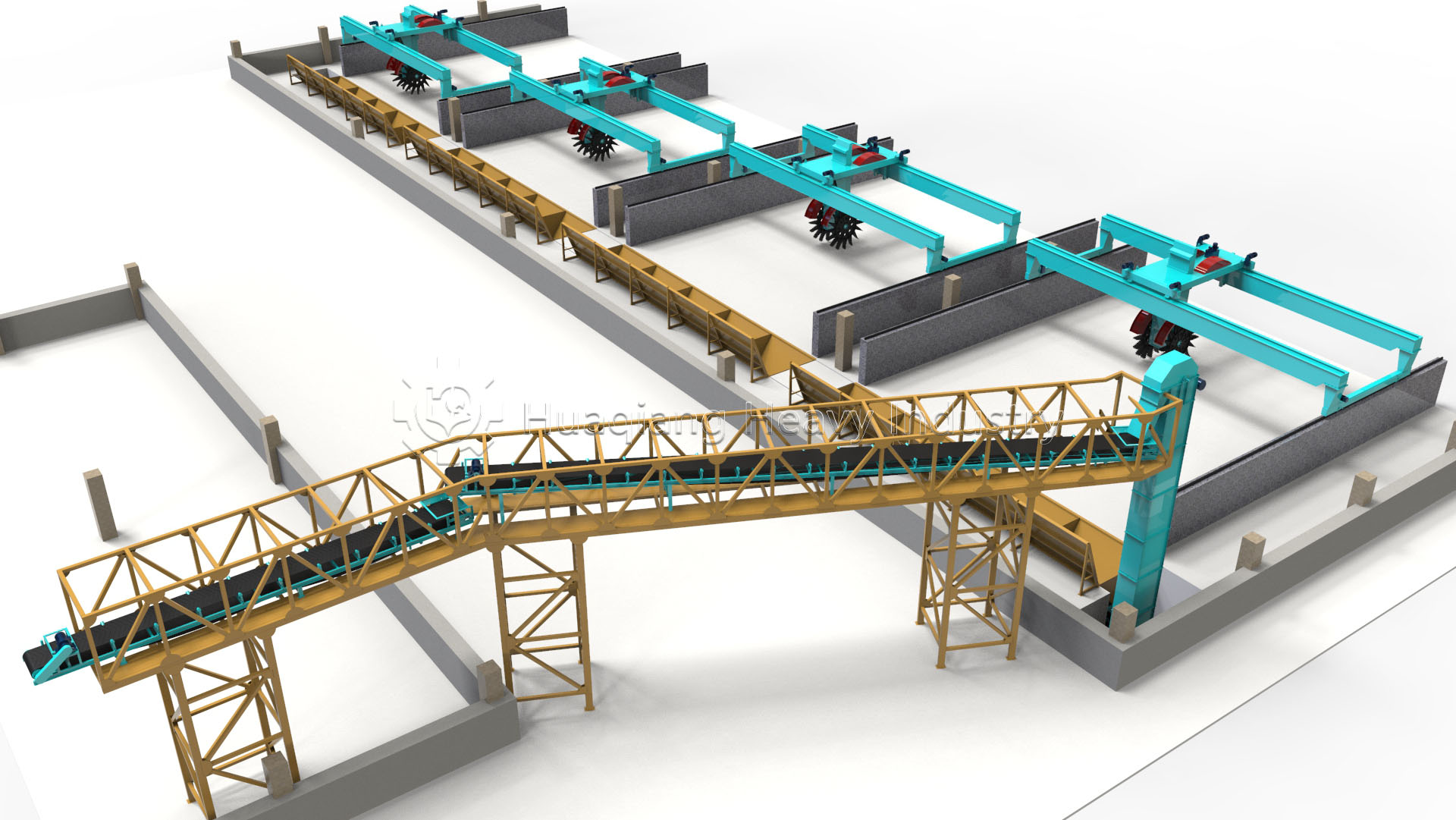
In practical applications, large wheeled compost turners are usually used in conjunction with loaders, screening machines, and crushers to form a complete bio-organic fertilizer production line. During operation, the following precautions should be taken: the turning frequency should be adjusted according to the temperature and moisture content of the compost pile, generally every 2 to 3 days; the equipment should move at a uniform speed to avoid localized over- or under-turning; the wear of the turning wheel blades should be checked regularly, and replacements should be made promptly to ensure effective turning. For organic fertilizer plants requiring further granulation, the turned and composted material can be directly fed into the organic fertilizer granulation process.
The large wheel compost turning machine is a powerful example of fermentation composting turning technology. As a large wheel compost turner (or large wheel compost turning machine), it is the workhorse of open-air windrow composting. This contrasts with a trough-type compost turner (or trough type composting turner) which operates within fixed channels. A windrow composting machine offers flexible aeration for smaller operations. After successful composting, the mature material becomes the ideal feedstock for a bio-organic fertilizer production line for pig manure or a general organic line. The material then enters the granulation stage. For producing high-quality spherical granules, a disc granulation production line is a classic choice. For very small-scale or specialty applications requiring cylindrical pellets, a flat die pelleting machine provides a low-cost entry point. The large wheeled turner excels in its large span and high efficiency, processing 200-500 cubic meters per hour. It requires no civil engineering and can operate directly on hardened ground. For large-scale organic fertilizer plants with an annual output exceeding 5,000 tons, this machine is the preferred choice for efficient, large-volume composting. Its ability to handle windrows up to 100 meters long in a single pass makes it a cornerstone of industrial-scale organic waste recycling.