
Returning untreated livestock and poultry manure directly to the fields will burn roots, spread diseases, attract maggots, and produce a foul odor. To achieve true harmlessness, it must undergo scientific fermentation and maturation. The core of this transformation is a fully functional organic fertilizer fermentation system.
Standard Process: Ingredient Mixing → Fermentation → Deodorization → Maturation
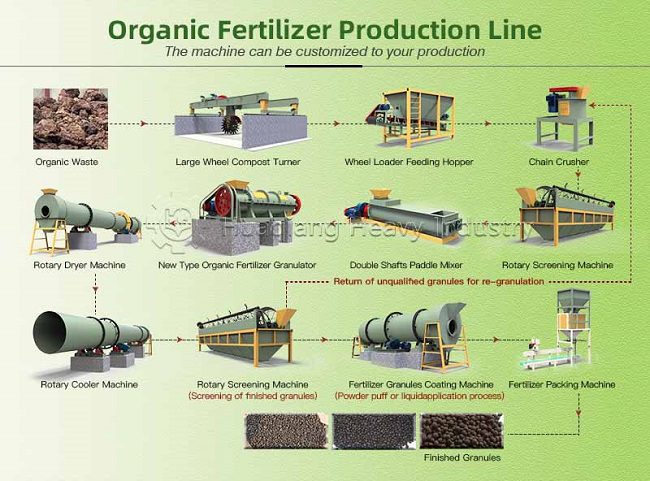
A standard aerobic fermentation system typically includes four consecutive stages:
Step 1: Ingredient Mixing and Pretreatment
Fresh manure (chicken, pig, cow, etc.) has a high moisture content of 70%-85%. It needs to be mixed with auxiliary materials such as straw powder, rice husks, and mushroom residue to adjust the moisture content to 55%-65%, while simultaneously adjusting the carbon-to-nitrogen ratio to 25:1-30:1. This step is usually completed using a horizontal mixer or ribbon mixer.
Step 2: Forced Aerobic Fermentation
This is the core of the entire process. The material is fed into a fermentation tank or fermentation chamber, where it is periodically turned by a turning machine—replenishing oxygen to the microorganisms while simultaneously evaporating moisture and dissipating excess heat. Depending on the process, there are two modes:
Trough Fermentation:Materials are piled in long, narrow cement troughs, and a trough-type turning machine moves back and forth on a track to turn the material. Investment is moderate, suitable for small to medium-scale operations, with a fermentation cycle of 15-25 days.
Booth Fermentation:Materials are loaded into sealed fermentation chambers with forced ventilation at the bottom and a deodorization system at the top. Highly automated and space-saving, but requires sophisticated equipment, with a cycle of 7-10 days.
Step 3: DeodorizationOdors such as ammonia and hydrogen sulfide generated during fermentation need to be collected and treated centrally. Common methods include: biological filters (odors pass through layers of bark and sawdust with attached microorganisms), water washing spray (ammonia is absorbed by acid), or activated carbon adsorption. Discharge is only permitted after meeting environmental standards.
Step 4: Post-fermentation AgingAfter the main fermentation, the material is not yet fully stable and needs to be transferred to a post-fermentation area and piled for 15-30 days, turning it every 5-7 days. During this stage, microbial activity decreases, the material continues to dehydrate and form humus, ultimately achieving the seed germination index ≥70% required by the organic fertilizer standard (NY/T 525-2021).
Detailed Explanation of Core Equipment Functions
In the above process, three types of equipment play irreplaceable roles:
- Turning Machine – The “Heart” of Fermentation
Its function is more than just turning. Each turning process:
Mixes the dry material on the surface with the wet material inside, ensuring uniform temperature (overall controlled between 55℃-70℃)
Brings oxygen from the air into the depths of the pile, maintaining an aerobic environment
Helps water vapor dissipate; each turning reduces the moisture content by 3-5 percentage points.
Recommended turning frequency: Once every 2 days during the heating phase, once every 1-2 days during the high-temperature phase, and once every 3 days during the cooling phase.
- Aeration System – Energy-Saving Oxygen Delivery
Perforated ventilation pipes are laid at the bottom of the fermentation tank, with a blower providing timed ventilation. This reduces the frequency of turning, saving approximately 30% of energy. Oxygen is more evenly distributed within the compost pile, making it particularly suitable for processing heavy materials such as cow dung.
- Deodorization System – An Environmental Essential
Biological deodorization: Low operating cost, but requires at least 50 square meters of filter bed area.
Chemical washing: Higher investment, but deodorization efficiency can reach over 95%, suitable for plants located near residential areas.
In daily operation, the three most practical indicators are: compost pile temperature (maintained above 55℃ for at least 5 days), moisture content (clumps when squeezed in hand, crumbles upon impact), and ammonia odor (a faint ammonia odor, not a pungent stench, should be present after turning and turning). Mastering these parameters will ensure a stable production of qualified, well-rotted organic materials.
The standard fermentation system—ingredient mixing, forced aeration, turning, deodorization, and aging—is the core of fermentation composting turning technology. The choice of turning equipment—a trough-type compost turner for controlled environments (trough fermentation) or a windrow composting machine / large wheel compost turner (or large wheel compost turning machine) for open-air windrows—directly impacts oxygen supply, temperature control, and moisture reduction. A trough-type aerobic fermentation composting technology system with a dedicated turner is ideal for controlled, continuous production, with a 7-10 day cycle (booth) or 15-25 day cycle (trough). The agriculture waste compost fermentation machine is the core of this process. Key parameters: C/N ratio 25-30:1, moisture 55%-65% (“clump formed when squeezed, crumbles upon impact”). Turning strategy: heating phase (turn every 2 days), high-temperature phase (55-70°C, turn every 1-2 days), cooling phase (turn every 3 days). Each turning reduces moisture by 3-5 percentage points. A bottom aeration system reduces turning frequency by 30%. Deodorization (biological filter or chemical washing) is essential for environmental compliance. After successful composting (GI≥70%), the mature material is ready for a disc granulation production line. Mastering the art of fermentation composting turning technology—maintaining pile temperature >55°C for at least 5 days, proper moisture, and odor control—is essential for producing high-quality, well-rotted organic material. Understanding the differences between trough-type compost turner and large wheel compost turner systems is key to selecting the optimal fermentation process for your scale and site conditions.